
The importance of geometric abstraction in Venezuelan art is well known. It has been an indisputable visual referent since the 1950s in our cultural context, and it has recently become popular not only in Venezuela but also across continents. Because geometry is a universal language, geometric abstraction is accessible to any viewer around the world. It offers unlimited possibilities and the gaze becomes sensitive to the novel forms, color contrasts, compositions, illusory optical effects, etc.
There is no doubt that geometric figures are a constant subject of exploration for artists that favor this artistic current. It can be innovative in an unlimited number of ways, and that is palpable when observing works by a new generation of artists. This is the case with the pieces created by India-Serena, a young Venezuelan artist raised in the state of Nueva Esparta and based in Paris since 2004. She surprised the public from Caracas with her Visual Symmetries, which she recently exhibited at the Galería Graphicart, in what represents her first solo exhibition in Venezuela.
Although India-Serena was born in Caracas in 1985 and spent her early years in Margarita Island, her exhibitions have almost entirely taken place in France. Since 2010, she has presented her work there, in Venezuela, Germany, China, and Japan. She has said that her interest in geometric abstraction is the result of the strong impact that the work by Jesús Soto has always had on her, particularly the yellow Penetrable exhibited several times at the former building of the Galería de Arte Nacional in Caracas. Other influences that she holds in high regard are Piet Mondrian and concrete art. Since a young age, India-Serena has approached her work with discipline and precision, as she has learned from the legacy of those great masters whom she admires.
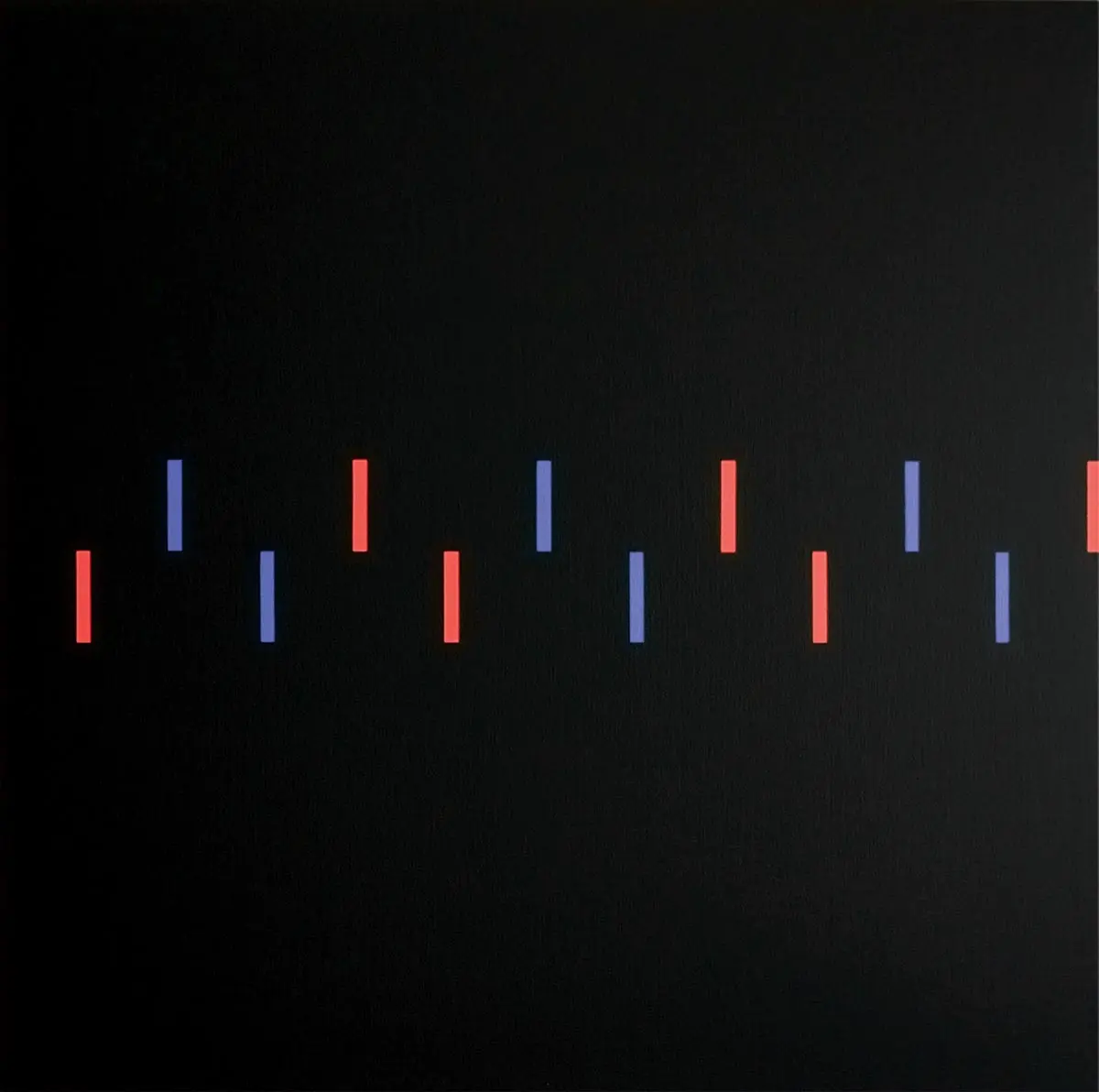
From Soto’s Penetrable she took the verticality of forms and made it essential in her work. She became interested in the rhythm that verticals generate. This has led her to reflect on the seemingly paradoxical concept of the verticality of the square, the conceptual basis in her oeuvre. She uses horizontal lines in opposition to such verticality. It is her way of reinventing geometry. While the square is an exact form that does not favor verticals or horizontals—for if it did, it would cease to be a square—through formal variations India-Serena is able to represent other geometric forms without losing the reference to that figure in her compositions. And this is precisely one of her virtues.
In addition to her focus on form, color is also an extremely important part of her work. On the one hand, because of the impact that the selection of intense colors has in her compositions and, on the other, because of the relationship that she establishes between the highly contrasting color planes. While the accent is on the form (on the square and its variations), according to India-Serena, her palette “is very select.” Indeed, red is not any red when she uses it in opposition to black. It becomes a very particular created color that, with a tinge of orange, achieves a high visual resonance. This is eloquent in pieces like Orden, Secuencia y Ritmo I (Order, Sequence, and Rhythm I) and Orden, Secuencia y Ritmo II (Order, Sequence and Rhythm II). The figure-background relationship is inverted in one work in relation to the other, which allows viewers to observe the manner in which the effect of the color red and the color black varies depending on their context. This also occurs in more recent works. India-Serena’s creative process has been recently more inclined towards synthesis, to the point of rendering the square invisible when the color black covers almost the entire pictorial surface, barely suggesting other segments of colors on some of the square’s sides (Orden, Secuencia y Ritmo III). It is possible to observe those strips or small segments, the way in which color becomes relative and appears to change according to the chromatic context in which is placed.
Based on the square format—which is the distinctive characteristic in all of her paintings—India-Serena pictorially creates a structure (or composition) that is also based on the square shape. These structures present significant alterations through the enlargement or disarticulation of any of their parts. The result is a series of moving forms (and/or structures) that are very dynamic as a result of the vibratile effect that they produce. Interestingly, all these movements eventually lead to the concept that is alluded to by Juvenal Ravelo in his presentation and that defines the title of the exhibition: to a visual symmetry; symmetry achieved precisely because the structural and symmetrical notion of the square is never lost.
This exhibition was conceived as a small anthological selection formed by pieces that compellingly describe India-Serena’s objectives: to make concrete, through form and color, the infinite metaphors of the square, as India-Serena calls them.
SUSANA BENKO