
Personalities from the cultural scene, visual artists, and a large number of visitors attended the opening of the solo exhibition by Jacobo Borges (1931) at the Galería Freites. The exhibition consists of a group of fifty medium and large two-dimensional works that attest to the evolution of Borges’s work during the last 30 years or so, from 1983 to 2016. It includes 38 pieces from different periods that belong to private collections—which turns the event into a tribute to this prominent painter from Caracas.
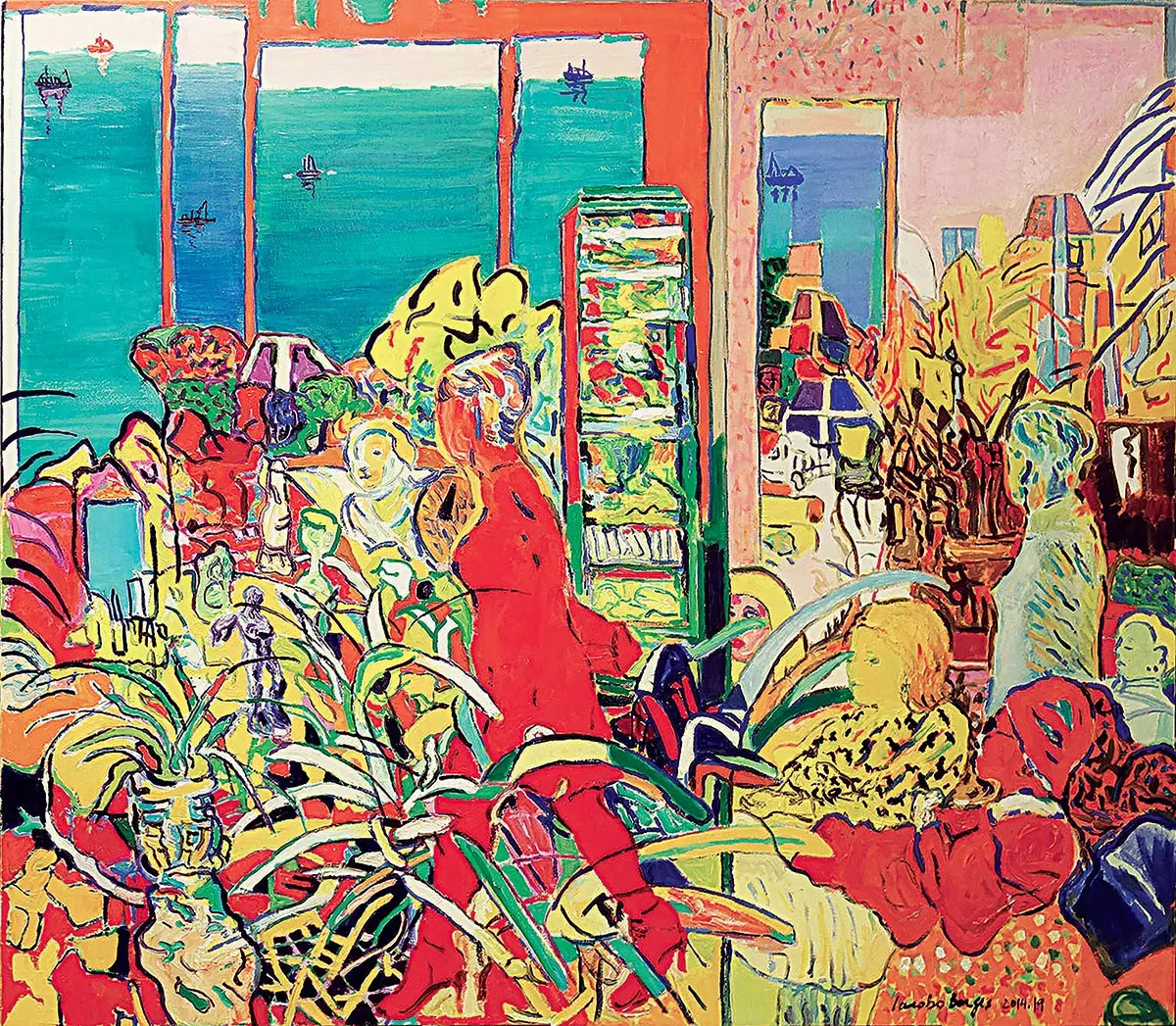
The exhibition offers a wide-ranging selection of pieces, from those created with the most traditional approaches—oil, acrylic, mixed media on canvas—to more sophisticated proposals transferred to digital patterns. Space, time, memory, and water are discursive centers that guide a body of work grounded on the idea of change as the transforming principle that drives life. The accompanying catalog offers a thorough study in which the curator of the exhibition, María Luz Cárdenas, analyses the thematic, conceptual and formal proposals of Borges’s legacy. The text includes critical references, experiences, and anecdotes that describe, in a clarifying manner, the different phases of his creative process, chronologically divided into twelve cores or chapters titled according to the themes covered: 1. Background and Gears, 2. Water Mirror, 3. The Door and the Threshold. Mexico and Berlin, 4. Matter and Time, 5. The Soul is a Strange Thing on Earth, 6. Approach to Paradise Lost, 7. Portraits and Self-Portraits, 8. Living Room with a Window View of the Ocean, 9. Color in an Observer of Sawn Leafs and Bulbs, 10. The Forest II and that Which Grows, 11. Landscapes of Memory, and 12. From the Ocean.
The works on the first floor of the gallery include paintings of large group portraits from the 1980s. There were other stylistic contributions during that same decade rendered with loose brushstrokes that attempted to imitate the flow of water. One example of this is the piece titled Reflexiones de Agua II (Water Reflections II, 1986) and Clavado (Dive, 1992). The canvases from the 1990s include doors, thresholds, and other elements that denote perspectives, movements, or separations between two places. In other years, he created several series that detail interiors, corners with found objects, as well as intimate and familiar environments, like in the work titled La Máquina de Coser de Mi Madre (My Mother’s Sewing Machine, 1994). The second floor contains Borges’s Portraits and Self-Portraits, some of which are inspired by paintings by Rembrandt but reinterpreted in a loose manner as in Retrato Amarillo con Libro (Yellow Portrait with Book, 2000). Towards 2005, Borges began to amplify and multiply the planes, implemented perspectives that elevated the horizon towards further away distances. This contraposition with the foreground saturated with strong tonal contrasts is evident in Sala con Ventana al Mar N° 19 (Living Room with a Window View of the Ocean N° 19, 2014). “The window is a cavity—writes the curator in the text—it is gap and interstice, space through which to view the exterior, a point of contact between reality and fiction, a place of light: it is access to the outside world, but also a tool to pull the exterior in […].”
The mounting synthesizes the preoccupations that led Borges to explore the perceptive phenomena that are intrinsic to the form-content relationship but that surpass the purely narrative and symbolic. Thus his interest to capture and explore through different supports, environments, and resources anything that is associated with the visual field—like he did in other circumstances of his life when he explored filmmaking, theatre, performance, installation, photography, video, and multimedia.
His thirst for learning new things is unquenchable. In 2008 he began to explore the possibilities offered by computers, with surprising results. He began this process with an actual sketch that he then transferred to a computer in order to turn the rendered composition into a photograph. Borges designed a unique methodology that began with the sketch, continued with fragmentation, superimposition, erasing, and repainting to reconstruct the final image by means of the duborcom technique. The impressive resulting print consisted of compact agglomerations and simultaneous volumes, an accumulation of crystallized patches, lines, and vibrant colors on translucent surfaces.
Borges invents, tests, and disassembles the technological schemes. In an interview he explained this as follows: “I decided to transgress its order [the computer’s], it's programming, […] by repeating one, two, three, thousands of times the same function or tool, randomly […] I was interested in producing a series of ‘digital accidents’ […] to go beyond the limits of programs or, perhaps, to transform them into new visual tools […].” The exhibition was accompanied by a series of six conversations with the artist, curator, and other guests. They talked about his work and its relationship with music, performing arts, and other artistic manifestations.
GLADYS YUNES YUNES