
Jaime Iregui has been interested in a long time in creating art that is inserted into public discussions. So much so that during the 1990s he gradually abandoned his work as a painter to develop a network of opinions centered on art; candid opinions that in 2000, with the strengthening of virtual networks, became Esfera Pública. For 16 years Esfera Pública has been an open forum about art. More than just opinions, the forum has also built an archive of valuable material that collects the issues confronting art, not only in connection with works and artists but also with respect to censorship, the public space, art education, the art market, galleries, the despair and hope of a “profession” very difficult to practice and conceive.
As I see it, Esfera Pública is also important because it puts stock in a person’s opinion; “sending” one’s opinion to “others” establishes an exchange that contributes to the construction of the common. While “the public” will always be mediated by the institutions of the state or by private entities, “the common,” according to Tony Negri, is a gathering of voices and actions by a diverse number of people that are “outside” and that gradually develop a way of thinking through transitory affinities. In this instance, there are thoughts about art permeated and influenced by social issues. It is likely that precisely for that reason Cordula Daus invited Esfera Pública to participate in the 2006 edition of Documenta (Documenta 12) in Kassel, Germany.
Jaime Iregui has also explored methodologies that encourage artists to survey and experiment in the city. Methodologies that revisit, for instance, the contributions of intellectuals Guy Debord and his dérives (drifts) and Miche de Certeau’s “city wanderings.” At any rate, this space for the walking artist erodes any notions associated with works of art, artists, and museums, and frames art as a permanent self-reflective practice.
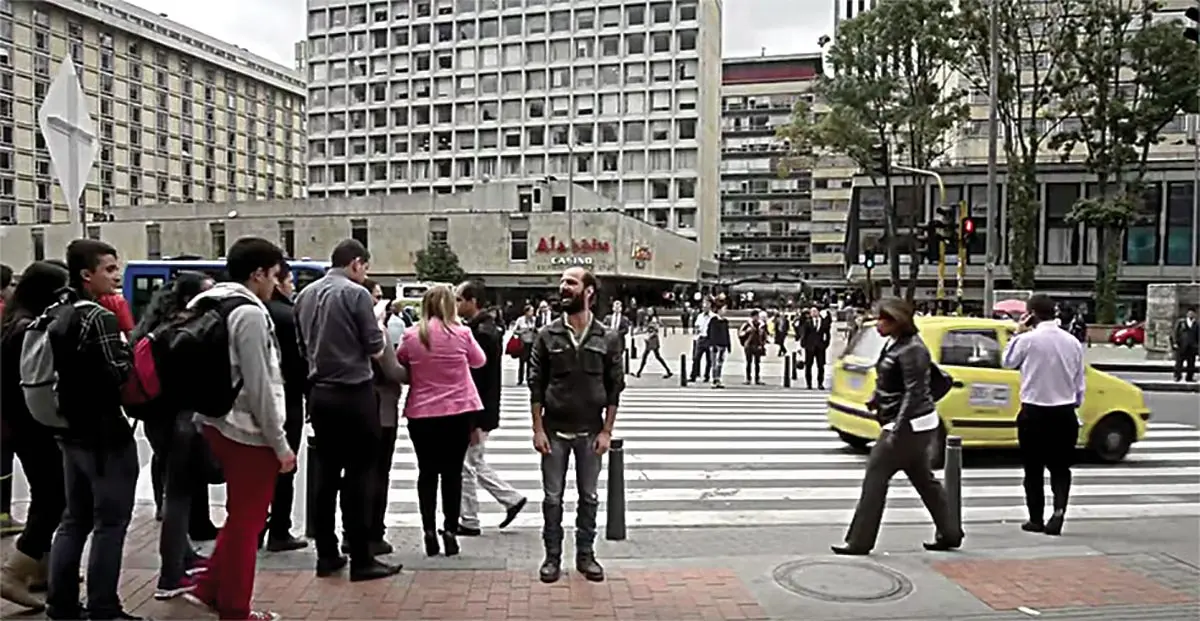
And this is also true in Manifests, presented at the Espacio Odeón in Bogota. When he met Felipe Botero—an student at the Universidad de Los Andes who also had experience as an actor—Iregui thought that he was perfect for his project, a concept that, in my opinion, is similar to the idea behind the Speakers’ Corner in Hyde Park in London, where the regular folk gets to offer their opinion in public. And about this, it is important to note that anyone standing on a Colombian street willing to voice his/her opinion out loud would likely be regarded as crazy. The idea reminded me of a crazy woman in my town who talked to herself and made a lot of gestures. We all laughed at her, but her outbursts about the armed forces being in power, the irrelevance of sermons, and the place of women in society, were all actually very illuminating ideas. We definitely know very little when we label those with a point of view “crazy.” We actually need more people willing to express their opinion.
In Manifestos, Iregui prepares a text with citations from the Proa periodical, the magazine for modern architects in Bogota. It specifically references an article titled “So Bogota Becomes a Modern City,” from issue No. 5, published in 1946. Botero then stands on a strategically chosen street in Bogota and speaks with a loud and clear voice in what appears to be a combination of speech, proclamation, and conversation. Most people continue on their way and some stop to listen to this person whose opinions are for everyone to hear on the street.
It is important to note that, when said out loud on a modern Bogota street, the text cited in Proa magazine sounds as absurd as any Dadaist manifesto: some sections contain the following passages: “Bogota is a detention center. This is the impression we get every time we ponder on the bad mood of its inhabitants. We have always believed that the source of such collective illness is its overly narrow streets, which leads pedestrians to get into each other’s space, causing altercations… Broad streets are happiness and healthy optimism.” But most meaningful is another text that it was hard for me to believe because it evidences the unwillingness of modern thinking to accept the singular conditions of the place: “There are cities like Athens and Rome erected with marble; others like Paris, Brussels and Madrid are built with stone; others yet, like New York, Toronto and Chicago are made of iron. In these, demolitions are expensive. But Bogota is a city made of soil and this is a good reason to be excited when considering the beginning of its definitive leveling and demolition.”
After reading and listening to those manifests, I left the space with the echoes of the “modern excitement” for flattening and cleaning. Their proclamations encouraged me to become more aware of the content in public discourses and to remember that Bogota, the city in which I live, has been shaped by a history of discourses that one must reference.
NATALIA GUTIÉRREZ