
The ironies in Javier Téllez’s continuing quest to tell us the truth(s) have led him consistently to investigate through others the limits of rationality: irrationality as the only rational discourse, one of the basic precepts of Dadaism transferred to the Surrealists. And it is the ethnographic branch of Surrealism that Téllez often conjoins with investigations into the boundaries of understanding. In this, he echoes much of the concerns of French philosophical questioning of Western thought emergent in 1960s poststructuralism, the decade of Tellez’s birth. The irrational has been reframed as inside normal discourse rather than extrinsic to it. Implicitly, this names joy and ecstasy as pathways to higher mental states, and Téllez devotes most of his artistic career to questioning institutionalized demarcations between madness and sanity.
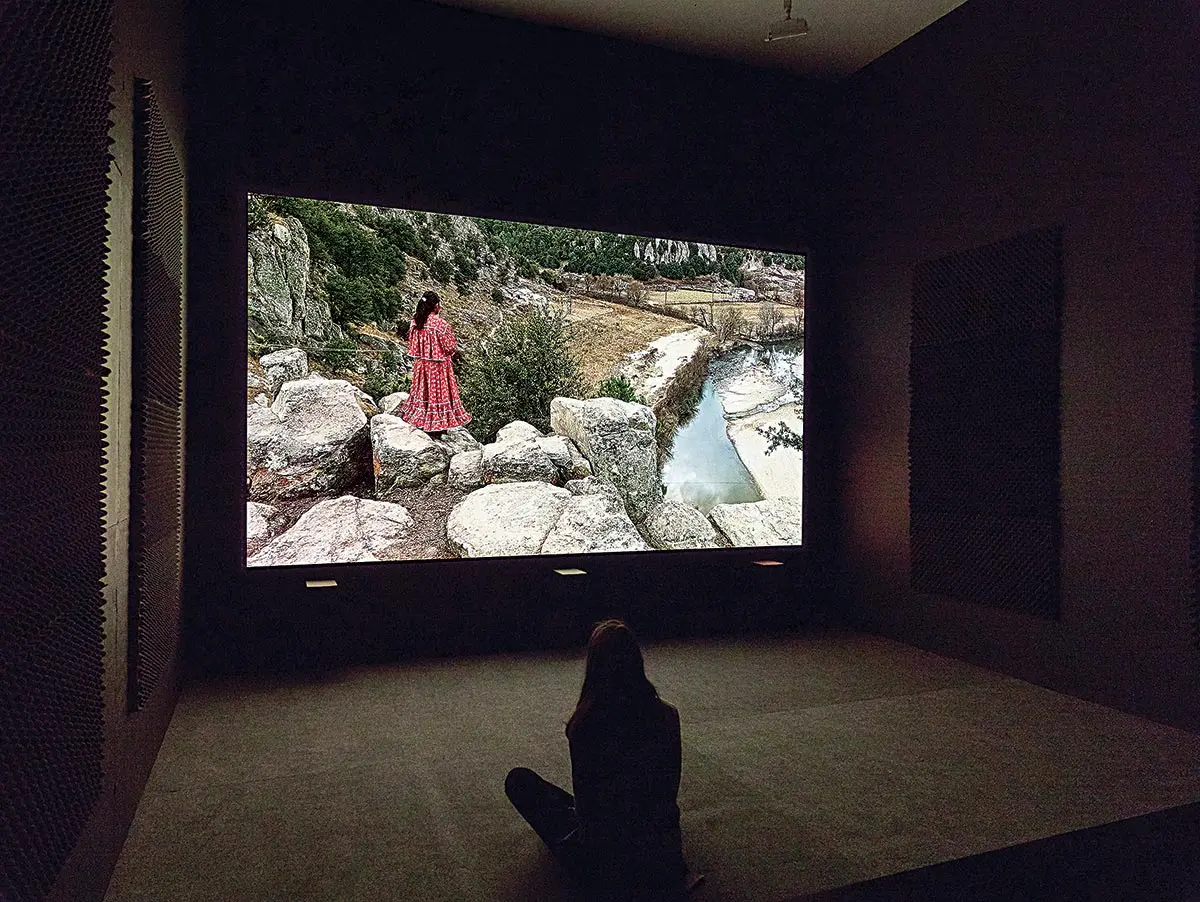
The centerpiece of this exhibition is a film by the same name, To Have Done with the Judgment of God, and it is Téllez’s second in a planned trilogy. The inspiration derives from the French dramatist and poet Antonin Artaud, a figure central to much of Téllez’s work. In 1936 he visited with the Rarámuri (or Tarahumara) Native Americans in northwest Mexico in the high Sierra Madres in search of a “primitive” experience as an antidote to the corruptions of Western consciousness. This included peyote and his writing of the experiences, A Voyage to the Land of Tarahumara. Its title is also the name of Artaud’s 1947 radio play that was recorded but censored due to its anarchic and scatological nature. Téllez uses both as a guide to constructing his film and he commissioned a translation of the play into the endangered Rarámuri language to rebroadcast it on a local radio station as the Rarámuri went about their daily life.
To judge by the film, most of the broadcast seemed to be ignored by and irrelevant to the peoples. One likely unintended consequence was to demonstrate the continued outside the status of much of Western avant-gardist strategies, or the absurdity of absurdism outside its narrow confines in art. However, the best parts were exactly what Artaud would have us have: his screams and nonsense syllables at high volume blasting across Téllez’s silent images of the rocky landscapes of the mountains that Artaud found symbolic. This allowed the viewer to experience their own unnamed delirium, with the vocables functioning exactly as Artaud intended in his use of glossolallia in the Theater of Cruelty: incoherent sounds and utterances as the only vehicles truly able to express the emotions repressed by rationalized language.
The second part of the film records fragments of two rituals described by Artaud but lacked sufficient context to function in either ethnographic or symbolic terms. At best we see the well-known post-colonial integration of Catholic rituals, ones Artaud wanted to deny, with localized gestures, dances, peyote use, and singing, whereby local traditions modify the global into hybrid forms.
The installation outside the film room consisted of postcards from places in Artaud’s life, first editions of Artaud’s writings, and extracts from Artaud’s glossolalla compiled in 16 pages and mounted on the wall (Artaud Remix). A sculpture (Artaud le Momo) was installed in the corner, a life-size mannequin dressed in a straight jacket and wearing a modern Tarahumara ritual mask. The straight jacket recounts both a specific moment in his life, one often used to assign his “loss of mind,” and a generic reference to madness as a category.
In many ways, the rest of the installation evoked a theme Téllez has used in many of his films which focus on and purposefully blur the lines between the artist and institutionalized patients. Here there seems an attempt to meld Artaud with Téllez himself, forgetting that while there may be no difference between an “art of the insane” and art (as Jean Dubuffet among others has pointed out), there is a legitimate distinction between those who are able and unable to operate within the constructions of society, where madness is no choice nor strategy nor merely, as Michel Foucault argues, following André Breton, a category produced by authoritarian regimes.
However, both Artaud and Téllez believe in performative rituals of communal actions, whether it be theater, the drumming cadences of ethno-poetics, or mythologies and drugs as thresholds to a change in consciousness. Both aim to keep the questions open, in front of us, rather than our unquestioned acceptance of understandings based on categorical barriers.
RICHARD LESLIE