
Nature has always been a recurrent theme in the history of art. Particularly from Romanticism to the contemporary period, artists have approached it from multiple numbers of perspectives. Artists have made visual inquiries into the relationship between the natura naturants—as Spinoza called it—and human and animal beings. The most complex part was proposed during the dawn of capitalism, which, according to the researches of the Potosí Principle1, dates back from the colonial period and was generated in our continent within the context of devastating imperial policies, in which the desire to learn about nature is driven by the desire to dominate and exploit it; thus, conquering expeditions in search of El Dorado and the ensuing Royal Botanical Expedition during the Illustration had no other pretension than to inventory the wealth in the New Kingdom of Granada. That expedition was led by José Celestino Mutis in the 18th century with the support of King Charles III of Spain. The physiocracy of François Quesnay helped Spain to understand that nature is a source of wealth. Artists played a central role during that period. They were entrusted with the development of an inventory, unprecedented in history, so the King could access those riches as he pleased. Is it possible that the contemporary boom in the art and natural worlds is somehow connected to this colonial baggage in which artists were at the service of a “noble clause,” still going on to this day, of exploiting the wealth of our territory? While this idea must be further developed in greater depth, the exhibition by Juan Cortés and David Vélez goes beyond those art and nature booms—which, by the way, sell very well in a contemporary art scene where there is an abundance of proposals that include plants, grass and other herbs, seeds, and water, among other elements from nature, in a sort of palliative that fails to confront the actual problem caused by the exploitation of the land and its riches.
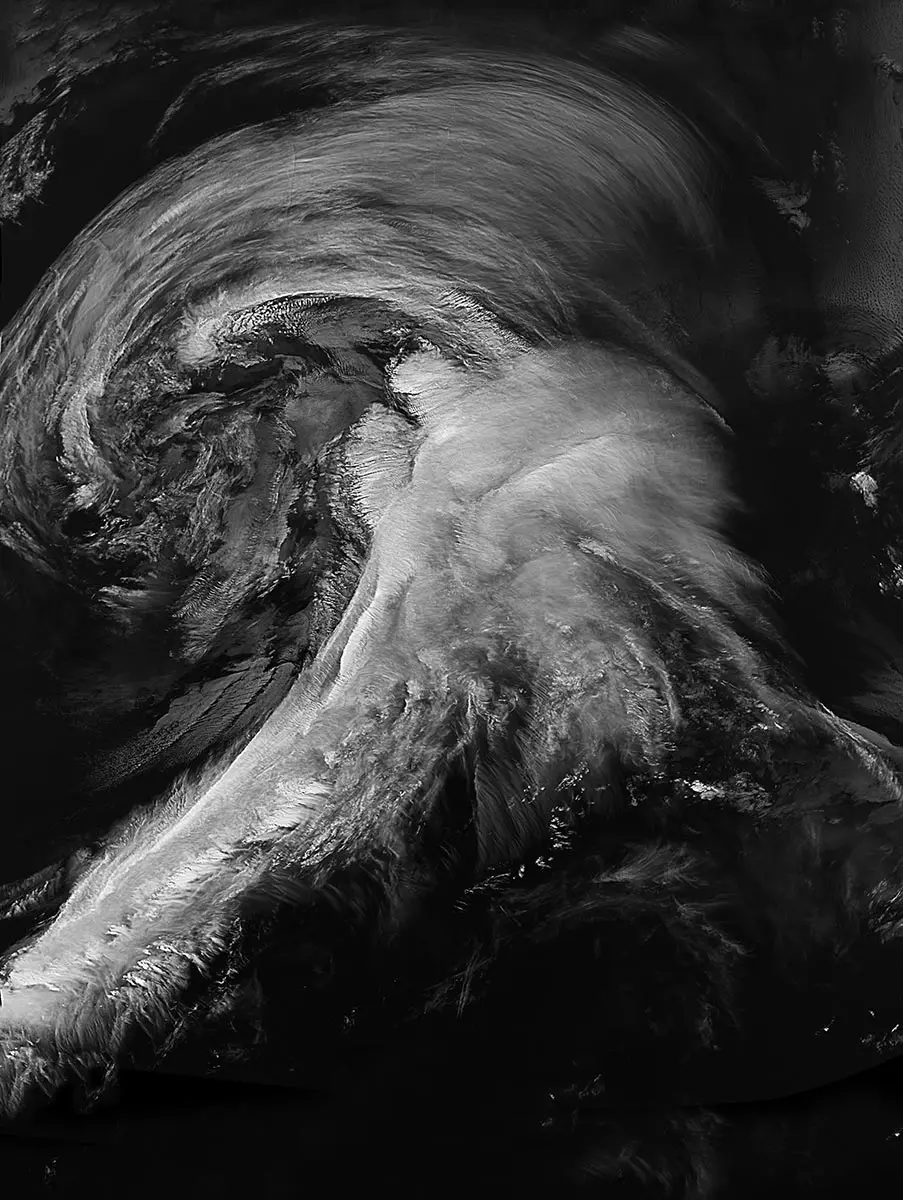
While Natural Order proposes from the beginning a close relationship between living beings and nature, it does not do so however in a futile or inconsequential manner. On the contrary, Cortés and Vélez propose an aesthetic experience in which sounds, images, and objects frame nature in its rightful place: as a force that is most of the time uncontrollable, unpredictable, and, thus, destructive. Natural disasters are interpreted by some as nature being vengeful, as a response to mankind’s incessant attack. This “natural order” or normal cause in the world is both terrible and terrifying, but also fascinating: it is that which Kant (I am sorry to have to bring up the old man from Königsberg, but it cannot be helped, we simply can not ignore him) called the sublime.
In this way, the concept of the landscape is approached in a fresh manner by the artists of this exhibition. Here the universe of sound becomes visible through the complexity of science. Fortunately, art and science go hand in hand and the landscape can be rendered in all of its complexity. “The concept of the landscape has changed dramatically since the invention of new instruments that allow the reading of a number of variables that is much larger than ever before, and the contemplation of other phenomena that are also part of the landscape. It is interesting when art is able to point to phenomena that are hidden. The landscape is much more than those things that we are able to observe. It contains waves, information, data, networks, etc. It is interesting to point to and observe the direction that the contemporary landscape is taking.”2
Indeed, it is about seeing beyond what the naked eye can see, and this can only be accomplished by creators who approach art from a scientific perspective. In fact, Cortés and Vélez worked with scientists from the Department of Geology of the Universidad Nacional de Colombia. In this sense, ruin and disaster are something natural, given that nature is in a process of continuous transformation and, thus, expresses itself naturally—and, thus, earthquakes, for instance, are not the result of divine design or the consequence of a curse that condemns the bad behavior of mankind. Cartografía Descompuesta, a Partir de Fragmentos de Ruinas y Grietas (Broken Cartography, from Fragments of Ruins and Cracks) presents a composition that elicits fascination in the viewers, as we unblushingly ask ourselves: Do we like ruins? According to Vélez: “Beyond any moral and spiritual aspects, I am most interested in nature’s need to move forward and to survive, to continue processes that cannot be caught by the layers of the human temporal scale.” 3
Natural Order is an excellent exhibition featuring work by two artists of international projection. The MoMA in New York City opened its doors to them during the beginning of this year, and their works are part of the history of sound art in Colombia that we are writing.4
NOTE
1. Ricardo Arcos-Palma, Principio Potosí: “¿Cómo podemos cantar el canto del señor en tierra ajena?” ArtNexus No. 80, 2011.
2. Words by Juan Cortés in “Juan Cortés entre la naturaleza y la tecnología”. Ignacio Mayorga Alzate, Rolling Stone, February 4, 2016. http://rollingstone.com.co/n_juan_cortes.html
3. Words by David Vélez. Idem.
4. Arcos-Palma, Ricardo. “¿Nada que ver? Hacia una historia del arte sonoro en Colombia. ArtNexus, No 94, vol. 13, 2014.
RICARDO ARCOS-PALMA