
To reencounter the early work of an artist is an extraordinary opportunity for young students and art lovers in general; all the more so in the case of Juan Fernando Herrán, who was born in Bogotá in 1963 and began to exhibit his work in the 1990s.
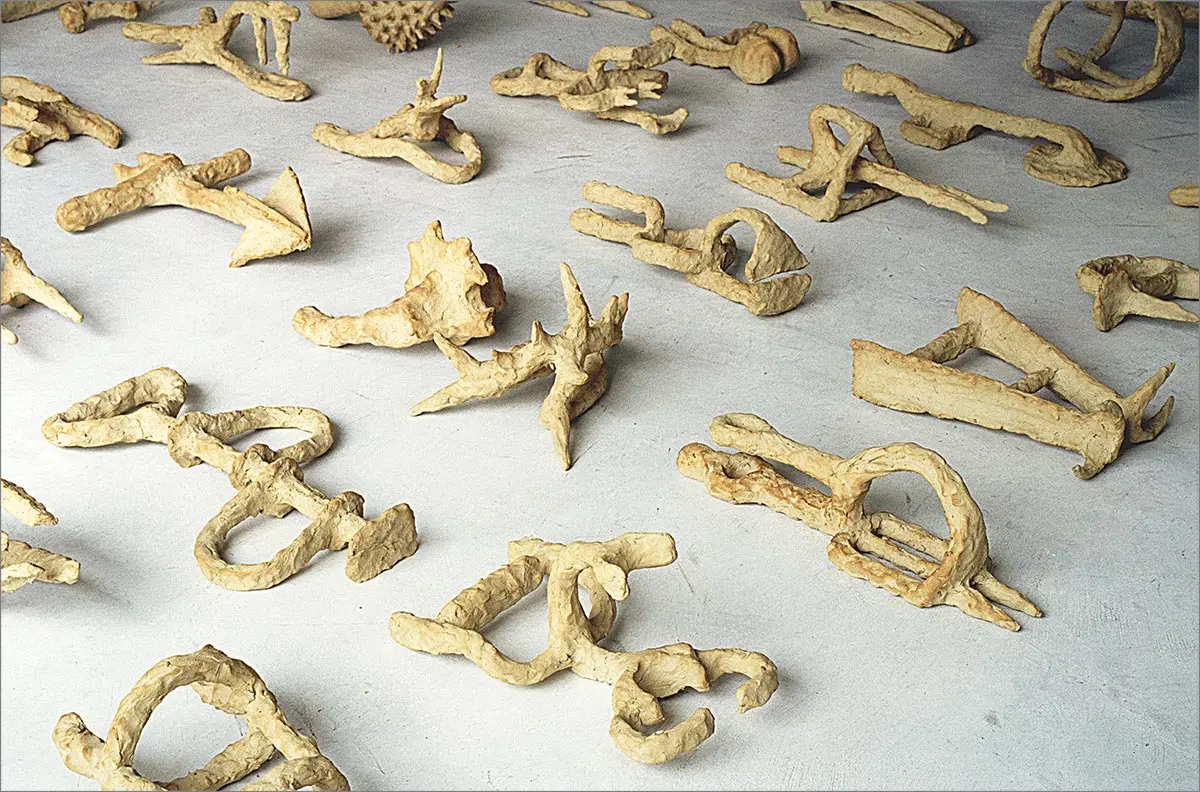
Revisiting Herrán’s early works in this exhibition, I have put in mind an artist who brought into the Colombian scene a strong understanding of different aspects of contemporary art. For example, the presentation of the space of matter and of “poor” matter: hair, uncooked clay, mashed bananas, bones, and metal bottle caps found in the street. These materials, like a behind-the-scenes of form, directed the viewer’s gaze towards life processes, which also take time to transform and to announce their eventual disappearance. It is along these lines that the exhibition presented us, again, with human hair displaying its malleability and softness on the floor; seventy pressed-clay objects resembling odd and fragile torture instruments; or a line of small metal bottle caps subjected to various kinds of destructive processes.
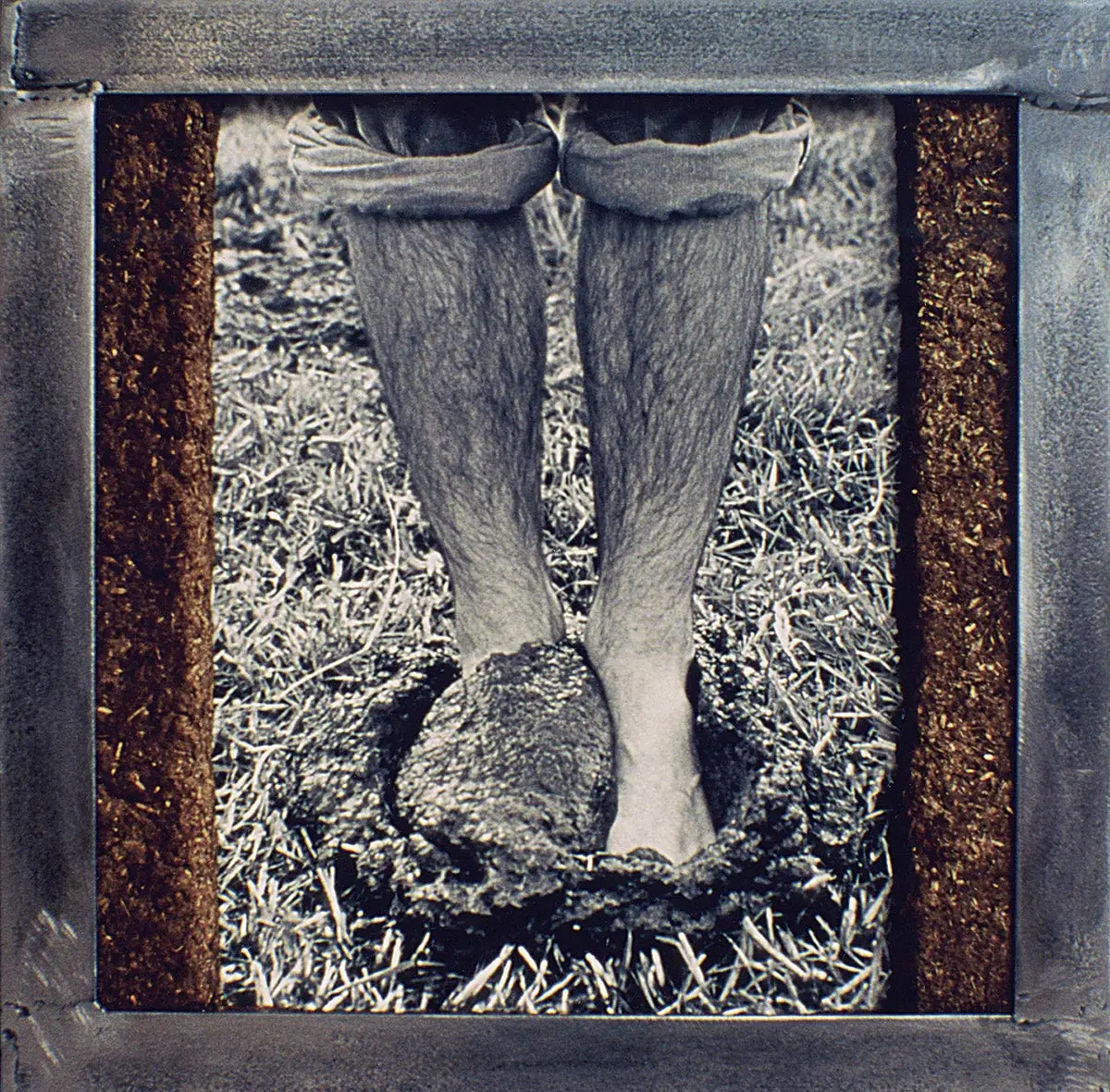
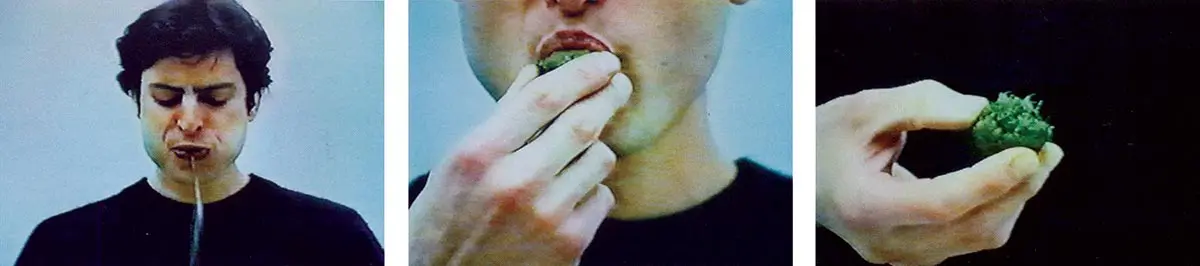
Herrán also brought into Colombian art the importance of a ritualistic way of doing, attentive to the particular manifestations of culture and to the result of its transformations as it encounters the body. To the surprise of younger students, the exhibition included a video where Herrán chews grass and turns it into an almost perfect sphere in his mouth, presenting it to the viewer as an offering. By these means, Herrán introduced Colombian art to the need to be aware of gestures; gestures that are simple, but cannot be forgotten: to ruminate, to press down, to beat, to burn, and to rescue atavistic acts. So, in this exhibition, we encountered once again Herrán’s photograph of his feet sinking in manure.
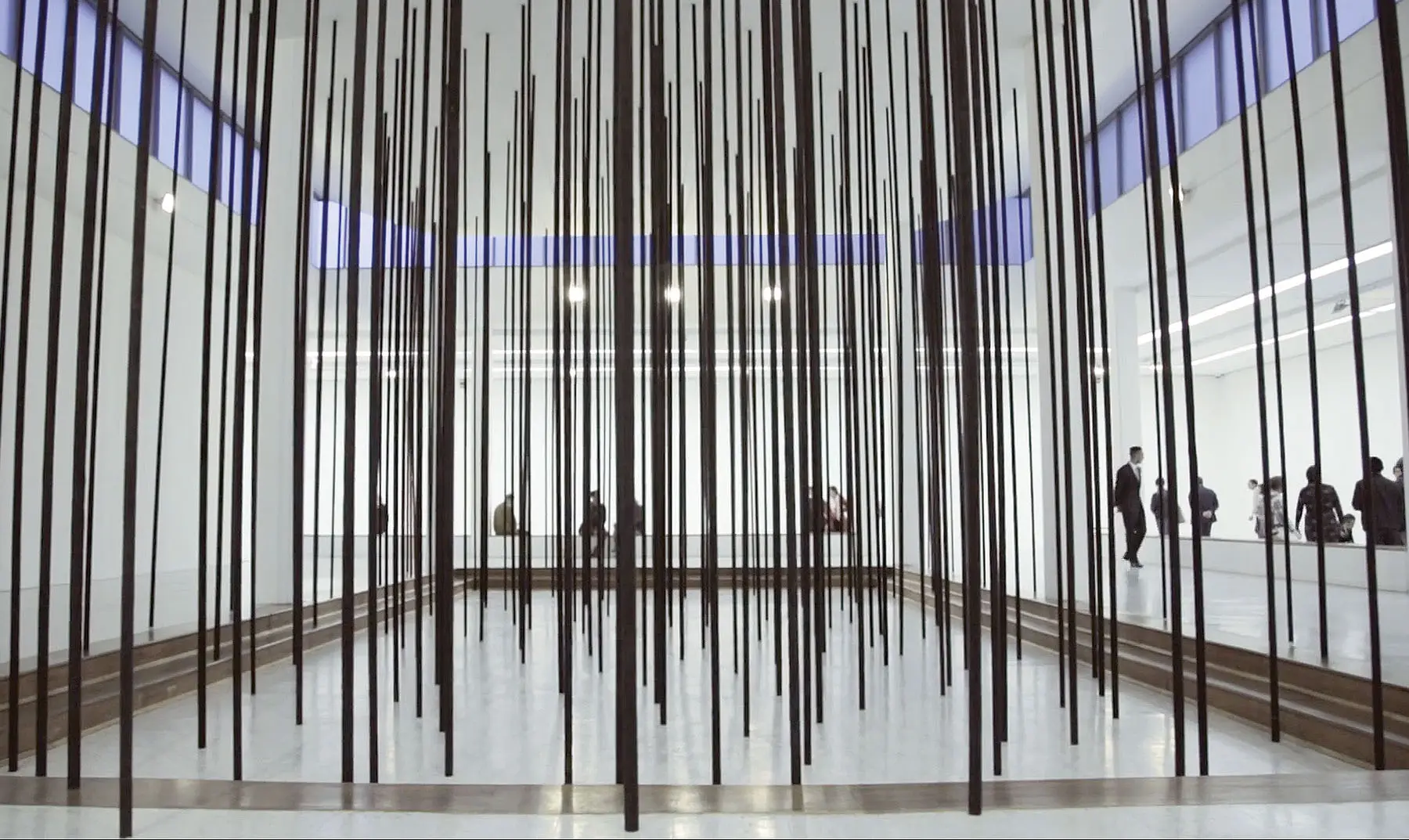
I think it is important to mention here a book about Herrán written by Nicolás Gómez, one of the most complete studies ever published on an individual Colombian artist. Its title is En materia (In Matter) and was published by the Ministry of Culture in 2012. Herrán says in that book: “The photograph was shot when I learned that peasant children in the highlands go out at dawn to milk the cows and step on fresh dung for warmth. I found this to be a very intimate relationship between the body and nature, determined by a need for comfort. The photograph underscores that action.” Bringing back actions that are lost in the midst of an accelerated process of modernization is a contribution of Herrán’s art, as is the intimacy that his early works, with their human-body scales, always favored. In that sense, curatorial decisions such as enlarging Herrán’s columns of hair and having them play with the site’s architecture, which emphasized the building rather than the body, made strange for me a work that was like an enchanted forest of hair rods, an intimate forest I had already crossed once.
I want to point out also that Herrán brought into Colombian art a commitment to highlighting the fact that objects are not the port of arrival in art, but a potency that captures communicative, psychological, and “traveling” flows. The object, then, can disappear to reveal that nature or society, in their way, also help configure landscapes and things. At that point, the artist can take a step back and account for the process through which social systems are flattened or configured. In this exhibition we had a chance to see Herrán’s unsettling flat sculpture of an artifact—an airplane wing, perhaps—transfigured by lead, which nevertheless seems to float on the floor. An “artifact” that acquires growing validity through its title: Flotsam and Jetsam, a reference to refuse and remnants, to floating debris thrown intentionally into the water or resulting from an accident.
In that order of ideas—the presence of objects transformed by stronger forces—I believe the exhibition would have benefited from one of the most important works of the 1990s. I’m referring to inter faeces et urinam nascimur, its title taken from a Latin quote by St. Augustine that can be translated as “we are born covered in feces and urine”, and its complement, titled Lat. 5º 02’ norte – Long 5º 40’ oeste (Lat. 5º 02’ north – Long 5º 40’ west). Herrán built a sphere using bones, a material he easily found and collected as he explored the Thames river; he then decided to give this perfect sphere to the sea so that it would travel to the 1994 Havana Biennial. Herrán also sent to Havana a wind map, trusting the forces of nature to do their work (and highlighting the fact that they do). This work is essential precisely because it makes it possible to discuss an obvious yet very important issue in Colombian art: the idea that art is not only an object for sale, but a reason to experiment, pull, and point out other forces, which the object allows us to name.
Another quality of Herrán’s oeuvre is its avoidance of over-signification. Most of these early works lack a title. They, along with the precision and sobriety of the artist’s statements, avoid cloaking the art on a generic discourse about violence or the situation in the country. Herrán’s works cannot be said to attempt a representation of the pain of the violence suffered by others. But it is precisely their silence and their material presence that help each viewer—I included—to recognize his or her own loss and emptiness, and to name each work with a title that expresses the meaning they, the viewers, find in it.
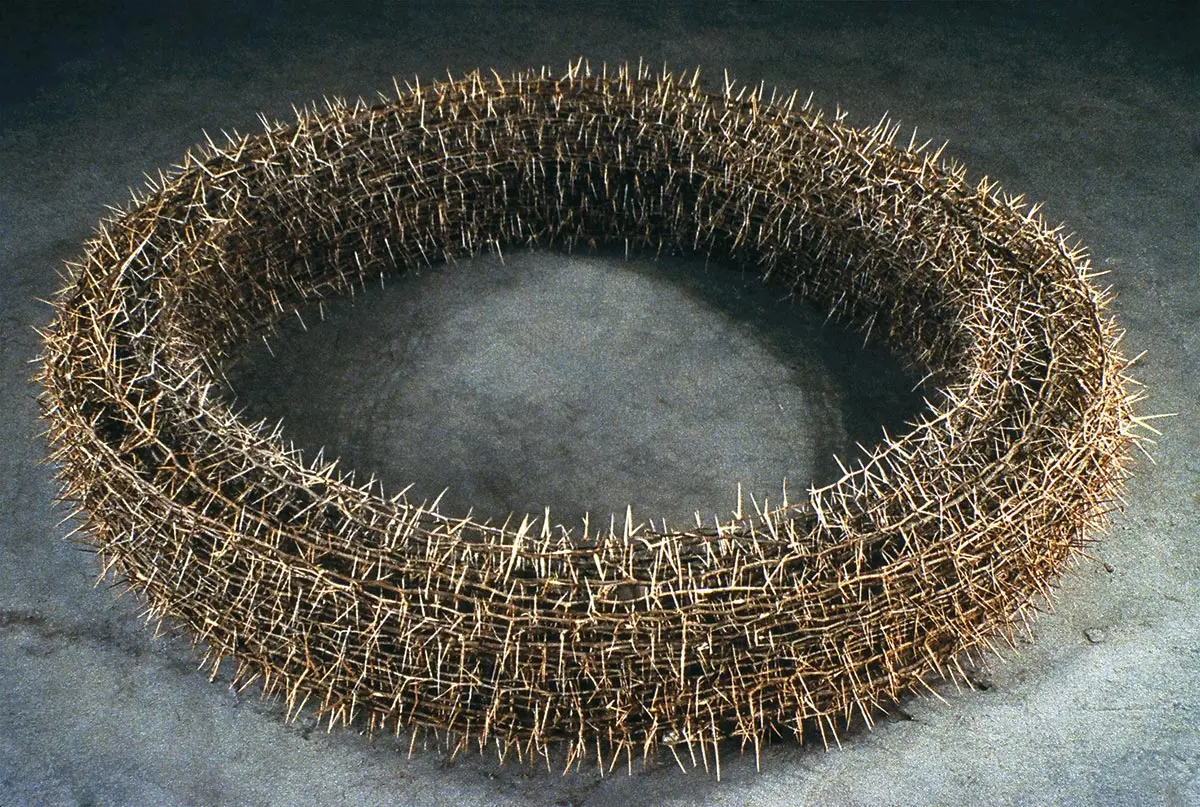
The scene is unforgettable: the 33rd National Artists Salon, in 1990, included an untitled work that the audience named the crown of thorns. Set on the floor, this thorny material, rolled up like a crown, came as a surprise in a Salon where sculpture in metal seemed rather self-satisfied with its forms; this was a discrete object that visitors could place in the space of their own loss, of their own grief, or of a collective grieving for the situation of the country.
All of this allows me to say that, while an exhibition like this one of Herrán’s early works must certainly be celebrated, Flujos deseantes (Desirous Flows) is a confusing title. It is faithful to 1980s lines of thinking and their gambit for a philosophy of desire, which might drive the empowerment of the subject as it inscribes its own rituals on the culture, but in the case of Herrán we are not talking about such an open kind of desire. The title signals an excessive, adrift individualism, as Santiago Castro Gómez puts it in his book Revoluciones sin sujeto, which critiques the excessive use of the word desire. Herrán’s work, evidence of the power of an artist guided by the drive to experiment with the matter, has clear ideas as a testimony—albeit not an explicit one—of what I would term a cultural and political shipwreck. Herrán’s early and later works express rage, despair, perhaps his own experience, and that makes a difference. Behind them is an artist who, I can’t be sure, may have experienced pain, and the work never allows itself to be dominated by their design or by an exaggerated formal precision. The form of Herrán’s work is just right; it does justice to experience. And this is why, in my view, the exhibition’s open title missed an opportunity to tell students in a university museum—and it is me, perhaps, who now attempts to over-signify the art—that Herrán is an essential artist to any understanding of Colombian society’s process of fear, fragility, and impermanence.
* Photos courtesy Museo de Arte Universidad Nacional.
NATALIA GUTIÉRREZ
Anthropologist. Professor at Universidad Nacional.