
Superficies tangibles (Tangible Surfaces) is the title of this installation by Oscar Lloveras (Buenos Aires, 1960), at the Musée des Arts et Métiers in Paris. The event is unusual not only for the size of the work but also for its location at the entrance of the traditional institution. A spatial structure with lines of planned expansion unfolds at a height that ranges from five to sixteen meters and covers a surface of over 800 meters.
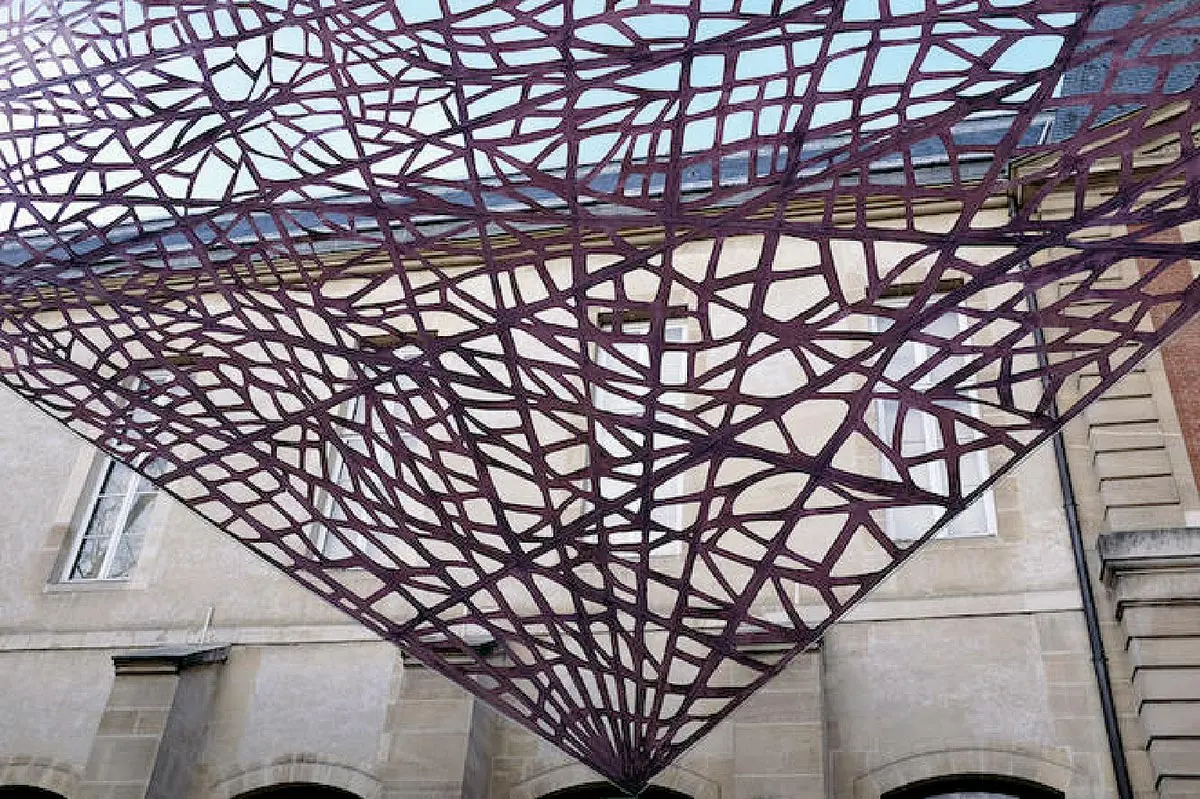
Lloveras’ work refers to the latest forms in design while maintaining a respectful attitude towards tradition. The three basic wings made in high-resistance polyamide canvas are suspended and kept in place by tension cables. This is an important discovery since the material is used in oceanographic missions at great depths that demand high resistance. Lloveras’ creation, inspired by aerodynamic or aquatic natural forms, roots, and leaves, adjusts to this primordial element. The parts prompt contemplation and adapt perfectly to the building’s structure, without altering it. Wind, light, and weather accidents are incorporated into the work’s modifications. Along the same lines of these dynamics and ecological rules, the colors have been produced using natural pigments fixed in alcohol. All of this is in accordance with Oscar Lloveras’ intended message of respect for the environment.
Lloveras began his artistic practice at the age of 14 when he started attending the School of Fine Arts in Buenos Aires. Later he studied Sculpture at La Sorbonne (Paris) and dabbled in anthropology. His education also included medicine and kinesiology. Lloveras’ interest in Eastern religions and writings took him to Japan and motivated him to research the origins of Shinto and Buddhism.
His work includes a preoccupation with social issues, the force and implications of energy, man’s relations with his environment, and the notion of temporality. Lloveras has created monumental works for the communities where he has resided and contributed to the training of youth in that activity.
The places selected for the earliest installations in the genre also correspond to an environmental approach and the search for a way for social groups to live in harmony with nature, and maintain values of ecological respect. Lloveras’ structures are the product of social work. Among their most important precedents are monumental sculptures created during the artist’s stays in Japan—in Kamiyama—in 1999 and in 2013; and his participation in the renewable Energy Festival in Pennsylvania in 2010.
After producing carvings in stone and wood, Lloveras gives free rein to our imagination with this new type of structure that integrates itself both into nature and into the urban space. The viewer who, in his or her motion, interacts with the work complements a perception of emptiness and plenty, of durability and instability, of shadow and light. This kind of spatial work of art is connected to the notion of harmony in relation to the space that holds it. Students at the Monotsukuri association from the University of Kawaga participated in the execution of this work.
Oscar Lloveras also finds innumerable aesthetic keys in Japanese literature, in a kind of ritual. He leaves nothing aside and pays great attention to every element. He joins in this way the ranks of those artists who achieved universality thanks to their respect for local cultures, and who sought new philosophical destinations and new explanations about the essence of the human. The integration of these elements is associated with a humanistic content and a committed attitude. The latter can also be read as a Latin American referent.
Lloveras’ work connects with a spirit of nomadism, intelligence, and poetic projection. His chromatic technique is particularly original, as natural pigments are fixated in alcohol: matter has been specially created for such construction. The achievement is even more impressive if we add the fact that for a long time historical sites of this magnitude remained closed to the possibilities of intervention. The museum, located in the Saint-Martin-des-Champs Abbey, preserves machines, drawings, and documents related to important inventions of the Nineteenth and Twentieth Centuries. This is a key historical site in France, and many architectural styles have come to overlap in its evolution. Inviting Lloveras to present this proposal is part of a new cultural policy in the museum, which nevertheless maintains its established line and its purpose of safeguarding our contemporary scientific and technical legacy.
Lloveras’ work extends into the city, as it can be seen from outside the museum. Spirituality and metaphysics come together in the vision of one reality overlapping with another: one architecture upon another.
SUSANA SULIC