
Ascending City was an installation of small houses in burnt wood presented by Roberto Diago at Pittsburgh’s Mattress Factory in 2010. Now arranged on the floor and the wall in the back area of Magnan Metz gallery for his solo exhibition Marca en la memorial (Imprint of a Memory), the little houses present us with the shine of their charred surfaces. The fire has turned them into a somewhat dramatic child’s drawing, which now expands theatrically and leaves only small gaps for viewers to wind their way through their accumulation. As we move further into the work, we discover areas untouched by the fire in which the natural color of wood pops up randomly.
Interested in areas of marginality, especially those related to racism in Cuban society, Diago has employed recycled “poor” materials in many of his works since he came onto the scene in 1990s Cuba. At the time, the country’s deep economic crisis forced him to adopt an aesthetic of poverty, which, while carrying a risk of stereotyping, still persists in this scattered citadel like the neighborhoods that surround capital cities in third-world nations, and also in the remaining works in the exhibition, which combine hard and soft materials, metal and canvas.
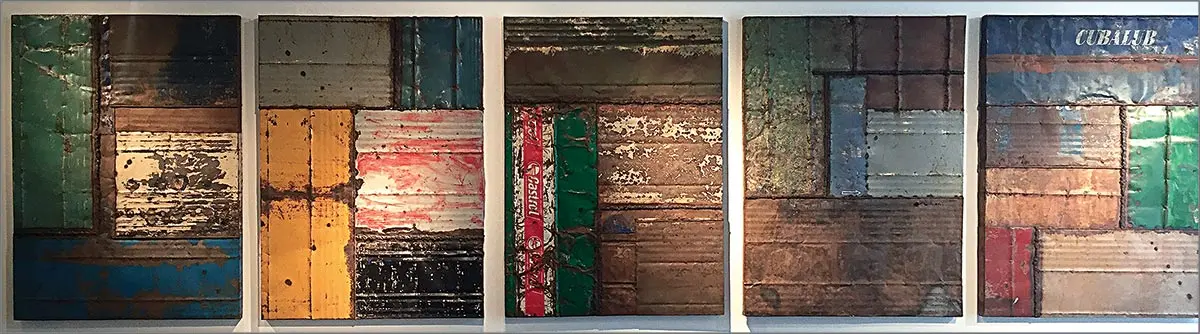
Five large-format works from the series Variaciones de Oggún (Variations of Oggun, 2010) stand out for their power. Oggún is one of the deities (orishas) in the Afro-Cuban pantheon of santeria, known as a warrior and protecting father, lord of iron, tools, and weapons. Created using roughly soldered metal plates, these works have been placed next to the wall that faces visitors as they enter the gallery. In this way, they are perceived as a giant protecting wall. The plates, painted in flat colors and polished by the passage of time, produce an agreeable effect. The wall seems to become a large quilted curtain, another technique associated with scarcity.
However, the most relevant formal element in the execution of Diago’s Variaciones de Oggún is the soldering joining the plates. Rather than hiding the joints, Diago highlights them. The soldering comes to represent keloids, the skin protuberances produced as a wound heals. In Cuba, such markings expand as traces of the mixed blood of their carriers. In 1997, an exhibition pioneering artistic engagement with the issue of racism in the Island adopted the term for its title. Diago’s work was featured in that show.
The protuberances created on the metal surface by means of soldering have an interesting correlate in one of the three white-colored works made on canvas, also in large formats. These are the artist’s most recent productions, dating from 2015. Against a ground of rectangles and squares with frayed borders, Diago placed a kind of braids, equally frayed. The white keloid doesn’t serve the purpose of joining the sections of the painting, but is overlaid on the background as a misplaced addition. It is also soft, although its appearance is rudimentary. Perhaps in this way Diago is allegorizing white racial privilege. The other two works combine rectangular patches with thin vertical stripes, which make the surface more dynamic without losing their decorative effect.
Roberto Diago belongs to a generation of Cuban artists who have adopted social themes as the center of their explorations. A graduate of the San Alejandro Academy (1990), he soon developed a language rooted in neofigurative expressionism, indebted to Antonia Eiriz, who burned the surfaces of her works and subjected them to extreme rigors. Diago understood that this language was appropriate for engaging a society where inequality was rapidly rising to the surface after the mirage of a Soviet-backed bonanza.
Unlike many of his contemporaries, interested in a return to the craft of painting, Diago devoted himself to the production of diaphanously brutalist works of art, focused on the symbolic load of the materials. After adopting this rough language he began exploring issues of race, albeit increasingly from a perspective centered on formal questions. This is why his recent work has been shaking off the direct allusions that characterized his art for over a decade, such as the use of text and black human figures. Diago has emphasized the symbiosis between the materials used and certain signifying forms. In this context, metal soldering and canvas suture are metaphors of cicatrization, like the marks left by suffering in the memory of all Cubans.
ELVIS FUENTES