
Sandra Cinto’s exhibition at Casa Triângulo was titled Acaso e necessidade (Chance and Necessity) and the works of art it brought together were strongly stimulating for the visiting public. Celebrating the 25th year of the artist’s career and also the opening of the gallery’s new location at Estados Unidos Street 1324, São Paulo, the show featured an installation and a selection of six works on paper.
The installation, which dialogued with the gallery’s architectural space, occupied Casa Triângulo’s largest area and was comprised of two canvases, 300 x 750 cm each, placed across from each other on the room’s main walls. It also featured a three-dimensional component in white wood, arranged as a divider between the canvases but directly connected to them in the construction of the work’s meaning. This three-dimensional element was a bridge with a toy horse at one end and a rocking chair at the other, perhaps in allusion to the transit between childhood and old age.
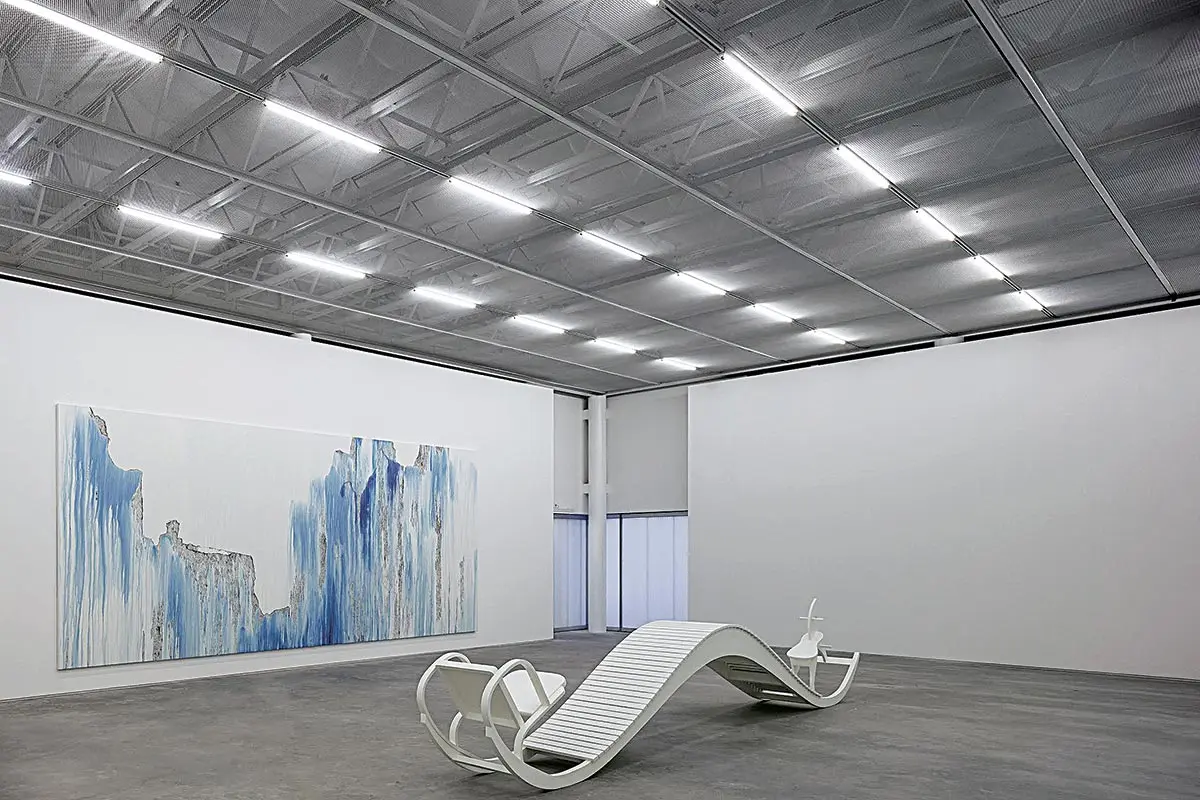
With great sensibility and careful technical execution, the two canvases impacted viewers with their blue and white hues, suggesting landscapes of mountain slopes down which water flows in abundance. The canvases were created by applying gesso on the white fabric, which was then sanded down to create a porous surface texture for the splashing of water infused with blue dye. The artist draws between the shapes thusly generated, inscribing delicate, detailed lines made with a special pen Cinto calls a “permanent pen”. The resulting work is a painting/drawing or a drawing/painting; the two genres fuse into one to produce a unique aesthetic language, enveloping the viewer with their beauty and sensibility. Behind the manufacturing process, one immediately notices something that is almost a ritual: Cinto positions herself on a scaffold to splash water on the surface and produces random effects, blotches that bring to mind the falling of water in mountainous geography. Only after the water has been splashed and the splotches are fixed does Cinto begin to draw. The necessity is interior, a motivating, gestural force, a creative drive.
A feeling of immensity and a sense of the potency of nature come from the image in the large canvases. Water, one of nature’s vital elements, is the force of the “landscape”—of that imagined site, a territory of reveries. More than ever, “landscape” achieves here its most general meaning: a place formed by natural elements observed from a specific point of view. It is the artist’s elegy for nature, for life. It’s pure lyricism.
The meaning of the work comes to completion with the three-dimensional component that represents a connecting bridge or a reference point separating waters as they flow, building a metaphor for the passage of time in life itself.
The six works (drawings/paintings on washi paper) exhibited in the room next to the installation signal the same quest: we also find in them the randomness of splotches created by the aspersion of water, now, however, using a dense Japanese paper as support. Again, the artist inscribes her draftsmanship between the splotches. Confronted with these works, we sense the boundary between abstraction and figuration, and we feel involved in a game of identifying shapes, akin to what we do as we watch the transit of clouds across the sky, although in this case, our perception takes us to an image of very tall mountains. Water remains the main material for the creative process.
There is a certain japonerie in the work of Sandra Cinto, as has been pointed out by critics in the past. In the works on exhibit at Casa Triângulo, the issue is forcefully present due to the special circumstance of the series that has evolved after the artist spent a few months in Japan, intensely imbibing the country’s culture. In Japan, she was able to research how dyes are applied to fabrics and to familiarize herself with the contemporary meanings of this ancient technique.
The title of the exhibition—Acaso e necessidade—comes, by the way, from a Zen Buddhism idea. The exhibition unveils a Zen feeling experienced by Cinto; it also indicates the profound maturity of her art at this point in her career. It illuminates the intensity of the aesthetic reflection it prompts in the viewer as it propels our potential for elaboration. The richness of these works takes us back to other moments in Cinto’s career, and this very dialectic is a key feature in the artist’s aesthetic evolution.
Like the clouds and the turbulent sea waves of previous periods, water serves here a metaphorical function: it means the vital flow of renewal, the passage of time; it possesses an ontology, and it is a poetic image. There is an intuitive cosmology in the work of Sandra Cinto. Water, like air—elements of the material world—give birth to fantasies, metaphysical messages, and an emotionally resonant creative imagination.
LISBETH REBOLLO GONÇALVES