
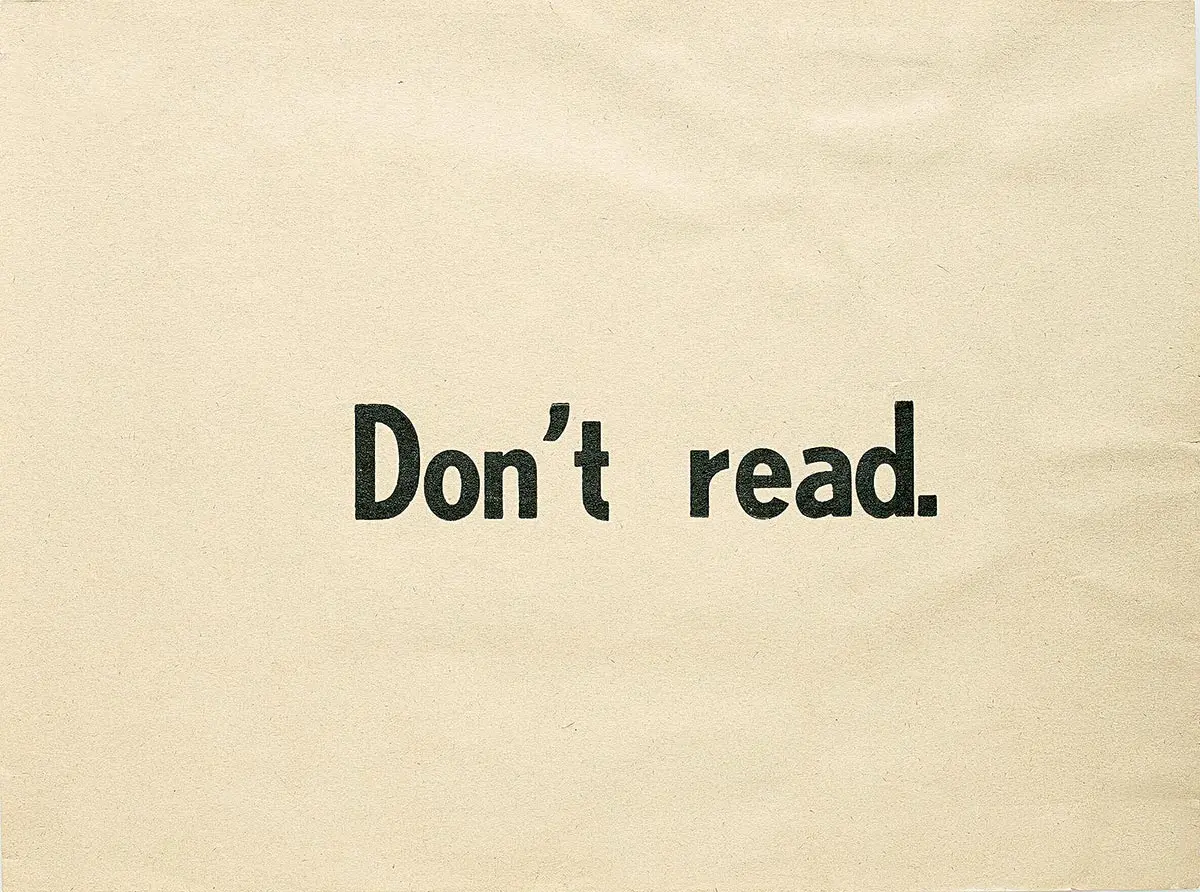
To understand Ulises Carrión in a museum context, it is helpful to think about the writer first and then move on to thinking about the artist, without ever setting the former too far aside or entirely forgetting about him. Let’s think about the artist who wanted to stop being a writer, who devoted his efforts to publishing, and who predicted the end of the book. Let’s think about the Wittgensteinian fly clashing against the glass of language, and also about the poetry of its flight. Querido lector. No lea (Dear Reader. Don’t Read), the work was appropriately chosen by curator Guy Schraenen as a title for the show, works not only as a motto and epitome for Carrión’s creative drive but also as the best possible user’s manual for visitors.
Ulises Carrión (1941, San Andrés Tuxtla, Mexico – 1989, Amsterdam, The Netherlands) was one of Latin America’s earliest conceptual artists. His first retrospective, Me ocurrió bastante tarde (It Occurred to Me Rather Late) was held in 2003 at Museo de Arte Carrillo Gil, but only now is he having a European one. His work has not been as visible in Europe as it deserves, with the obvious exception of The Netherlands. Ultimately, this initiative by Reina Sofía can be seen as part of the institution’s gambit for collecting Latin American art of the 1970s and 1980s and giving it greater exposure. In recent years, this inclination has prompted the acquisition of archives and a collaboration with the Red de Conceptualismos del Sur, crystallized in the 2012 exhibition Perder la forma humana (Losing Human Form).
This exhibition offers a complete, well-rounded panoramic not only of Carrión’s work but, even more importantly, of his creative processes. With great conceptual solidity and based on a deep knowledge of the work and the artist, this exhibition features some 350 items, including books, magazines, sound-art works, mail-art works, public projects, and performances, never losing sight of the fact that many of these fetish objects are nothing more than the remnants of the inexhaustible methodologies and explorations behind Carrión’s many initiatives as a curator, publisher, distributor, lecturer, archivist, art theoretician, and writer. Some sections of the exhibition are articulated around thematic-conceptual nuclei that remained constant throughout Carrión’s career (fundamentally, the ideas of reading and of books), and others touch on specific projects such as Gossip, Scandal and Good Manners (1981), a field study of the mechanisms and structures of gossip and rumors, documented in a graphic format and later presented in a conference, like any scientific investigation would be.
Carrión is primarily identified with projects like the legendary bookstore-gallery Other Books And So (1975-1979), the first of its kind devoted to artist’s publications, which in 1979 became the archive of the same name or his participation in the mail-art network. This show also presents visitors with lesser-known projects and works, such as Carrión’s organization of a film cycle about Lilia Prado at De Appel Arts Centre, in 1984, or videos like TV-Tonight (1987), which posited sharp and humorous reflections about language, communication, writing, and visuality. The show ends in a multidisciplinary gallery featuring video, here sound-art works, and a reading area where visitors can (finally!) peruse facsimiles or some of Carrión’s books, non-books, and anti-books, and consult a bibliography about the artist. The gallery’s simple idea would have delighted Carrión—it could indeed have been one of his own works—who was a precursor or the agitated debate around notions like “original,” “copy,” and “forgery,” and an enemy of fetishism in the arts.
The stimulating power of Carrión’s work perhaps resides in the fact that it remains an enigma. His early career in Mexico unfolded in literary circles, and his self-exile in Europe meant also an exile from literature and a move towards the visual arts. He never settled definitively in any of those two fields, and his main contribution to both is, precisely, his positing of a lack of definition as the site of the poetic. His status as an outsider in every aspect of life always meant the challenge of construction/deconstruction as inevitable moments of the processes of life and communication. Revealingly, the work from which the exhibition takes its title was conceived as a diptych. Querido lector. No lea (1975): two phrases, two moments, two frames, two images. In Carrión’s video A Book (1978), one hand tears pages from a book and crumples them up, while another hand smoothes them out and reorders them into a pile. In the first instance, the gesture of unfurling the creative process into two parts is, clearly, the closest thing to an incantation or an act of therapy; in the second, integration is, undoubtedly, an accurate self-portrait.
DIANA CUÉLLAR LEDESMA