
Galería Bacelos presented the exhibition Who Said What to Whom by Adriana Bustos. The exhibition resumes key inquiries by the Argentinean artist about capitalism and its influence on knowledge, the body, and the mechanisms of control. On this occasion, Bustos focuses on the scientific field and the manner in which it too channels those structures regulated by the more aggressive type of capitalism.
The exhibition begins by addressing the Golden Record case, a gold disk designed by Carl Sagan for the Voyager space missions that contain information about our civilization in case of reaching an alien life form. In any story there is always a considerable amount of fiction—since it is impossible to do without points of view—subjectivity, things selected over others for being considered more important. Even when the discourse stems from science, postmodernity has avoided those supposed neutral, objective, and apolitical elements of modernity. How to deconstruct what we have been taught to be true in academic or official organisms? Bustos combines pencil and color drawings with texts on primed canvas to reveal propaganda strategies by NASA and its relationship with power and control. Oddly, according to Bustos, three important themes were omitted in that scientific project: sexuality, poverty, and war. These are three important notions that support the invisible and that, nonetheless, operate through the mechanisms of civilization.
The iconography also uses the aesthetic of the journals by the first travelers of the colonies. Concepts such as taxonomy, classification, codification, and systematization are key for understanding the construction of Illustration and Modernity, and everything else that resulted from them. One of the features that characterize the work by Adriana Bustos is the contrast between the innocence of visual language and the depth of the notions that it addresses. This is one of the greatest successes of the exhibition. The scientific texts are alternated with, for instance, the red-colored interventions by Bustos that serve as a critique of the optimism of the scientific discourse. In this manner, Bustos builds an encyclopedia of her own with which to generate personal and critical knowledge.
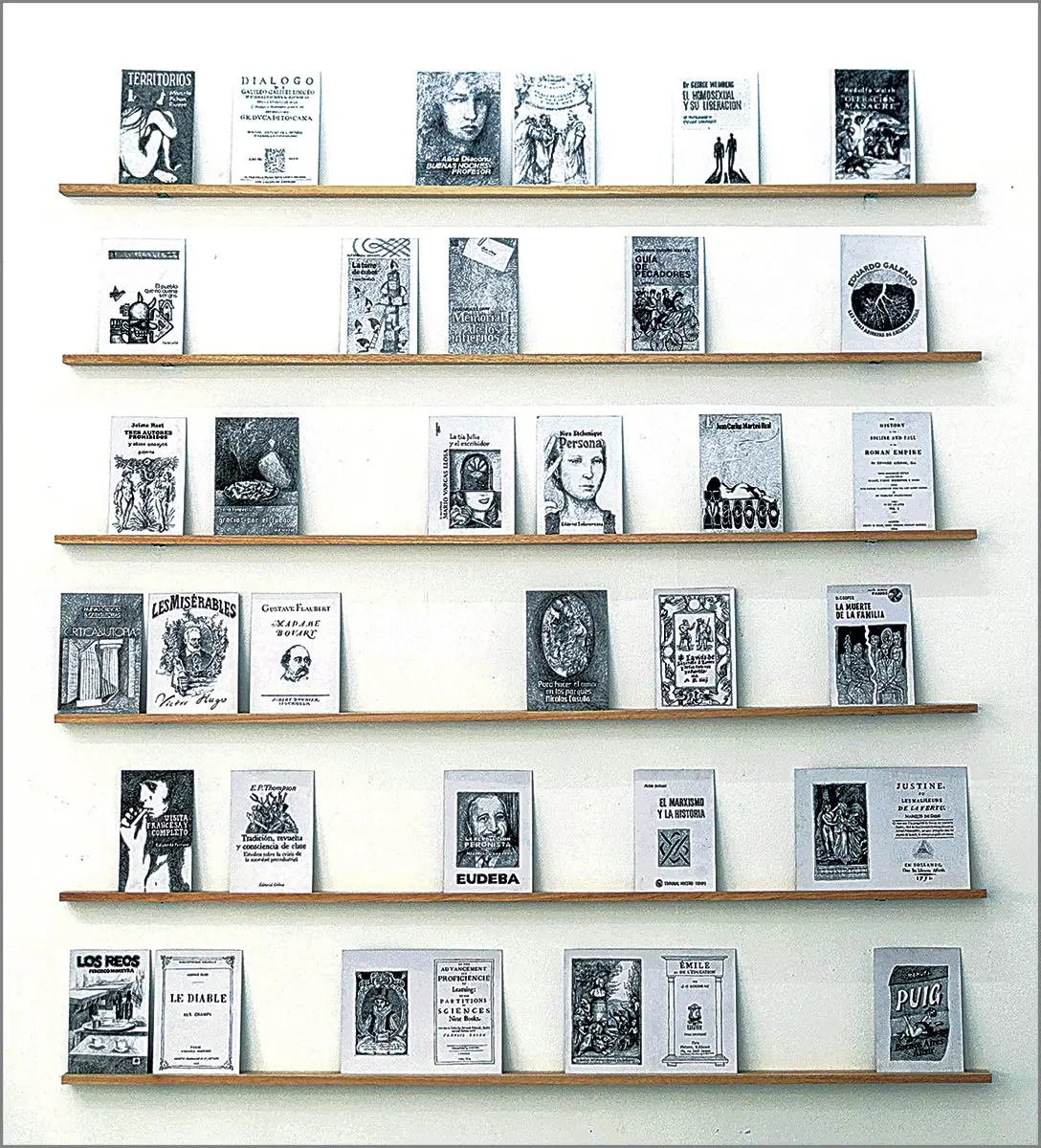
Other works in the exhibition include a display case with reproductions of books forbidden during the Argentinean dictatorship. Bustos only drew the cover, alluding to the arbitrariness inherent to censorship, which often allows the infiltration of a subversive text while forbidding some of the most innocent types of volumes. Some of the titles observed include Les Misérables (The Miserable Ones), Madame Bovary, Operación Masacre (Operation Massacre), Las Venas Abiertas de América Latina (Open Veins of Latin America), and La Tía Julia y el Escribidor (Aunt Julia and the Scriptwriter), among others. The books only cover precisely because Bustos plays with the iconic nature of those censored books. More than texts, they are circulating images that have been forbidden for representing an ideology.
Two videos are displayed in a corner of the gallery. They are juxtaposed one next to the other and projected in such a manner that both appear to tilt towards the wall’s edge. The video on the left shows the 1978 Olympic Games in Argentina. The video on the right shows the famous 1936 Olympic Games documentary by Leni Riefenstahl. We immediately notice the militaries between the two: the camera’s point of view, the construction of the planes, the body language of the athletes marching in military fashion, the repertoire of physical gestures and codes, and a competitive, hierarchical, environment of, why not, underlying violence. It is a subversive idea if we stop to consider that sports are traditionally associated with capitalist notions of wellbeing, health, and fulfillment.
Whether through films, photographs, or advertisements, the images are always susceptible to being used as propaganda. And this is the case of a drawing on canvas that is part of the exhibition. Bustos renders the drawing of a car that was very popular during the dictatorship period in Argentina. It contained the following advertisement slogan: “Punish me. Mistreat me. Starve me. Exploit me.” The relationship between the object of consumption, advertising, and violence is evident. One of their similarities is perhaps that the three notions operate through silent and invisible strategies.
Another installation presents the following message: “Those representatives of planet Earth hide the machines of production and sex while destroying the world because it is profitable.” This is one of the exhibition’s central ideas and one that drives Adriana Bustos’s complete body of work: to unmask the mechanisms of production of knowledge that respond to concealed principles based on the most virulent form of capitalism, violence, aggression towards the body, and scientific classification as a double-edged sword.
ANA FOLGUERA