
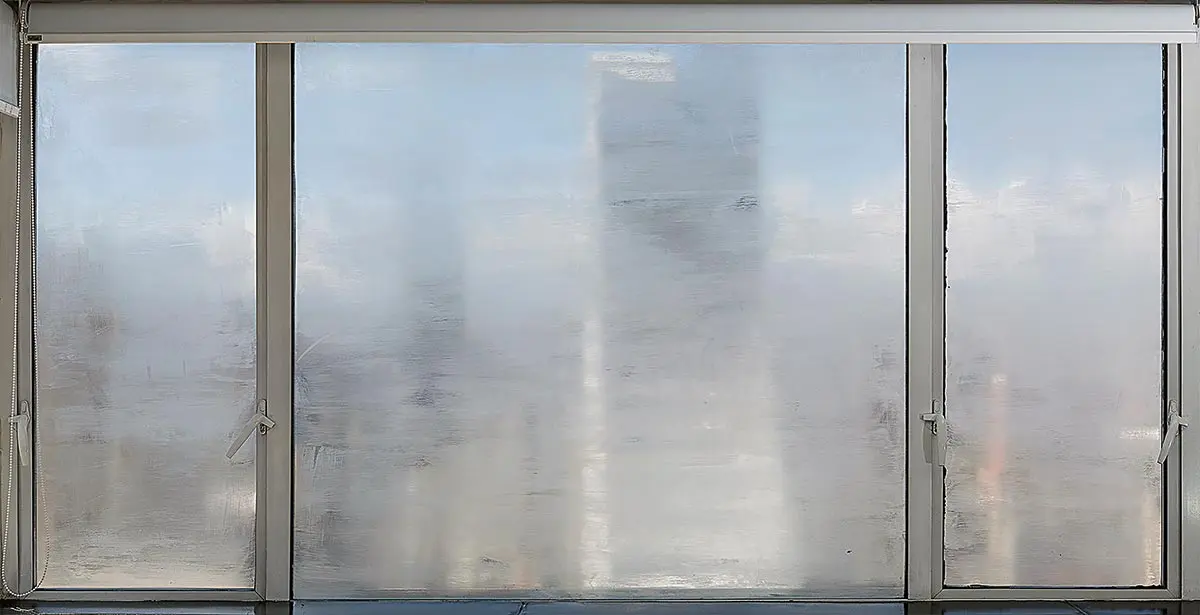
The photographic series in Caroline Peña-Bray’s most recent exhibition titled Semblance, makes viewers unsure of what they are actually observing. A first look elicits the initial necessary question: Are these photographs or paintings? A closer inspection makes viewers a little more certain—if only the works could be touched, be totally sure—that they are indeed looking at photographs; images that depict hyper-realistic looking windows that appear to have actual openings piercing through the walls of the exhibition space. They look like paintings because of the textured veiling covering the window glass, which gives the photographs a textile or painterly quality. The surface is so inviting to the touch that viewers seize it with their gaze to feel the reliefs in the retina. This trompe l’oeil—carefully orchestrated through digitally constructed images based on the original photographs—represents the first layer of a complex play on perception and construction of meaning that Peña-Bray puts into motion in this exhibition of appearances and deception. It is tempting to linger on the surface of the trick, on the visual play that keeps us from accepting what is in front of us. The window in Palacio de Nariño (Nariño Palace) is barely open. One of its doors appears to open towards us and we feel compelled to touch it. We cannot move. Peña-Bray always allows us to sense what is behind the glass. The titles suggest emblematic buildings located in the city of Bogota; containers of power and symbols of key moments in the history of Colombia. This information offered by Peña-Bray helps us look beyond the glass with the gaze of our imagination. Although we do not know the things that power conceals within its walls, we allow logic to infer the events within those walls that strengthen the silent but indiscrete windows.
As I observed the works, I thought that despite their foreign appearance they compellingly resonated in the Colombian context; the perspective afforded by the distance of a foreign gaze surely facilitates the extrapolation of the essential elements of such context. Perhaps the universal elements of Colombian history stand out more clearly to a foreign gaze. In any case, Semblance has the ability to address issues without literally showing them. As a great metaphor for the gaze in the history of art, the window has often been used an element for self-reflection.
Peña-Bray obstructs the possibility of building a mathematical and measurable reality like it occurred with the Renaissance gaze. Instead, she offers us reality with two edges: on the one hand, we sense the world through forms and volumes; we know that beyond the glass of the Capitolio Nacional stands the Palacio de Justicia, or that through the windows of Hotel Tequendama we inhabit the heart of the city, from which we can visually access a large part of the city from several vantage points. On the other hand, the soap applied to the windows with a paintbrush, stops the gaze to offer us the knowledge of a violent history without the lurid details. Avianca Boeing 727, a work that makes reference to the airplane windows of the Avianca Airlines flight 203 that exploded in the air in 1989. It is a magnificent series of works that place us in the middle of an event that we did not experience but that we can now feel a part of, or at least imagine what it must have felt for those who did experience it. The lack of a clear vision in these pieces activates a sensorial, emotional, and psychological experience rooted in a violent reality that is never revealed to us but that is always there. After decades of watching the blood splashing TV screens, it is time to look at it in a different way, to gaze at several realities but without the sensationalist lurid details, without the superfluous noise. The immediacy of the events and the need to assimilate them without getting too hurt, require the application of an opaque veiling on them that allows us to forgive without forgetting.
Large and within reach as if we could open them to have a look, the windows in Semblance serve as vehicles for reflection and as metaphors for the current reality of Colombia: on the verge of peace but still with a long way to go and with no clear end in sight. The soap application process on the windows adds an action aspect to the works that could be interesting to turn into video work. By taking the time to impede our vision, the idea by Peña-Bray contains then a previous ritual for a process that is presented to us as a completely finished photographic work.
CARIDAD BOTELLA