
The exhibition Color en tres (Color in Three) brought three contemporary Venezuelan artists together around the convergent issue of color. Elizabeth Cemborain (Caracas, 1959), Marylee Coll (Caracas, 1957), and Lourdes Peñaranda (Maracaibo, 1964) were the artists selected by curator Susana Benko to offer an approach to such a basic element of visual expression and to treat it from a contemporary point of view that experimented with different media and materials and, at the same time, proposed relationships with the context from a variety of perspectives. The exhibition was organized specifically for the open space of La Caja, and the works on exhibit, all in large formats, also unfolded with the capacity to be spatial events.
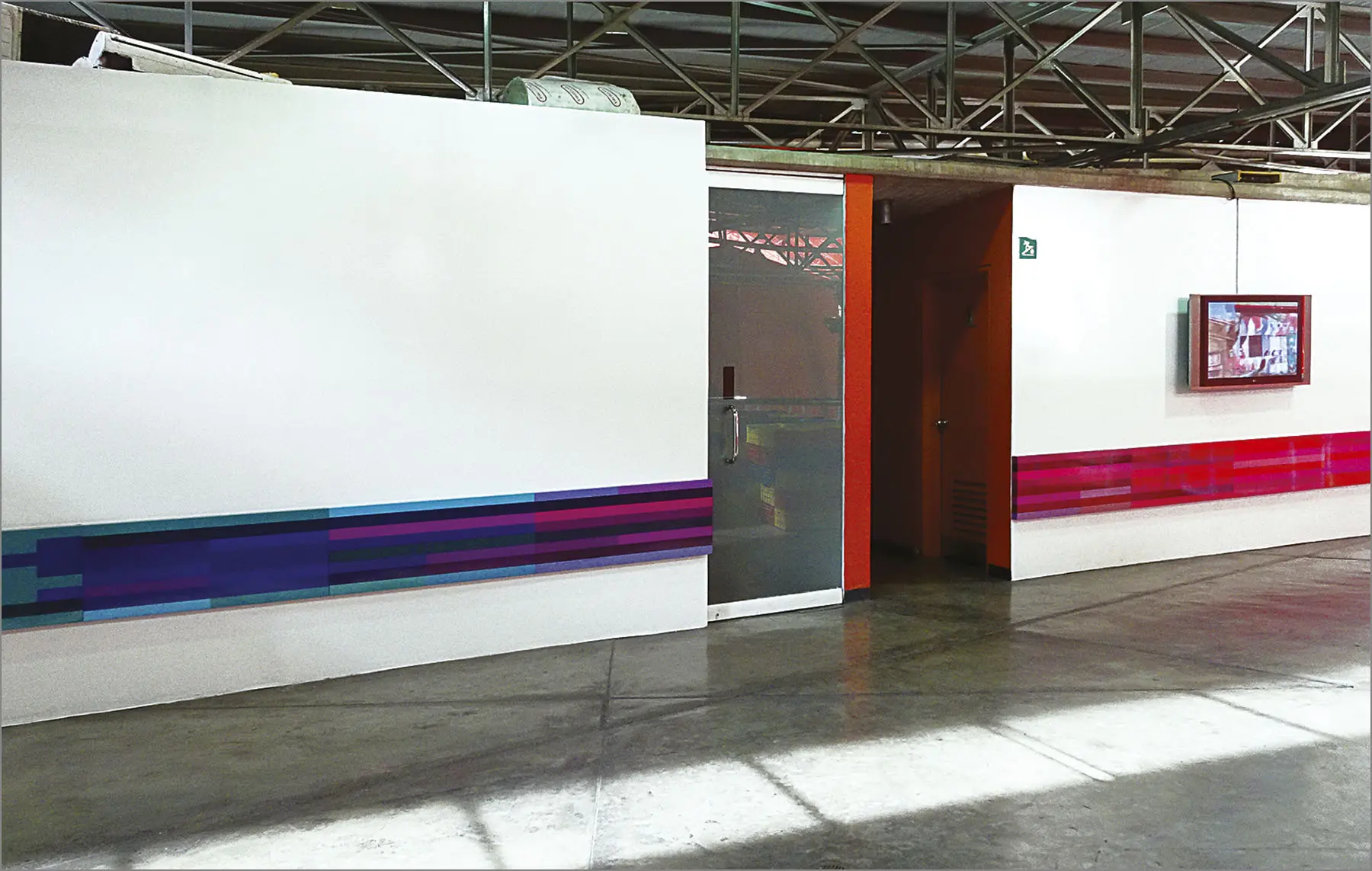
Elizabeth Cemborain presented Santa Lucía 2, made with MDF and laminated vinyl boards printed with eco-solvent ink, dated from 2016. It derives from a video titled Santa Lucía, where the artist recorded picturesque streets in the city of Maracaibo, characterized by its colorful traditional architecture. The video features vistas of the streets captured from an automobile. At a certain point, the images start to zoom in and get distorted. In this way, the regular vistas are deconstructed into rectangular segments that grow larger and less referential until we reach a simple succession of absolute-color planes. As Benko notes in the catalog essay, Cemborain’s procedure “consists of going from the general to the particular: the greater the closeness, the greater the image’s degree of abstraction.” Santa Lucía 2 is comprised of several printouts of these photograms.
Along the lines of her previous work, Cemborain has created a landscape, if we understand the genre as a mediated representation of the environment. This is a synthetic landscape, made of stripes, but where color expresses the tones—at times evident, at times hidden—of the city. An architect by profession, Cemborain’s gaze for to the structures that populate the urban landscape and promote a dynamic interplay of colors. The speed of the contemporary city, that fleeting, continuous gaze from a car or a train, is also part of her representation—one, in fact, that freezes it. In its resolution, Santa Lucía 2 reminds us of Alejandro Otero’s planks, with the caveat that Otero’s work was imbued with the issues that pertain to modernist aesthetics.
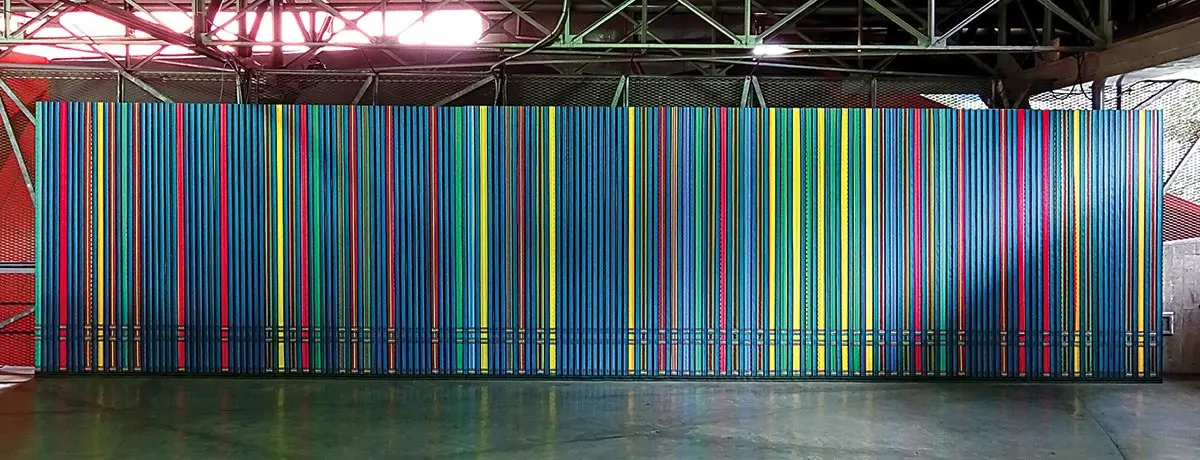
Marylee Coll participated in the exhibition with Colorama (2016), a large installation (976 cm in length) arranged like a panel and made with nylon ribbons. Following with her investigations of recent years, Coll turns to the kind of nylon ribbons printed into colorful bands that are used in the manufacture of beach chairs. This material allows her to create works of art that, in a way, parody the formal resolution of works in the abstract-geometric tradition. Using an industrial material, Coll distances herself from the formalist obsessions of abstract self-referentiality. In prior works, Coll built planes in a geometric format and covered them with these bands; in Colorama, she uses them to cover a long wall, creating overlapping layers. “This horizontal format forms, precisely, a colorama (…), which is the term the Kodak Company used to refer to elongated photographs projected from the East balcony of New York City’s Grand Central Terminal,” Benko notes.
With this large-format work, the artist sets in motion references to Frank Stella and kinetic art, obviously activated by the succession of color bands and the visual games that derive from it, but she also revisits the kinetic-art movement interest in incorporating the viewer into the artistic experience. Emulating these motivations, the artist allows us glimpses of the different layers of ribbons, inciting viewers to separate those closest to the surface and unveil those below. The interplay of color generated after these “discoveries,” gives this work a playful and dynamic character.
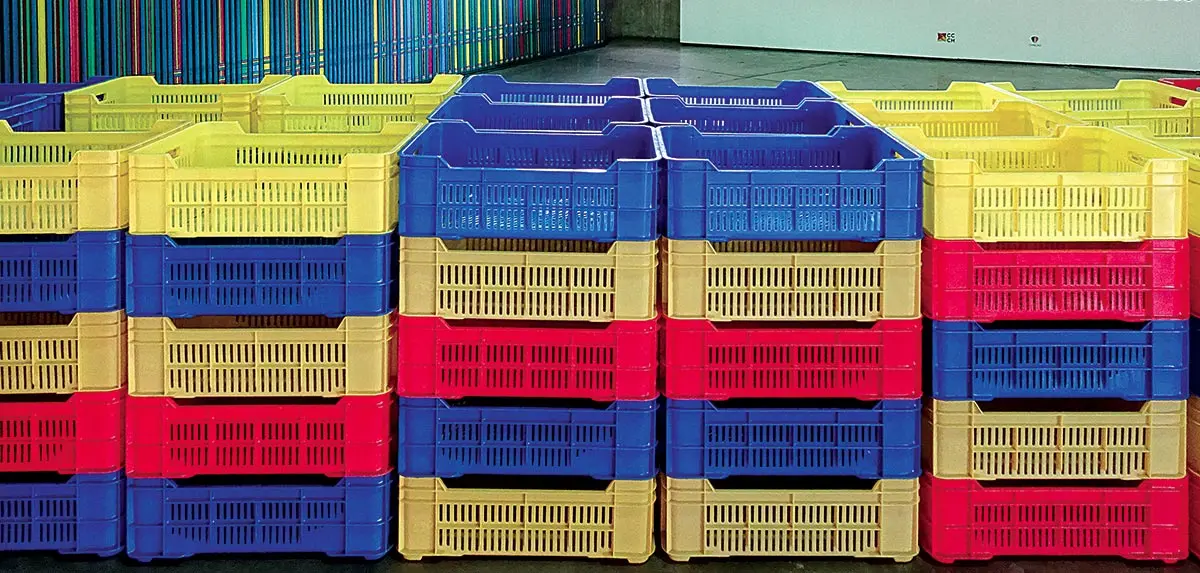
Lourdes Peñaranda participated in Color en tres with her installation Venezuela sin título (Untitled Venezuela, 2016), made using yellow, blue, and red plastic crates. The political and social critique aspect in this work is evident in this work, which, like all of Peñaranda’s, is traversed by references to reality. The artist resorts to Venezuela’s harsh current reality, marked by scarcity. The empty crates, an unequivocal symbol of the lack of food provisions are arranged as if in a warehouse or at a point of sale. They display the colors of Venezuela’s flag. They remind us, by force of contrast, the colorful stalls where tropical fruits and other staples of the local diet are sold in the country’s cities and highways, now crushed by inflation and the object of the population’s generalized disenchantment.
Peñaranda’s work is very well informed, and thus able to establish relationships with contemporary art, which she knows well thanks to her broad education. In that sense, notes Benko, “with this arrangement [of the crates, the artist] also refers to Donald Judd’s spatial interventions; she has studied Judd deeply both for her doctoral dissertation and for her own work.”
At the same time, the modular, detachable character of the crates, along with their lively colors, refers to the game of Legos, in a clear allusion to the arbitrary, patchwork way in which the country’s economic policy has unfolded in recent years.
Color en tres was a fresh, open, concise exhibition that put on the table the way in which these three artist’s exploration of color is intertwined with contextual problems that relate to the realm of art, but touch on matters beyond its ever more diffuse borders.
KATHERINE CHACÓN