
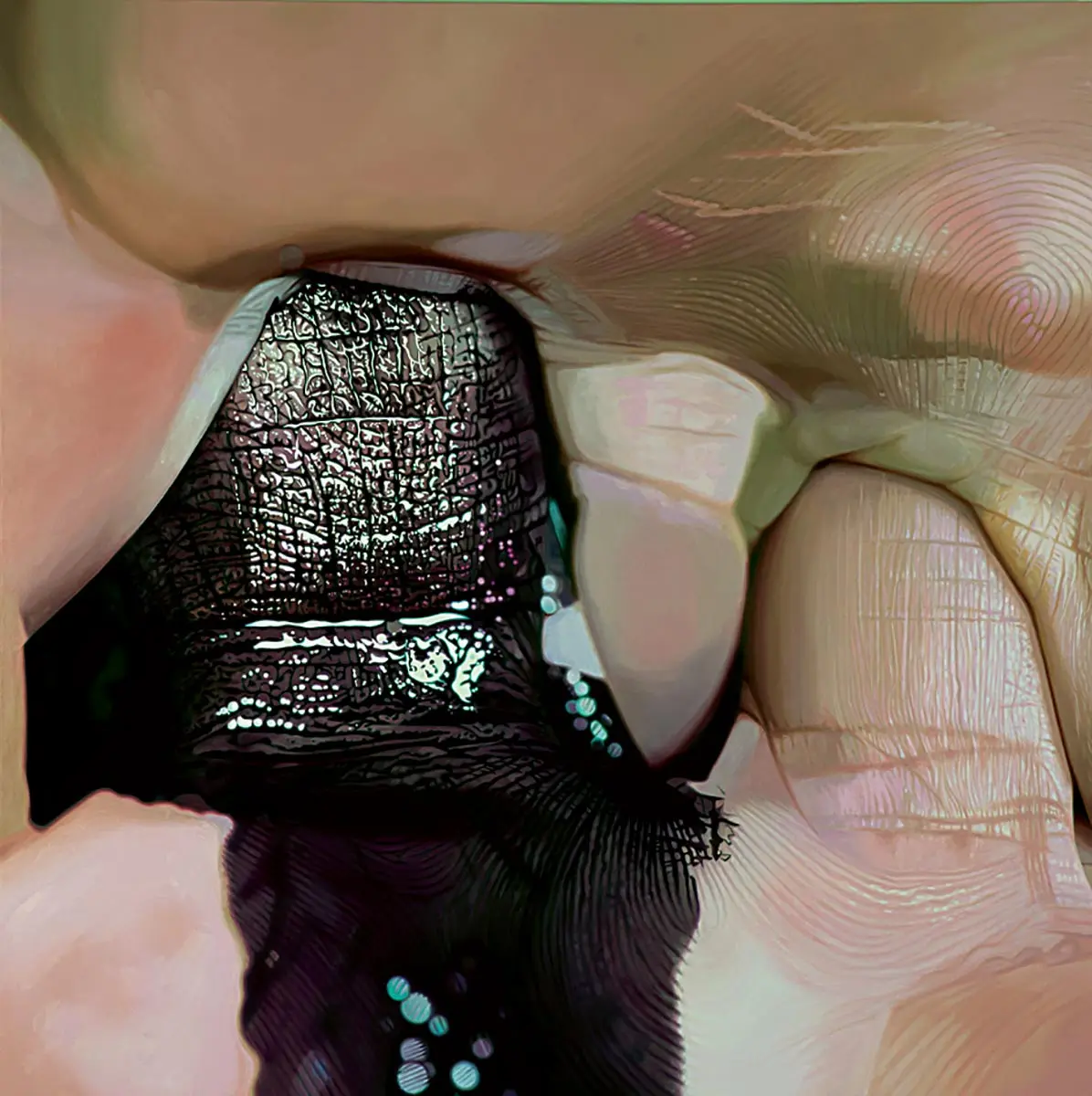
In Cybelle Cartagena Romanacce’s rigorous and sensual oil paintings, seeing is modeled on the experience of touch. The artist’s body is both subject and object in her tactile topographies. Ink-stained Skin, her latest series, features magnified details of her fingers, hand, mouth, lips, closed eye, belly button, and body hair stained by shocking pink and black ink. Her accessible, yet mysterious images reveal themselves slowly through a layered working process and the controlled and free dynamics of her media and materials. This buildup of energies activates a charged space of sensation and psychological resonance that seduces the spectator into a silent dialogue with each work. The artist’s tinted skin looks back at the viewer, and this shared physicality prompts one to contemplate, how do things feel?
Galeria de Arte at San Juan’s Universidad del Sagrado Corazón has always supported singular figures in contemporary art in Puerto Rico, like Cartagena Romanacce. It had been eight years since the artist’s last one-person exhibition, and on opening night, a diverse audience packed the exhibition. On view were twelve square-format paintings, ranging in size from 8 by 8 to 60 by 60 inches, and a video. The artist’s calibration of touch felt most on target when ink demonstrated a life of its own--dribbling, pooling, and seeping--as opposed to a painted design on the skin, and when the dye traveled across a shifting ground of hyperrealism and abstraction.
Cartagena Romanacce’s work is driven by process and materials. She sets things in motion and then gets out of the way to let accidents happen. She painted and poured ink on a small area of her skin and a photographer recorded its interaction with her epidermis. This took place under bright artificial light which caused, at times, the black ink to appear to be midnight blue or aubergine in color. In a few paintings, one could barely make out the overhead lamps reflected in wet ink or saliva. The artist selected from the photographic details the various amplified intensities she wanted to paint, and she re-specified these images throughout her long and laborious painting process. She treated her canvases like “skins” that bend around the body by painting the edges of her works royal blue, black, or reddish-pink. This act emphasized how information appears here and elsewhere and in different formats that question continuity and discontinuity.
Like Philip Guston, Cartagena Romancce has a deep affinity for all shades of pink. She uses pure colors to investigate the concepts of contamination and permeable boundaries, as seen in the slow-motion video of the artist at work in her studio. Some areas of the paintings were sharp and meticulously precise, whereas others were a muzzy field, similar to our memory. This play of visual definition within the space of the painting and within the viewer’s space intensified a picture’s tactile pictorial order. From a distance, her paintings seemed to be hyperrealist, but up close, they were all color, line, and shape, with visible brushstrokes. The element of time was implied by the lines on the skin, the unexpected in-between state the camera captured, and the months it took to represent it.
Every work was untitled and open to possibilities. Sometimes the ink suggested an oil spill, a border, a rope ladder descending from the corner of the artist’s mouth, or a cell cluster. Untitled, 2016, eight inches square, was sublime. It reminded me of Frederic Edwin Church’s paintings of Cotopaxi erupting. Glossy streams of shocking pink ink on the artist’s skin suggested a dramatic sky, a burning lake, and molten lava. Black ink oozing from crevices evoked smoke and ash bursting forth from a crater and rolling down the sides of a volcano. In Untitled, 2009, fifteen inches square, the artist’s naval next to a large black ink stain with six streams trickling down became an imaginary cosmic landscape with portals, a galaxy, and a black hole. Untitled, 2014-2015, 52 inches square, had the strongest gravitational pull. The black dye that soaked the infinite crevices of her interlocked fingers was an awe-inspiring, dense grid of patterns and shapes reminiscent of a Chuck Close portrait.
Ink-stained skin can be a metaphor for something that leaks into our lives. We don’t know if it is going to be a trickle or a bleed, what shape it will take, and what our reaction will be. The flow may stay puddled on the surface, it may penetrate deeply and broadly, it may dribble astray, it may reflect light. In Cartagena Romanacce’s paintings, there is always a sliver of a velvety black cavity through which we can escape. Ink-stained Skin reminds us that things never end where they end.
CHERYL HARTUP