
I always see Elio Rodríguez in Madrid or Elche, in Miami or New York. And, every time, it becomes impossible not to laugh with unusual ease about everything and everyone. Even when we are talking about something serious or worrisome, his gestures and voice are charged with an irony that permeates his words in such a natural manner that it always leads to laughter, no matter the gravity of the situation discussed. The same joyful humor and the sharp irony is contained and have defined, an important part of his work.
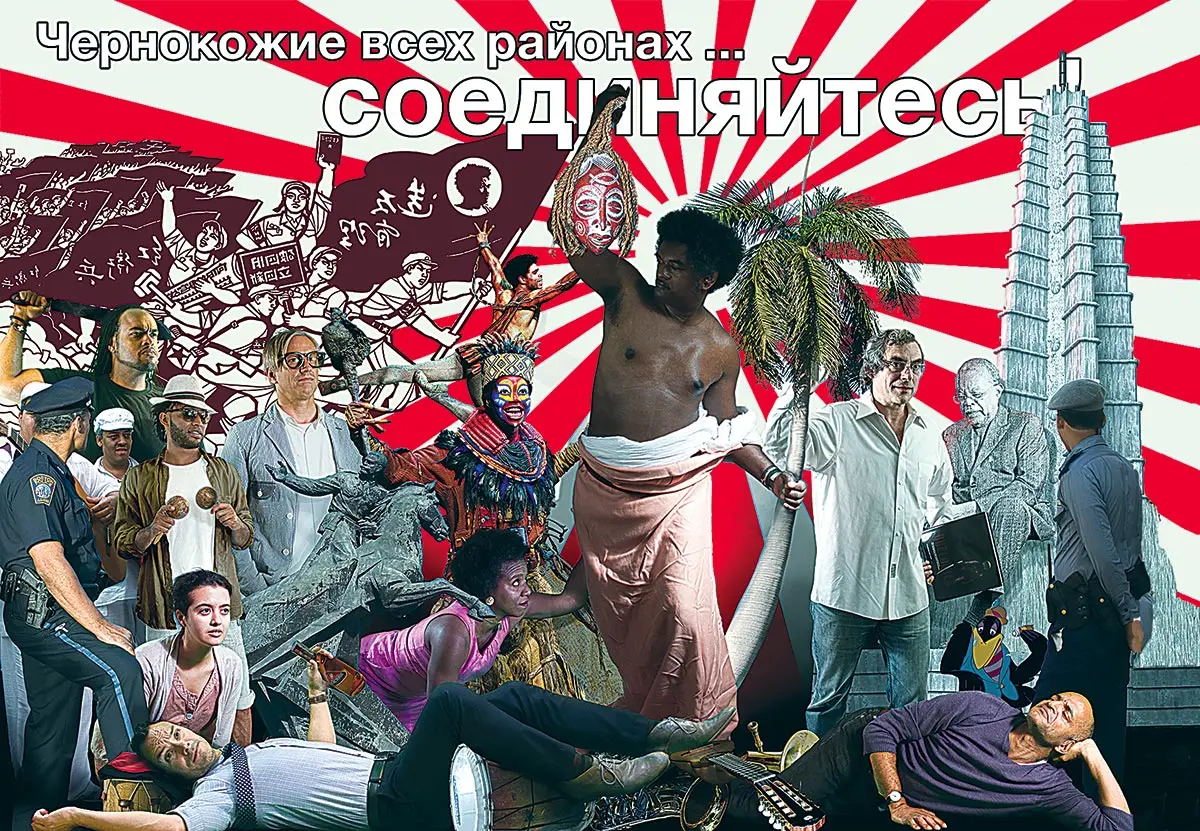
A case in point is the 2016 exhibition titled On Guard recently presented at the Hutchins Institute’s Rudestine Gallery in Harvard University, Cambridge. Curated by Alejandro de La Fuente, the exhibition represents the first time that Rodríguez shows his photographic work. It consists of large, pastiche-like, color photographs that incorporate symbols used in political posters and in advertising campaigns, in combination with lascivious and cunning humor and the corrosive imagery implicit in popular and everyday life. There is nothing missing in this dislocated and feverish cascade of images. There are all kinds of them, like a sort of permanent undercurrent. Viewers are presented with a parade of posters with Slavic-looking alphabet, Star Wars’ iconography, José Martí’s statue in Plaza de la Revolución [Revolution Square] in Havana, or references to bullfighting and to Goya’s painting. There is a cocktail, a hodgepodge, of graphic and pictorial quotes, environments, and socio-cultural situations, always with Rodríguez’s alter ego at the center of them: Macho Enterprise. As a group, they form a sort of afflicted rosary of those cultures that have influenced Rodríguez’s artistic sensibility. Among them, of course, Cuba and Spain, but also of the former Soviet Union and the United States.
A look at Elio Rodríguez’s entire artistic trajectory allows us to clearly discern one of the discursive strategies of legitimization most used by humorists: to underscore the serious nature of humor. A counterintuitive notion in itself, but that is what humor is all about after all. Somehow connected to it—in this case—is the notion of transcendence conveyed by art. It is the most compelling subjective manifestation employed by mankind to exercise and affirm his freedom. But, to counterpoint this vision, Rodríguez also recognizes the circumscribed and circumstantial nature of humor and, thus, its inescapable limitations. Somehow humor becomes enslaved by the references that it depends upon. Therefore, while humor has been at the core of Rodríguez’s discursive production, it has experienced several subtle changes throughout his career. Sometimes is more explicit, marked by a neo-figurative poetic that emphasizes the narrative element. On other occasions, he employs a more reflective type of humor through an abstract expressionist poetic that accentuates disaffection.
The 2016 exhibition On Guard could very well be placed in the former category. On the other hand, an exhibition like Puzzled, also presented this year at the Thomas Jaeckel Gallery, also in New York, can be squarely placed on the latter. Regardless, both approaches to humor, through parodic and satirical expressive resources, are the result of a poetic and discursive maturity that Elio Rodríguez has been articulating in his work for the last five years.
Like in the rest of Rodríguez’s oeuvre, On Guard and Puzzled convey a critically and socioculturally tinged discourse. Humor must subvert the order of all reigning things, whether it is in the realm of logic, aesthetics, morality, or politics. Humor challenges the established order, but it does not affirm anything and, therefore, leads to an essentially negative path. This leads us to think that there are two forms of exercising freedom: a sublimated approach paired with artistic expression, and a libertarian an iconoclastic approach associated with humor. And Elio Rodríguez relies on these two approaches to develop his current work. In this manner, laughter is guaranteed in his work, but as the result of subversive humor that questions the establishment and the strategies of domination.
DENNYS MATOS