
Felipe Herrera’s trajectory has traced a well-defined, original, and deeply poetic line in the visual arts of Venezuela. Over the course of his fifty-year career, Herrera has given shape to a language that identifies him, on which recurrent symbols converge with a refined technique. With the purpose of providing a retrospective—and greatly needed—review of Herrera’s career, the Ateneo de Caracas presented Inexorable, an exhibition featuring 18 works from different periods.
Herrera adopted sculpture as his avenue for expression early in his career, but since the late 1970s, he has opted for drawing as the path for his creative work. An avid reader, his production in this genre has been nourished ever since by fantastic literature and by poetry, in particular the writing of Jacques Prévert. The construction of a vocabulary of signs that would become recurrent, with traces of the Surrealists’ oneiric compositions and of M. C. Escher’s paradoxical works, began in those years. In the 1980s, Herrera began to stand out in the Venezuelan art scene after winning First prize at the 1st Fundarte Drawing Biennial in Caracas and the 9th Aragua Art Salon in Maracay. His work of this period, made “with filigree-like meticulousness,” shines for its masterful draftsmanship, an abundance of detail, rich depictions of textures, plays of light and shadow, interconnected spaces, and, at the thematic level, by the reiteration and enrichment of the vocabulary of symbols that, over time, would come to characterize his oeuvre as a whole. In that sense, Herrera’s contributions to Venezuelan drawing are unobjectionable, and today he is recognized as a defining artist in what is known as the country’s drawing boom of the 1980s and as a master of the genre at the continental level.
Later, Herrera’s expressive explorations drove him to work in assemblage, a medium where he was able to bring together his interest in highlighting and enhancing the complexity of space with the creation of visual metaphors. His backgrounds as a sculptor and as a draftsman complement each other in these works, where, in order to achieve the hyperrealism that makes the symbol effective, Herrera deploys the full extent of his technical virtuosity. Works like Trampajaula (Trapcage, 2007) display several of the formal elements that recur in Herrera’s assemblages: a quadrangular box or compartmentalized chessboard square whose structure comes from the image of the chessboard as a metaphor for life’s eternal confrontations: one of its quadrants contains a heart behind bars (passion), posed on a chair; another (reason) depicts three basic geometric shapes: cone, cube, and sphere; and another, a hand holding a flowering branch (life), with a manuscript poem in the background. Herrera often introduces elements external to the box, in this case, two hands that cross in order to pull it like a piece of luggage, or the baroque ornament attached to its lower section.
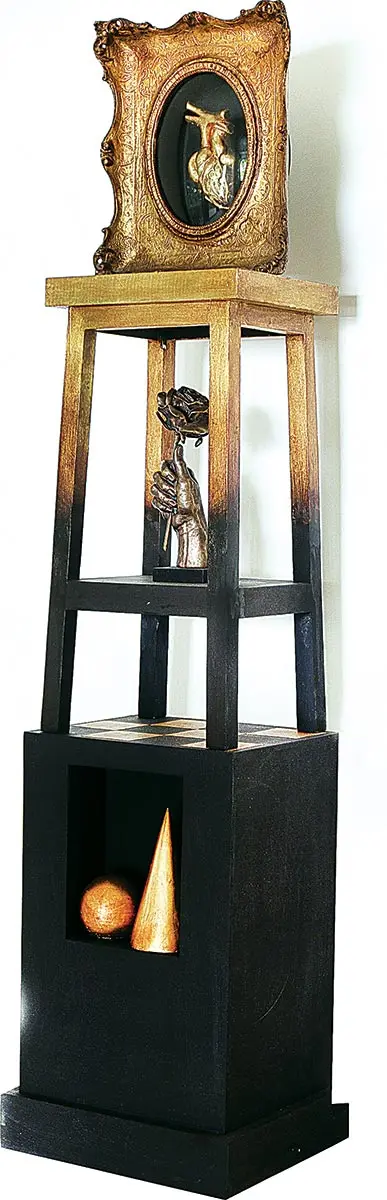
Other works are chairs, found objects that Herrera intervenes with drawings and modifies via the addition of other objects. This is the case of Ella I (She I, 2015), a beautiful work where a chalice holding a branch is placed on the chair’s seat, and where the human figure dissolves and is poetically and dramatically suggested by the hands and feet surrounding the chair. It is an image of absence. In Tótem I (2015), Herrera experiments with the verticality of the titular ancestral object, superimposing found objects that serve as a base, frame, or support for his symbolic sculptures. A gilded heart mounted in a baroque frame crowns it.
In works like Escaques (Chessboard Squares, 2016), the squares form an installation of niches to house these small sculptures. Horse, heart, hands and feet, playing cards, eye, chair, clock, geometric shapes, all converge as a succession of those “visual words” that give structure to the plastic poem that is each one of Felipe Herrera’s works.
Despite its limited extent, the Inexorable exhibition was a laudable attempt to fulfill one of the many debts that Venezuela’s official culture has with artists like Herrera, whose careers and mastery deserve long-range retrospective critical assessment. In this beautiful show we were able to visit portions of Herrera’s trajectory and to understand the coherence of his disciplined effort, which, following a solitary path, speaks to us of love, death, time, reveries, reason, and the eternal mystery that is Man’s fugitive existence in the world.
KATHERINE CHACÓN