
Despite its geographic importance, its connection to the nation’s sense of identity, and the political struggle it has embodied, the Panama Canal has not been a dominant theme in the history of Panamanian art. It is an issue worthy of analysis and a consequence of diverse historical circumstances, including the fact that the Canal was not transferred into Panamanian hands until January 1, 2000. The administration of the canal by Panama since then has been remarkably efficient and productive. This process, together with the celebration of the Canal’s centennial in 2014 and its expansion concluded two years later, have contributed to a renewed sense of patriotism, as well as to a greater interest—for both locals and foreigners--in the history of the canal, the country, and its people, which has found expression in diverse cultural fields.
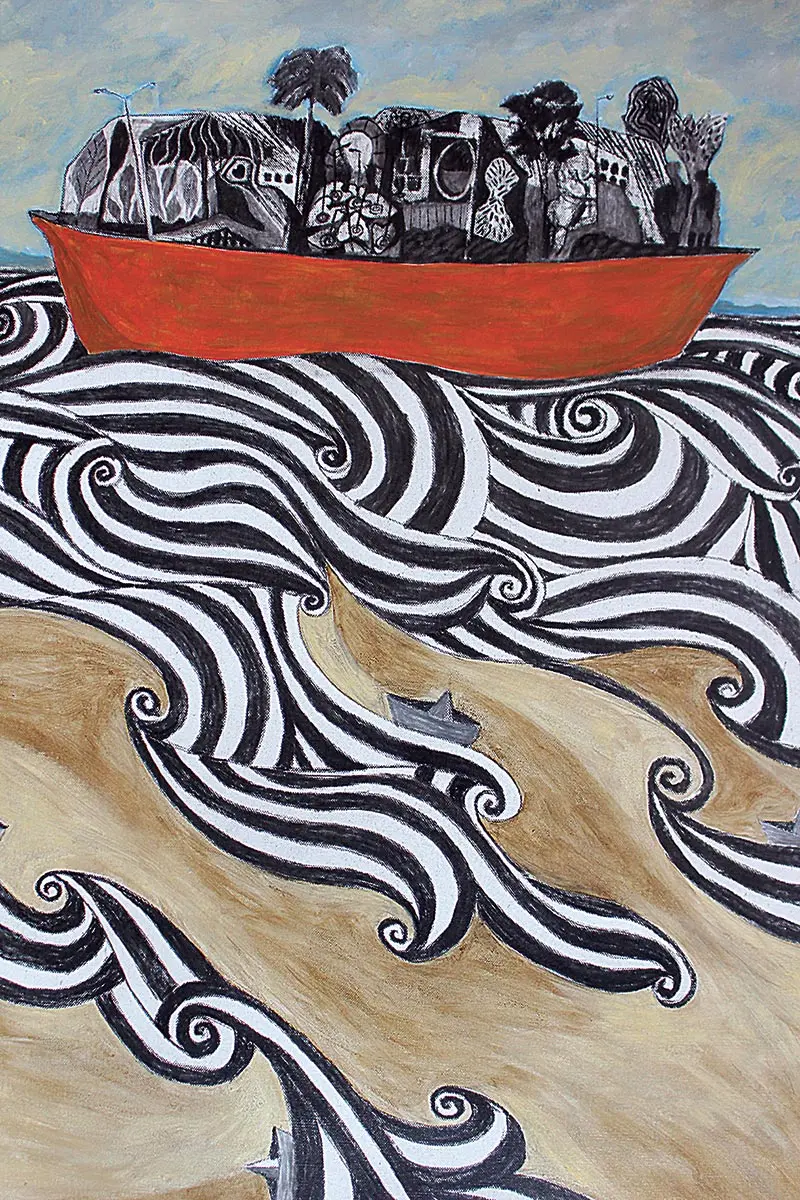
With his solo exhibition entitled Where the Other Sea May Take Us, Ecuadorian-Panamanian artist Fernando Toledo paid homage to the Panama Canal through a series of paintings on canvas, three-dimensional objects, and an installation. Nevertheless, it was not an exhibition of views of the locks, the engineering infrastructure, nor the tropical landscapes that are part of the waterway, as has been the case with some other artists. Rather, Toledo focused on the history of the canal and the city, its character as a place of transit and witness of so many human voyages, with semantic interpretations that range from cruises to lifetime journeys.
The artist has said that his interest in painting a series about the Panama Canal arose after he was invited to take part in the remarkable exhibition República canalera (Canal Republic) curated by Mirie De la Guardia at the Allegro Gallery in 2014. Among the variety of works by the artists challenged to consider the topic, Toledo showed a dramatic installation entitled Remembering a Legacy, which comprised a cayuco (as native canoes are called) filled with basalt rocks extracted from the area of the canal expansion. Words written in white on each rock revealed the name of significant individuals or places linked to the canal, the history of which the artist had researched in-depth as part of this project.
In his subsequent works, Toledo has reconsidered the subject, albeit with an approach that is less strictly historic, and with the more poetic and playful tone he revealed in his Where the Other Sea May Take Us exhibition of 2016. For example, he showed a new installation titled Crossing that included a triptych of paintings on canvas, each displaying a ship on turbulent waters, which the artist depicted with striped waves, scrolls, and spirals in dramatic, contrasting black and white. One perceived a sense of artistic mischief in the graphic and symbolic nature of the water’s swell, as well as in the painted paper boats that accompany the ships, like toy tugboats. On the sidewalls, the artist placed real paper boats that he had made with copies of bonds from the French company which failed to build the canal in the 19th century. Those historically interesting, but economically useless, bonds are also to be found in the stunning three-dimensional objects that were part of the exhibition. Little boats made with real bonds “float” on small patches of the ocean inside transparent acrylic boxes, in which the antique documents’ subtle color and material contrast with the water’s vicious appearance.
In contrast with those tiny paper boats, most of the canvases display the dominant shape of large single ships with monochromatic hulls, that loom overseas depicted with dynamic strokes and colors. Rather than real depictions of the ocean, these large areas of repetitive spirals, expressionist brushstrokes, and dripped paint resemble technical experiments or artistic divertimenti. The boats are filled to capacity with human, natural, architectural, and emblematic forms depicted in the kind of charcoal drawing that Toledo handles so well.
It was particularly interesting that these works were presented in combination with paintings from an earlier stage, revealing contrasts in the artist’s aesthetic and conceptual development. Among the earlier works, from 2010, there were paintings in which the ocean can be seen only as a dark horizon or a place far beyond the dominant cityscapes. At the time, Toledo painted overloaded cities where a great number of buildings restrict the natural environment, which the artist reduced to representations as gray as the omnipresent concrete in Panama City’s recent disproportionate urban development.
Those same crammed buildings, trees, and people fill all the space available on the ships in the canal paintings, but now with a different purpose, for they serve as metaphors for Panama as a place of transit and the multiple immigrations that have characterized its history. Each one of those ships could represent human beings who travel, loaded with their physical and psychological baggage; or maybe modern Noah’s arcs that offer people an escape. They could even stand for large urban conglomerations, which are approached by other waves of individuals, symbolized by the small paper boats that Toledo inserts in those tempestuous seas.
MÓNICA E. KUPFER