
Fernando Uhia belongs to a generation of Colombian artists influenced early on in their careers by the emergence of deconstructivism, appropriationism, simulation, and the analysis of the art system. Like his contemporaries, artists like Jaime Ávila, Fernando Arias, Santiago Echeverry, and Wilson Díaz, Uhia belongs to the era of the post-that and post-the other, of the end of one thing and the beginning of another. This is the reason why his canvases are populated by the art critics of the 1990s whom Uhia also quotes in works like Sin Título (Untitled, 1990-1991), and why he creates copies of works by Fernando Botero, like in Clon Clown (1997), and invents a French photographer named Jean Jeaffreneau (1992), as French as Lyotard or Baudrillard, for a local store—an art gallery—in the Zona Rosa neighborhood in Bogota. This is also the reason why, in his series “Technoesmaltes” (2002), he offers disguised political reflections in paintings rendered on the doors of public housing homes. Since the beginning of his career, Uhia has been able to cleverly identify the nature of his practice, his provincialism, limitations, and pretentions.
He has used painting as a form of resistance against commercialization, exploitation and the generalized objectification of art and artists. In this sense, his work compellingly illustrates the Americanization of Colombian culture, the adoption of products, values, trends and ways of life that have permeated our lives without even noticing. They are the symptoms of a local culture attempting to emulate that which it is not. Uhía successfully conveys this through history art lessons, appropriations of works by Frank Stella, Morris Louis and John McCracken, in which he demonstrates that contemporary art is not so contemporary after all.
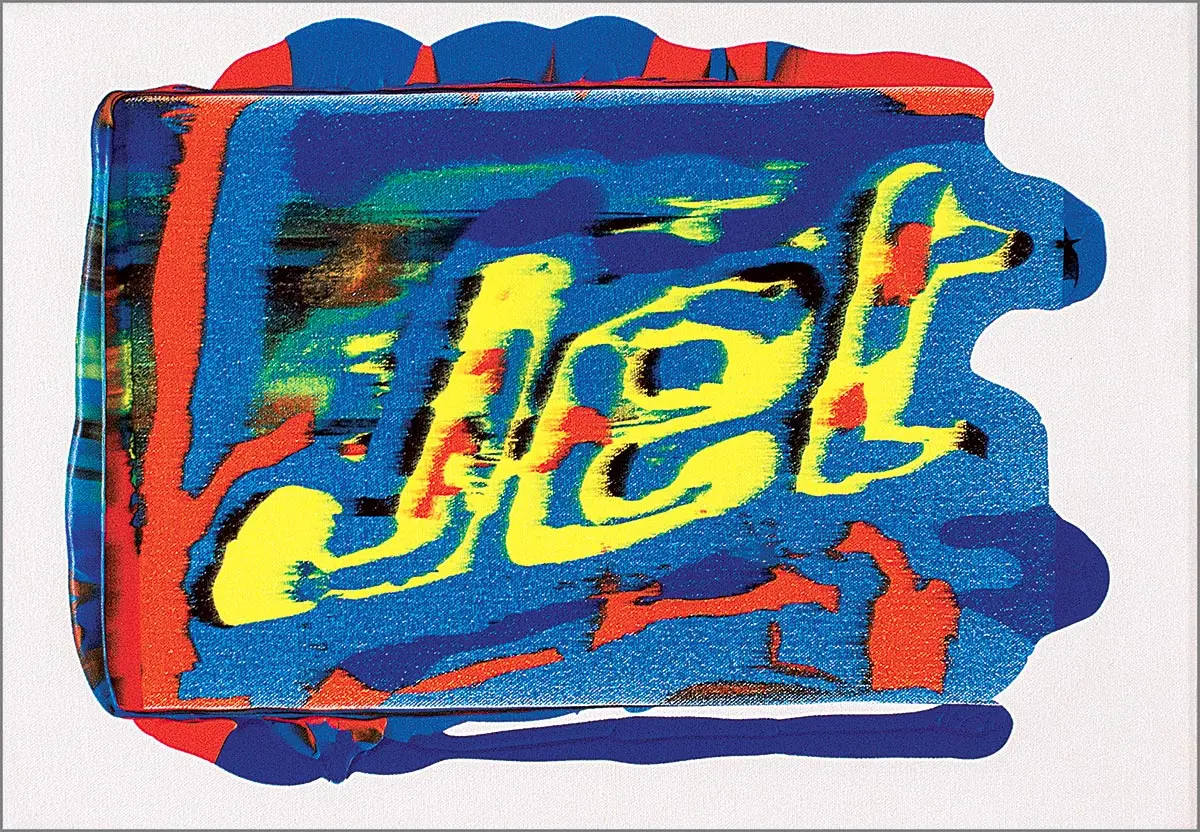
Titled “Multinational Impressionism,” Uhia’s most recent exhibition is once again proof of that. Unlike the large paintings that have characterized his work since the beginning of his trajectory—he has exhibited his work regularly since the age or 21—the exhibition consists of a series of small, uniform, works in which he has printed or painted, or both—ambivalence that makes the exhibition fascinating—more than one hundred images of logos belonging to brands active in Colombia today. The strident colors, the irregular, pasty, inexact and emotionally compelling textures of these small canvases, produce an immediate affective response. We automatically identify with those dignified logos and brands because—if we chose to see it that way—they are art presented in an art space. In stark contrast to the excessive grandiloquence of his previous exhibition titled “Cromaberraciones Full HD” (2014), there is in these new series a certain modesty in the way he approaches the subject matter, the treatment of the images and format that made this current exhibition even more effective and memorable, particularly as result of the application of paint—which looks as if it had been engraved.
In this exhibition, Uhia surprises us for the technical leap and formal departure shown in proposals that are nonetheless framed by the reduced conceptual space that he chose early on in his career and to which he has been loyal to ever since: tempered canvas. Since Uhia is secretive about the technical process involved in the execution of these works and only describes it as “scraping,” we can only wonder about the bombastic title “Multinational Impressionism.” Why use the word “impressionism” in an exhibition that appears more closely associated with Abstract Expressionism and Pop? According to Uhia, “Every time I travel to a city in the Old Continent I find an exhibition centered on Impressionism. There is always one over there… It is a very particular vanguard: vehemently rejected when it emerged, but one that has gradually become—along with other currents of expressionism—the art form and/or painting style preferred by the masses. It is like a vanguard whose virulence and originality has been removed to make it globally appealing through the continuous exhibitions everywhere of original works, or through reproductions in t-shirts or posters adorning the walls of homes around the world.”
This idea of a global corporative aesthetic has been in Uhia’s mind since 1995, when he painted the logos of international companies on Van Gogh’s Wheatfield with Crows. For Uhia, “Multinational Impressionism” has ultimately to do with a sanitized abstract expressionism, “forced to fit in a shrunk and uncomfortable format,” a format that, according to Uhia, is applicable to most impressionist paintings. Local features—the logos of national brands like Atlético Bucaramanga, Néctar, Pintuco, Colombiana, and Jet—offer the happy vision of underdevelopment that Uhia shows in his work from time to time. As also demonstrated in his outstanding 2012 exhibition titled “Soccer, Tennis, Cars, and Other Manly Things,” in this exhibition we celebrate that Fernando Uhia continues to successfully, generously and stubbornly paint like a painter that is busy exploring and learning from a trade that, although so devalued today, continues to be the artist’s modest kitchen.
SANTIAGO RUEDA