
Entering Another Way of Seeing, an exhibition of the work of Francisco Matto, was like entering a peaceful refuge, and it produced the distinct sensation of being in an art show. This may sound traditional, but isn’t: the proposals presented might not be novel, yet they are unsettling, even today. This writer is attentive to the new and can distinguish between art that is sustainable over time and art that is merely contrived. To leave the current moment and access Francisco Matto’s exhibition is to cross a tunnel that sieves and hems our urges in. That the period (Francisco Matto, Uruguay, 1911-1995) was marked by problems, changes, and disorders that the present has largely overcome cannot be doubted. How did these artists construe their world?
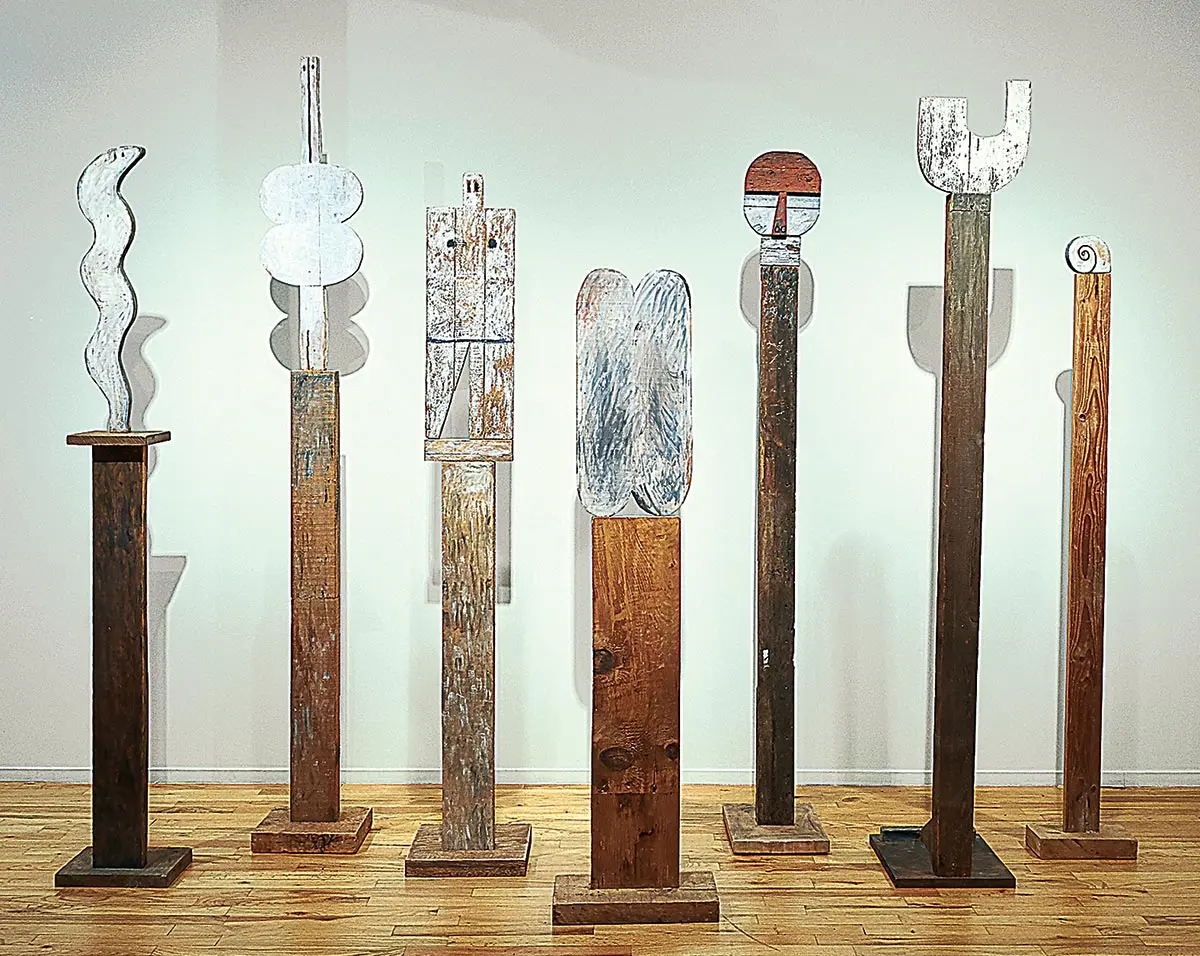
Painter and sculptor Francisco Matto was always interested in primitive forms. He had great respect and admiration for pre-Columbian artistic expressions. Such artistic expressions did not develop in the territories of today’s Uruguay or Argentina, but in Mexico, Peru, Colombia, and Central America. Having established this Uruguayan artist’s concerns, let’s also note that he painted, to a degree, under the influence of Surrealism. Matto met Joaquín Torres-García in 1939 and became a regular at his conferences. He was a founding member of the Torres-García Workshop and remained in charge after the great master died. Matto’s understanding of the relationship between primitivism and modernity was based on Torres-García’s vision, as well as on his own emotions and ideas. The variety of activities undertaken at the Workshop brought about changes in his own work. He moved away from Surrealism and incorporated orthogonality into his two- and three-dimensional compositions. In concordance with primitivism, he used salvaged, humble materials such as wood and cardboard. But the simplicity of his supports did not inhibit the results, as can be seen in this exhibition with admirable clarity.
Four examples of the latter would all by themselves suffice for an exhibition: White Form (1970); Construcción en blanco y celeste (Construction in White and Sky Blue, 1975); the installation Tótems, comprised of works from different dates; and Serpiente (Snake, 1960, the same year Matto began work in his Tótems.) The last two titles belong to wood sculptures, painted in oil. These sculptures are characterized by their totemic aspect; they are thin and part of their support is in view. Their shapes are simple, semi-figurative, and they might even be merely organic forms not directly representing anything. The application of oil paints is as careful as it is free.
There are some sgraffito applications on the thin sculptures themselves. Their total height ranges from 1.83 to 2.36 meters. They are set on wooden pedestals that in turn feature integrating pictorial touches on both sides. While also oil-on-wood works, Construcción en blanco y celeste and White Forms present certain differences, being as they are paintings of a mysterious sacredness comprised of orthogonal elements and light reliefs. These are constructive paintings that almost silently reveal stories upon stories—those from before Matto’s intervention and those the artist contributed to the work.
Matto’s handling of matter varied. Both in the reliefs and in the paintings, the presence of the material is unostentatious. His paintings on canvas and on cardboard also evince the artist’s hand: Matto’s brushstroke is legible and doesn’t seek to cover the entire support. For readers who haven’t seen the exhibition, we can describe Matto’s use of oil paint as an economy that simplifies the medium. Under no concept does Matto intend to deafen the viewer; on the contrary, in general, his works communicate peacefulness and a harmonious visual depth. Such is the case of Constructivo rosa con caracol (Pink Constructive With Snail), from 1967. The exhibition also features works unlike those cited above, more Torres-García-like, highly compartmentalized in orthogonal patterns and with elements in each section. Among them, Paloma (Dove) stands out for the division of each motif in red and blue. Francisco Matto made many drawings. In them, he laid out projects, as in Drawing for Monument, from 1967. Another Way of Seeing includes works in pencil, crayon, and ink, pencil, and watercolor on paper.
The works included in the exhibition ranged from the highly saturated to the sparest. At times they evoked the mildest purring of the waves where Matto used to find his pieces of wood. Over the years, Francisco Matto acquired a significant collection of primitive art he called Amerindia, which he made accessible to the general public in Uruguay. Without the wide circulation reached by Joaquín Torres-García’s writings (teachings and lectures), Matto contributed solid ideas that remain unpublished or are little known, on topics around his revered primitivism in connection with modern and contemporary art. Let’s close by quoting his words: “If we are successful in creating elemental forms, we will achieve the understanding of the mystery.”
GRACIELA KARTOFEL