
The Marcia Barrozo do Amaral Galeria in Rio de Janeiro presented Outra Naturaleza (Another Nature), a book-object about the art of Frans Krajcberg launched by SP-Arte from April 7 through April 10, 2016. The limited edition of 72 copies can be viewed and purchased at the aforementioned gallery.
Edited by Leonel Katz, the piece contains an original photograph of Krajcberg with his signature etched with fire, a staple of the artist. It consists of 12 image series of 6 prints each. The 72 images were printed in Fine Art (giclée) on photographic cotton paper. Each photograph is framed in a hand-made album made of bamboo.
The album also contains texts by Leonel Katz and João Meirelles, as well as sixteen photographs of Krajcberg taken during the 1980s by Walter Carvalho. Belonging to a series of only 6 prints, each image was printed in Fine Art on 300 gram Velvet paper. The publication was executed by Lucia Bertazzo of UQ! Editions, in collaboration with the Marcia Barrozo do Amaral Galeria.
The projects date back to an experiment that editor Leonel Katz and his partner, Salvador Monteiro, carried out with Krajcberg in 1975 when they worked with the artist to produce 60 copies of a book-sculpture that featured a different sculpture in each copy. Forty years later, Leonel Katz and Krajcberg collaborate again in this ambitious project.
The 1975 book-sculpture was very important for both Katz and Krajcberg. That same year, poet Carlos Drummond de Andrade wrote the following about that work: “[Krajcberg] incorporates a new category into what used to be art in a natural state, and vegetation gains the magic of abstraction.” Leonel Katz comments on that quote by Drummond: “The magic of abstraction occurs when the objects that surround us shine under the unconventional gaze.” Thinking outside the box is what enables true artists to truly perceive, from among the myriad forms in the vegetation, that something else to which they will confer new meaning. This is what the images convey: an explorer of worlds, Krajcberg resolves to use nature’s creations to render the environments of his imaginary.
Krajcberg has been a singular artist ever since the time he won the São Paulo Biennial and the Venice Biennale’s City of Venice Prize. He became an advocate of the environment even before we came to the full—and anguishing—realization of the devastating impact of mankind on nature.
Born in 1921, in Kozienice (Poland), the sculptor, painter, photographer, and engraver lost his entire family during World War II (1939-1945). At the end of the war, he attended the State Academy of Fine Arts in Stuttgart, Germany.
On his arrival to Brazil in 1948, Krajcberg initially settled in São Paulo, where, in 1951, he worked as an exhibition fitter in the First São Paulo Biennial. As an artist, he participated in the 2nd, 3rd, 4th, 6th, 7th, 8th, 14th, and 20th editions of the event. He lived in Paraná and then in Rio de Janeiro. His experiences in Brazil connected him to nature. In 1957, he became a Brazilian citizen. Krajcberg regards himself as a citizen of the world: “I was born in the world and I have the right to live in it,” said the artist who, after living in several cities of Europe and Brazil, chose Nova Viçosa, in Bahía, as his place of residence.
When he arrived in Brazil at the age of 27, after having suffered the terrible experience of WWII, he was alone and avoided any contact with other human beings. In Brazil, he rediscovered life, freedom, and nature. Nature is the raw material of its poetic.
Krajcberg lives in a house built on a tree, seven meters high from the ground. For a while, during the 1960s, he lived a reclusive life in the mountains of Minas Gerais inside a cavern on top of Cata Branca, a region with heavy mining activity. There he earned the nickname Bearded man of the Stones.
In that house simplicity is a metaphor for his life. The furniture consists of barely a few chairs, a narrow bed, a few items of cloth, and five suitcases. The only luxury is a collection of shells, rocks, dry branches, and seeds, most of which were collected in Sitio Natura, where he arrived in 1972 at the invitation of a friend, architect Zanine Caldas, who helped him conceive the house tree: “He dreamt of transforming Nova Viçosa into a cultural capital.” Zanine Caldas’s utopia brought together people like Chico Buarque, Oscar Niemeyer, and Dorival Caymmi. Only Krajcberg remains there.
For Krajcberg the search for harmony in the interaction with nature is a metaphor for life, for resistance. After suffering the bitterness of war and witnessing the death of family and friends—he found nature, life, and freedom in Brazil. As a young man in Hungary, he approached what he thought to be a pile of garbage in a concentration camp, only to discover with horror that it was actually a stack of corpses. But nature healed the wounds that the war inflicted in his soul.
Fighting on the side of life, his works rely on tree logs and branches from fires, with the goal of bringing awareness to mankind about environmental devastation. More than an artist, he is an environmental activist.
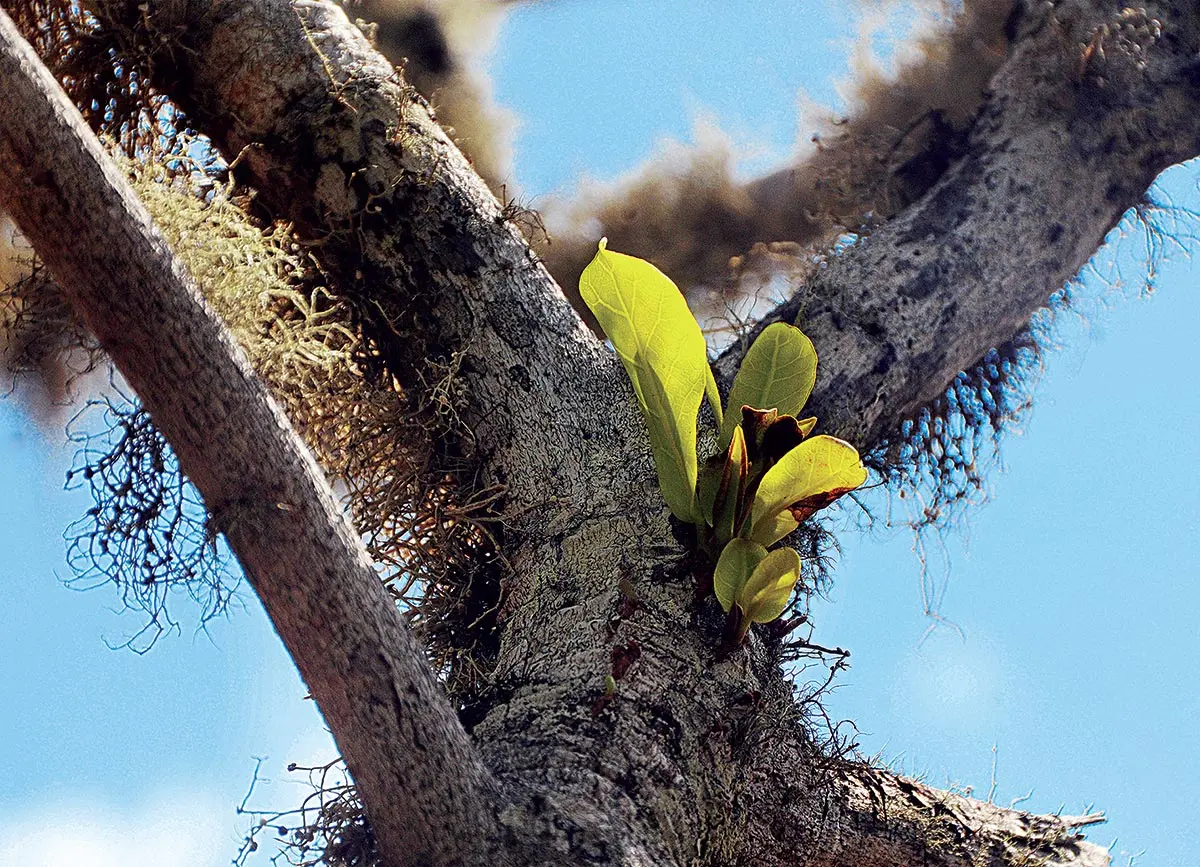
The images photographed by Krajcberg for this book focus on flowers, true poetry of nature. These images reveal a tireless artist who at 95 years of age continues his pursuit of color, aesthetics, harmony, and promising life.
HÉLCIO MAGALHÃES