
Gabriel Rosas-Alemán (Mexico City, 1983) focuses on language, its boundaries, and aesthetic power. He disassociates the signifier from the significant as he explores all of the language’s visual dimensions while divesting it from the pre-established content we have assigned it.
Rosas-Alemán does this by combining performance, video, dance, text, and, as of recent, painting and sculpture. His solo exhibitions include: Le Grazie at ARTmax and the Braunschweig University of Art (HBK), Germany (2013); Mexican Beauty at Proyectos Monclova in Mexico City (2014); Untrained Voices at Travesía Cuatro, in Guadalajara, Mexico (2015). He has also participated in some group exhibitions, including Business As Usual at Turf Projects, in London (2015); Celemania at Frac des Pays de la Loire in Carquefou, France (2014); Dancing Circles at No Space in Mexico City (2013); and Ich Ich Ich, at raum LABOR in Braunschweig, Germany (2012).
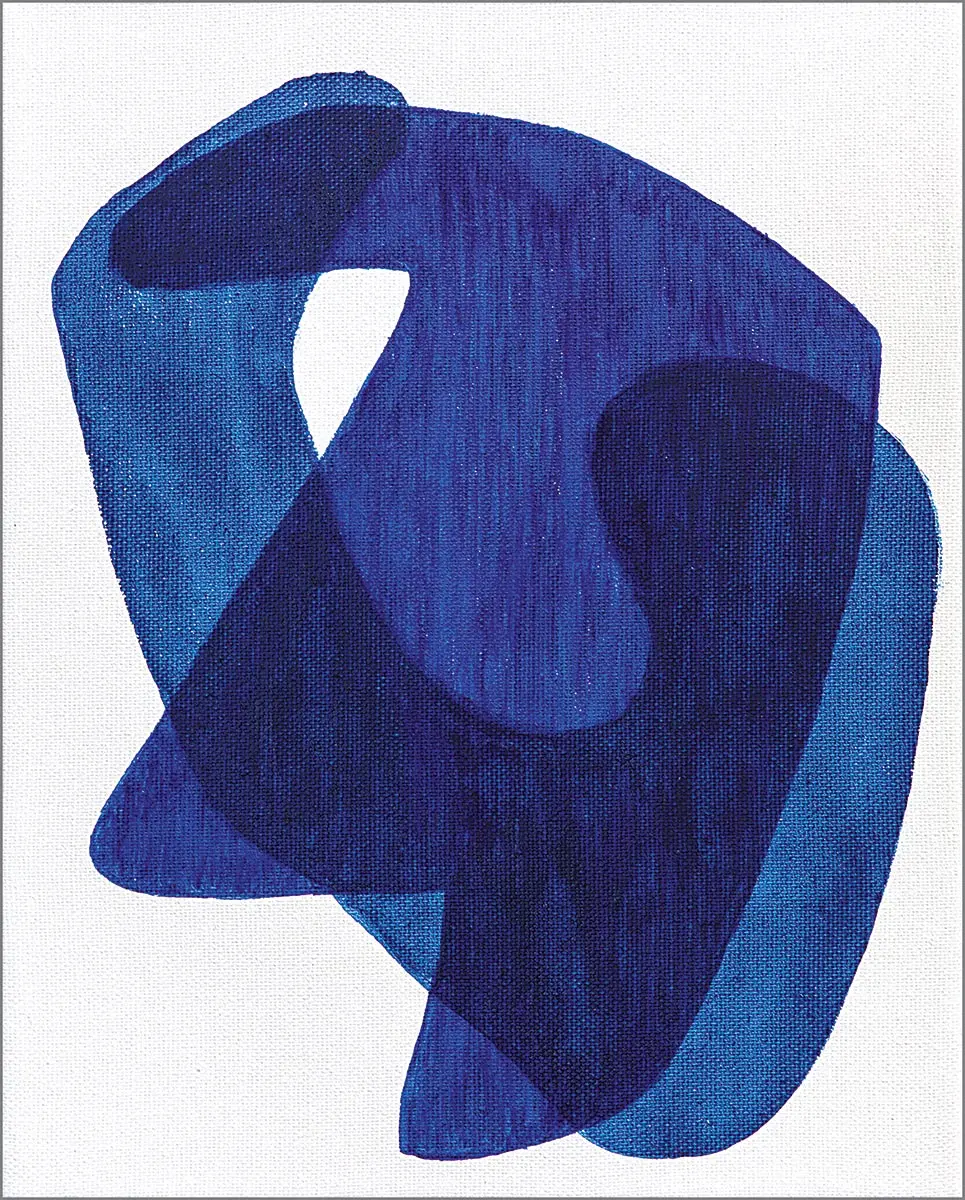
In the exhibition Novel at the Galería Travesía in Madrid, Rosas-Alemán explores the potentiality of language and proposes breaking it apart, ridding it of its immediate and inherited symbolic content, to incorporate other codes, forms, and interpretations.
For this purpose, he constructs an alphabet that enables him to play with other language processes and transform language into physical matter. He explores concepts like referentiality, representation, denotation, connotation, enunciation, and construction that result from such a process. When does language stop being referential and begin being representational? How do the conditions for connotations come into being? Who does the speaking: the object or the observer?
Novela is articulated from ceramic pieces that gradually form a text, a physical weave that avoids recognizable symbols. The different chapters (from the first one to the fourth) are juxtaposed against the inertia of the images. In fact, the very “display” of the exhibition supports that intention to eliminate any construction with conventional writing. The ceramic enameled pieces—all of them in soft white and ochre colors—are gradually assembled with the contingency of a language that could be constructed in more than that way. As Roland Barthes wrote in The Pleasure of the Text: “[…] there will always be a margin of indecision; the distinction will not be the source of absolute classifications, the paradigm will falter, the meaning will be precarious, revocable, reversible, the discourse incomplete.”
Besides that three-dimensional format, the exhibition also includes a series of watercolors that explore the concept of the “indefinite article,” namely, of those particles that accompany words with lexical content that, nonetheless, are often presented as mere links. There, the indefinite article is materialized through evocative and abstract forms. Perhaps the deep blue is conducive to the synesthesia that operates throughout language: the power of the significant, in its most physical and material form, transports us to other meanings, even if these are of an opposing nature. In this sense, the work Artículo Indefinido. Algunos (Indefinite Article. Some) operates with the same strategy, but this time within the indefinite, unquantifiable, category. In this instance, there are two—perhaps because of its “plural” nature—bright red forms. The various layers of color allude to the nuances of language that are distinguishable from each other precisely because of connotations. Something similar occurs with Una (One), where two blue forms—one lighter and the other darker—are superimposed. Here, the nuance of the singular feminine perhaps emerges through the opposites in a binary structure. In other words: “It is feminine because it is not masculine.”
In the series Palabras Frágiles (Fragile Words) and Palabras Torpes (Clumsy Words) the pieces are arranged on the floor, probably to allude to the fragile condition conveyed in the titles. Here the whites, ochres, and blues are combined to operate as signs overtly and subjectively perceived.
The most singular piece—because of its dimensions—is Leontyne Price Singing “Hostias” from Messa di Requiem by Giuseppe Verdi. In this installation consisting of a copper mass on a museum bench, Rosas-Alemán returns to synesthesia: material objects that evoke a sound. In this manner, two-dimensionality is replaced by a three-dimensional language.
Challenging the asepsis inherent to any white cube, Rosas-Alemán presented a performance at the gallery space that involved several persons reading at the same time the following text: “I want to invent a word that enunciates all […] A word that transforms in the space […] An independent word […]. How much do words weigh? What are the objects that I produce good for? Transportable sculptural objects. And think of one word that contains all words […].” Each performer placed the pieces on their respective shelves, making the final appearance of the exhibition the result of a collectively read the text. A polymorphous and polysemic novel.
ANA FOLGUERA