
The twentieth century was, to a great extent, the age of the rise and fall of utopias and of their seemingly antithetic cult heroes. Today, an ongoing revision of these figures created by the different totalitarian movements reaches beyond the mere iconoclastic gesture. Far from the avid eagerness with which other iconoclasts from other eras destroyed images, contemporary art approaches emblematic symbols and figures from that past with blunt and humorous skepticism; with a sort of pure distrust, not only towards all the promised paradises on Earth made during that time, but also towards any epic vision of history. On the other hand, systematic skepticism directed at old promises made to people about grandiose destinies and the miserable ways to achieve them has these key characteristics: heroes and idols of any powerful faction are alike, and lucidity is a ludic power deconstruction practice that extends to art. After the big narratives in history were debunked, just as Arthur C. Danto predicted, what appears to sustain us, that which we are actually left with, is the space inhabited by the small stories, the realms in life in which we relate with others, and the certainty of such bonds. From this perspective, I see a revealing relationship between the two solo exhibitions by Cuban artists presented—independently from each other, but in contiguous exhibition areas—at the Mindy Solomon Gallery in Miami. One is the exhibition by Geandy Pavón (1974) titled Political Fold, and the other, by José Manuel Mesías (1990), titled About the Absolute Truth.
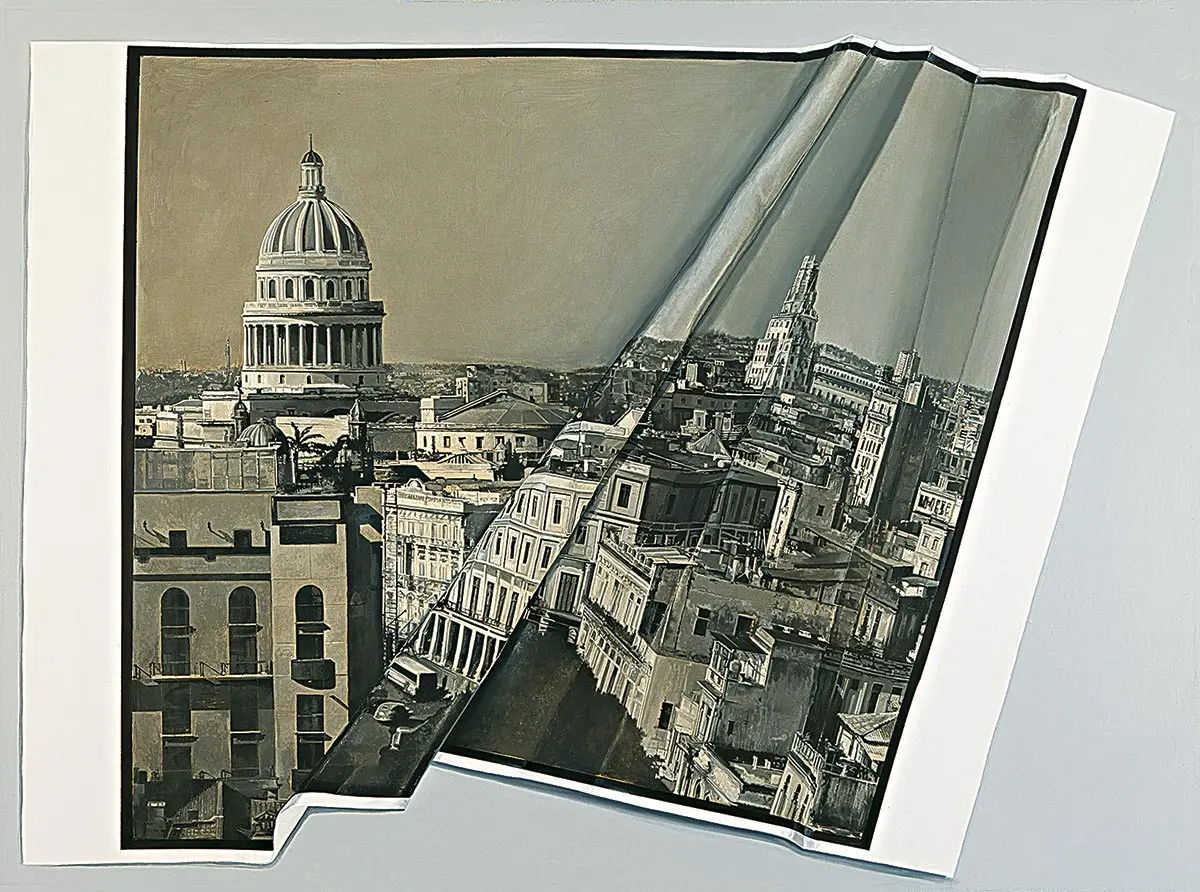
The work by Geandy Pavón is characterized by diverse forms of deconstructing the narratives of power and by an ingenious rebelliousness that approaches ludic practices playfully—which saves him from the dangers of grandiloquence. This approach exposes the extent to which such narratives were shared by all sociopolitical systems. Thus, observed from a distance, Marx, and Batman may appear to belong to the same platform or be both included in his metaphor of crumpled papers. While in earlier photographic series Pavón created scenes that depicted screen heroes picking up the garbage of history left on New York streets, in this exhibition he goes back to painting to perform a double operation: on the one hand, he appropriates the epic history of nineteenth-century art and its great emblems and, on the other, he masterfully reproduces on the surfaces of wrinkled or folded papers paintings like Washington Crossing the Delaware (1885) by Emanuel Leutze (part of the collection of the Metropolitan Museum of Art), or like La Liberté Guidant le Peuple (Liberty Leading the People, 1830) by Eugène Delacroix. In this manner, Pavón not only devours the great narrative of the history of art, but also the stories from the American and European continents that promised greatness to all their children. But in his wrinkled papers—and at the bottom of empty boxes—there are also the empty expressions, divested of the aura of promised futures, of the faces of those heroes whose papers and stories were the bases for communist revolutions. It should be noted that Pavón had previously projected onto buildings in the Big Apple—a city accustomed to the neon lights of advertisements—the faces of two individuals persecuted by totalitarian regimes: artist Ai Weiwei, incarcerated for confronting the Chinese government; and Cuban political activist Orlando Zapata-Tamayo, which was turned into a tribute in the piece Nemesis, screened on the facade of the Cuban Interest Section in Washington.
“The tragedy—affirms Pavón—is in the tribe, in our notion of nation.” According to Susan Sontag, the tribal mentality makes us accept horrific acts when they are perpetrated by our own tribe. And this is ultimately what Geandy Pavón examines in his works. The fictions that he creates with wrinkled papers and three-dimensional illusions on the planes of the paintings that he appropriates expand to the very notion of history and its traps. Doubt takes hold and fulfills its healthy function.
On the other hand, the rarified environments of José Manuel Mesías’s paintings in the exhibition appropriately titled About the Absolute Truth offer the experience of something that rings true. The works are characterized by unbelievable tones, like the intense rose that unifies water, earth, and sky in My Father Can Walk on Water, My Sister and I Cannot (2010); by fantastic characters, such as the turtle and the kid dressed in white that form an alliance in an untitled oil; and by the use of strange materials, like the fragments of a blouse in Detail of My Mother’s Chest that belonged to the artist’s mother. These proposals compellingly communicate a form of intimate truth without an apparent formal unity, not even in the languages used. While some works may be closer to an expressionistic style, others, like the portraits, use a more realistic approach against empty backgrounds. But these works by Mesías are nonetheless unified by a very moving underlying affective quality expressed through a personal poetic expressed in a variety of ways.
One of the strongest works in the exhibition by Mesías is My Mother (2008). It depicts the artist and his mother resting on a sofa. The canvas was actually burned (there is a hole in it as result) to evoke the sofa that his mother set ablaze with a cigarette. She has depicted seating while he is lying down with his head covered resting on her lap. The tenderness of their closeness, their vulnerability—and the uncertainty that it conveys—are some of the converging feelings captured in this work. In addition to the formal effectiveness of the sofa’s perspective, the powerful effect of the burned canvas, and the white background that outlines the scene, there is also the image’s compelling ability to contain the internal life of a scene.
ADRIANA HERRERA