
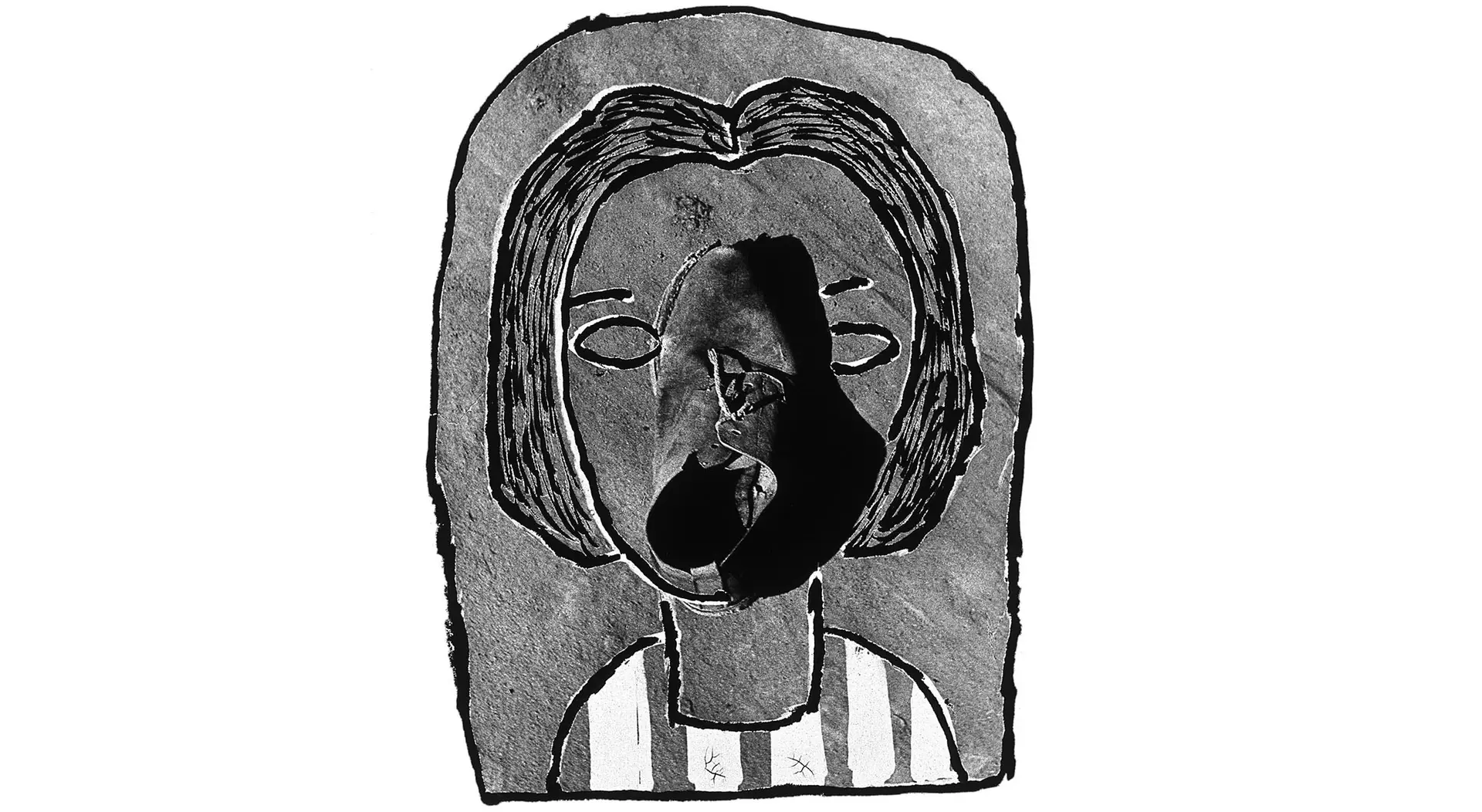
Geraldo de Barros’s Menina do Sapato (1949) was published in the catalog of the exhibition of the first Latin American Colloquium of Photography: Hecho en Latinoamérica (Mexico, 1978). When I first saw it I was twenty-six and I mistakenly assumed the author was another enthusiastic young man experimenting with the photographic medium. In the said catalog, there is no date for the work, so I got the impression that it was a recent work. What I liked about Menina do Sapato was the cleverness with which the opening of the shoe doubled as a gaping mouth on the cartoon-like face of a little girl vaguely resembling Little Lulu (the latter was available in Portuguese in 1949).
Although Geraldo could have staged the old shoe for constructing the image, more than likely it was an object he found half-buried in the sand. The shoe part of the image agreed with the way I had learned to engage the medium of photography; namely by looking, finding, and capturing. So it was easy to imagine myself finding an old shoe at the beach and photographing it. However, de Geraldo’s work taught me that I could also draw on found images by scratching their negatives and painting over them.1
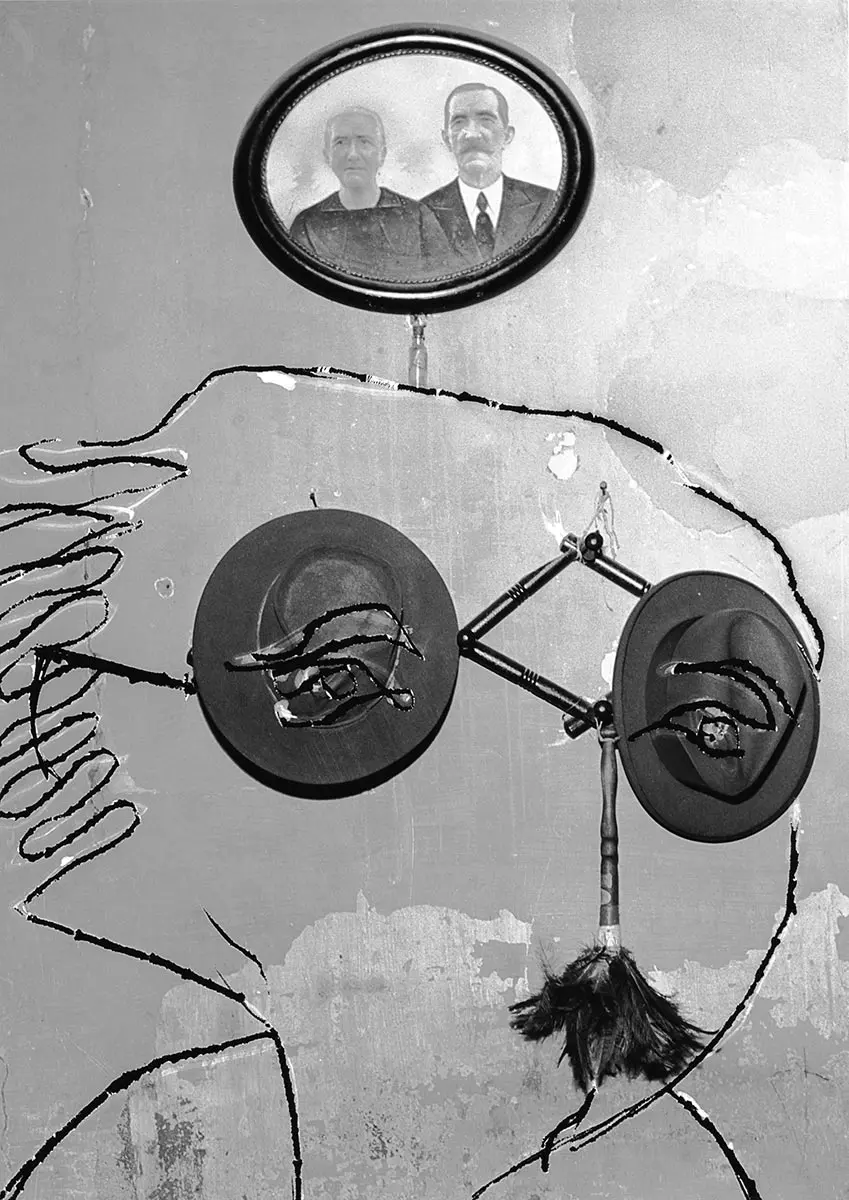
In time, I also came to see a social commentary and political dimension in Menina do Sapato. There is something very destitute about a single old discarded shoe acting as the girl’s open mouth. It is as if the abandonment and poverty of the shoe nuanced the drawing of the girl so that she was no longer the middle-class Lulú. Her straight hair—roughly drawn on the negative with a sharp tool— made her look like one of those pauperized indigenous girls that roam the streets of Lima, Mexico City, São Paulo, etc., clinging to their mother’s skirts and extending their small hands to the passersby pleading, “Señor, una ayuda por favor.” That open mouth that in Edvard Munch’s Scream (1893) expressed a sort of existential howl of despair, in Menina is something as basic and passive as hunger, or as critical and active as asking “why?” The hollow of the shoe is so very dark, deep, and deafening.
In 1992 I started writing the essay “Crossover Dreams” for the book that Fotofest later published Image and Memory: Photography from Latin America 1866-1994 (University of Texas Press: Austin, 1998). It was then that I took another look at Menina do Sapato. I wanted the image to accompany my text, but how would I find it? Still thinking that Geraldo de Barros was a young man I wrote to him. To my surprise, a month later I got a letter from his daughter Fabiana de Barros in which she thanked me for the interest in her father’s work and cordially agreed to send me the picture for use in my essay. It was only when I received the print that I found out that Menina do Sapato was made in 1949!
Although I did not know it then, the reason Geraldo had not answered my letter himself is that he had suffered a couple of traumatic ischaemias that had impaired his speech and motor skills. Fabiana, who is also an amazing artist in her own right, had taken it upon herself to have her father’s photographic oeuvre receive the recognition it deserved. She was instrumental in arranging the exhibit Geraldo de Barros, Peintre et Photographe, a major retrospective at the Musée de l’Elysée in Lausanne, Switzerland in 1993. In 1994, she helped organize another exhibit at the Museu da Imagem e do Som de São Paulo: Geraldo de Barros, Fotógrafo. It was thanks to this last exhibit that I came upon the only book about him at the time: Fotoformas, Geraldo de Barros (Raízes: São Paulo, 1994). Both shows were based on the seminal 1950 Fotoformas exhibit at the Museu de Arte de São Paulo her father himself had curated when he was only twenty-seven years old.
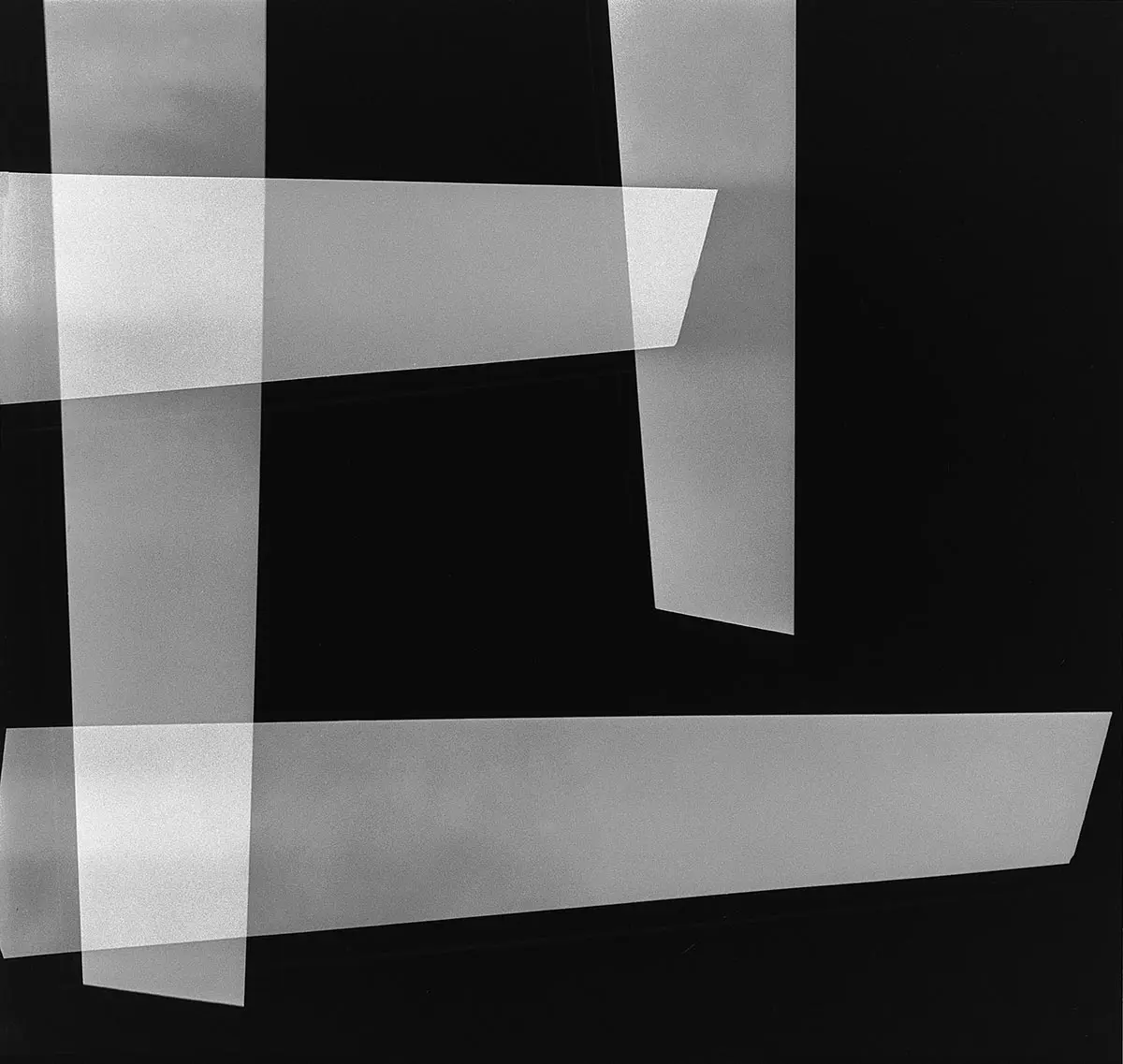
The book Fotoformas, Geraldo de Barros, contains installation photographs of the 1950 exhibit, and among the works that appear in them was Menina do Sapato. The work was shown almost as a sculptural object: the print cut along the edge of the image and mounted on a solid support to stand by itself. In addition, the book listed the photographic techniques with which de Barros had experimented: multiple-exposures, cut-negatives, pinhole photography, etc. Some works were labeled “superposição da imagens no fotograma”—a phrase in which the term fotograma turned out to be a false cognate for “photogram.” Although in the French translation the aforementioned book used a better phrase—“superposition a la prise de vue” (superposition at the moment of shooting)—my confusion had begun.
The confusion was fueled by the fact that a Portuguese dictionary used in preparing the credits defined fotograma as “cada uma das imagens registradas en filme fotográfico ou cinematográfico.” (Each of the images recorded on photographic or cinematographic film). Needless to say, the meaning of the English word “photogram” is significantly different: namely, “a photographic image produced without a camera, usually by placing an object on or near a piece of film or light-sensitive paper and exposing it to light.” Adding to the confusion was the fact that many of Geraldo’s fotogramas were very abstract and geometric and really looked like photograms. I was not the only writer who took Geraldo’s fotogramas to be photograms, but I did not pay too much attention to the issue because the works that most captivated me were the ones described as “desenho sobre negativo com ponta-seca e nanquim” (drawing on the negative with dry-point and ink). These are works like Menina do sapato, in which Geraldo scratched and painted the negative: Homenagem a Picasso (1949), Homenagem a Stravinsky (1949), O anjo (1948), and Cemitério do Tatuapé (1949).
Image and Memory were finally published in the fall of 1998. In the interim, I had begun curating photographic exhibitions for Sicardi-Sanders, a then small Houston gallery committed to Latin American art. In 1997, when the gallery started making plans for Fotofest 1998, I suggested to Maria Inés Sicardi an exhibit of Geraldo de Barros’s work. Once again, I got in touch with Fabiana de Barros, who was delighted at the attention her father’s work was getting. In fact, she told me that in spite of his precarious health, her father had started doing photography again. Geraldo’s mind remained lucid, and with the help of an assistant, he worked on a new series of photographic works titled Sobras (leftovers)—because they were made from the negatives that were “leftover” in his travel albums.
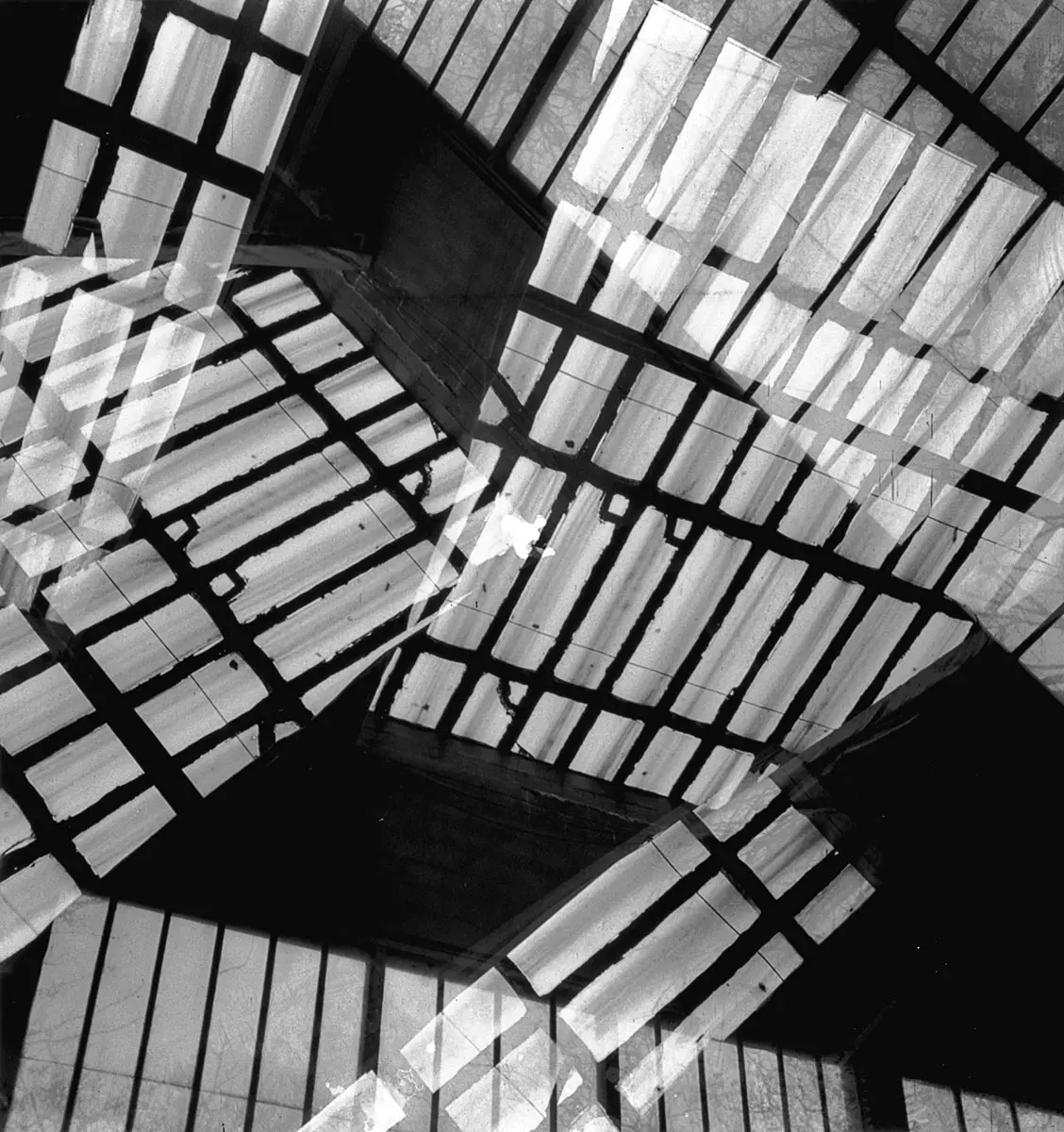
The 1998 exhibit at Sicardi-Sanders was titled Geraldo de Barros: Traces on the Glass, and it paralleled the selection of works in his 1950 Fotoformas exhibit. Fabiana had arranged the production of a new numbered edition of her father’s photographic works. Unable to travel on account of his poor health, Geraldo himself did not see his first solo exhibit in the United States. Shortly after the exhibit at Sicardi-Sanders, Geraldo de Barros (1923-1998) passed away. Although I never met him, his death caused me great sadness and left me with unanswered questions. Why had he stopped practicing photography for forty-four years? To find an answer we have to go back a few decades. After the 1950 Fotoformas exhibit and partly as a result of it, de Barros spent a year in Europe. That journey changed his artistic vision. He met Concrete artists Max Bill and Otl Aicher, and the meeting reaffirmed convictions he had already been entertaining in São Paulo. On his return to Brazil in 1952 he joined other artists as a signatory of the Ruptura Manifesto of Concrete Art.
Although photography is not mentioned specifically in the manifesto, it is certainly implicated in it as the kind of visual realistic representation that was developed since the Renaissance it describes as “naturalism.” A passage of the Ruptura Manifesto reads, “because the scientific naturalism of the Renaissance—the old process of rendering the (three-dimensional) external world on a (two-dimensional) plane—has exhausted its historical task.” In other words, Concrete artists were to avoid all kinds of figuration; i.e., mimetic art. By and large, they produced artworks that were abstract but geometric; works that did not represent anything but themselves. As a result of its chemistry and premeditated optics, photography not only points beyond itself (it is indexical), it also mimics the visual world. Consequently, it is an unlikely medium for Concrete artists.
Of the works Geraldo produced for his 1950 exhibit, only his most abstract works seemed to be congruent with the premises of Concretismo; that is, non-mimetic, non-indexical works, that represent nothing but themselves. Some critics and curators took these works to be precisely the ones described in the Fotoformas book as “superposição da imagens no fotograma.” Judging by the abundant comparisons of Geraldo’s work to that of Man Ray and Laszlo Moholy-Nagy in the literature, the mismatch of meanings had led not only myself but also a few others, to believe that Geraldo de Barros had produced photograms. That error also makes one draw wrong conclusions about the connection of these particular works to Concretismo.
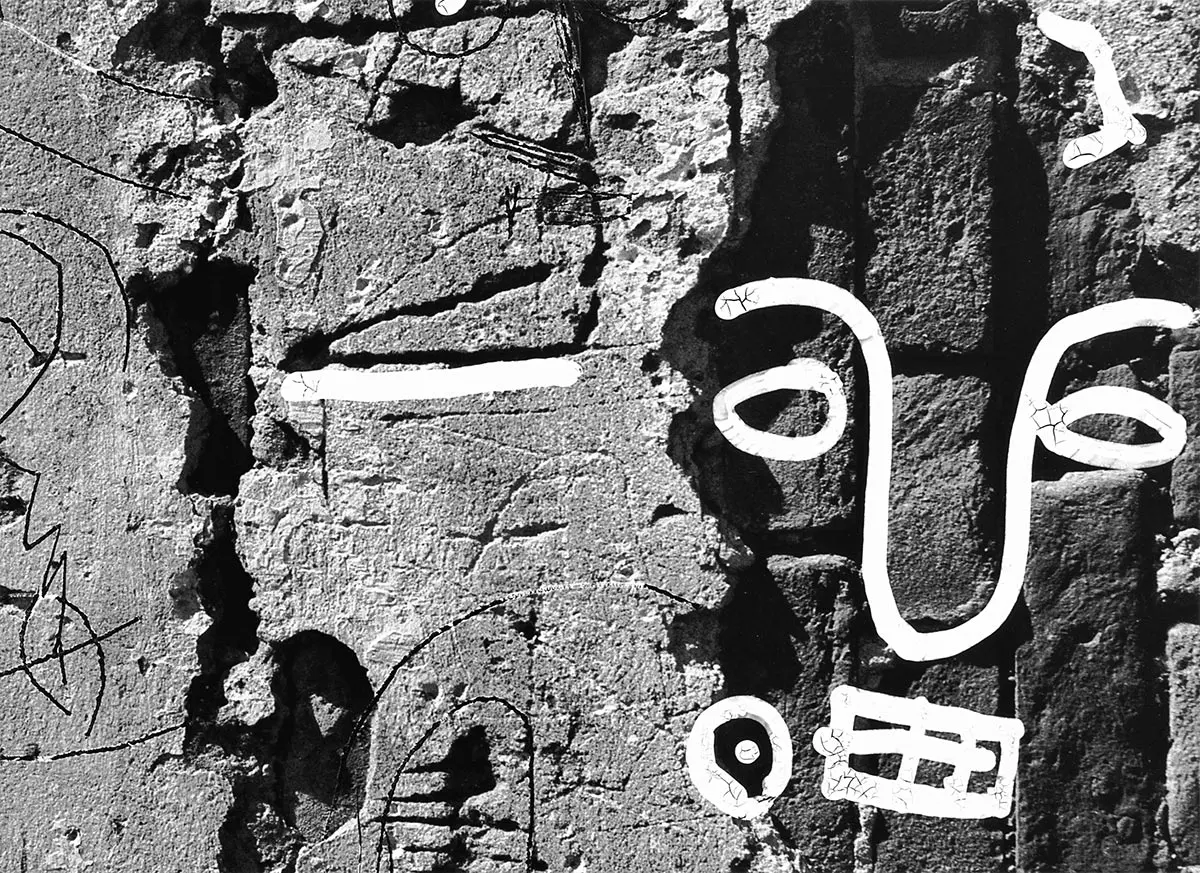
Although a bona fide photogram is still indexical because it points to an object of which it is a kind of shadow; it is not necessarily mimetic because there is no camera involved in its production so the portion of the photographic process that gives the medium its mimetic power is absent in it. A shadow as we know, may or may not resemble (mimic) the object that projects it. Conversely, two different objects (say, a cylinder and a tennis ball) can project shadows of the same shape. Finally, the same object may project shadows of different shapes. Indeed, if you were to make a photogram using a cylinder, depending on how it sits on the photographic paper, it could leave a white silhouette shaped as a rectangle or a circle. The proponent of Geraldo’s fotogramas as photograms, and hence, as examples of Concrete Art, gains a modicum of support from these conclusions. The shapes used to make them—he/she could argue—would be tantamount to mere rulers or templates.
So photograms appear to be ideally suited to have that disconnection with visual reality that Concrete artists found so appealing because they wished their art to express only the “quintessential values of visual art (space-time, movement, and material).” The problem with this line of thinking is that—as I will show below—Geraldo did not produce photograms. Whatever he did in photography during the 1946-1950 period may have been influenced by Concrete Art, but did not follow its dictates. Moreover, Geraldo’s ideological commitment to Concrete Art did not take place until his return from Europe in 1952.
In my curatorial essay for the 2008 exhibit at Sicardi Gallery, I decided to follow the taxonomical logic imposed by the different techniques de Barros used to produce his photographic work. Once again, I came upon “superposição da imagens no fotograma.” I was bewildered by the fact that in the gallery documents there were entries for “editions” of those works. How could that be if photograms are unique? There are indeed artists who produce editions of photograms with works that are sufficiently similar albeit not identical or by re-photographing a photogram and using that negative for making third-generation prints. In Geraldo’s case, each of the prints in an edition is identical to the other (as much as prints from the same negative can be). I sought Fabiana de Barros for clarification and after a few emails this much was clear: there are negatives of many images that were formerly labeled “superposição da imagens no fotograma.” After carefully scrutinizing them, it became clear that those negatives are really multiple-exposures and not re-photographed photograms. One can recognize the objects from which Geraldo so cleverly abstracted geometric shapes: for example, tops of buildings seen from below. At the risk of being obnoxious, I asked Fabiana if perhaps her father made photograms that he later re-photographed to get negative, but she firmly stated her father never did this sort of thing. Although it was correct in Portuguese to call said images fotogramas in the book Fotoformas, Geraldo de Barros, doing so contributed to generate an important confusion.
In the end, the face of Menina do Sapato came to have an unexpected expression: a mischievous one, with her open mouth by the surprise of her own mischief. If what I once believed to be photograms are actually double exposures—in spite of their abstract geometric look—they have a semantic component based on mimicking something that existed on the other side of the camera lens. In fact, aside from the different techniques used to produce them, thise fotogramas only differ from Menina do Sapato in that the referents of the geometric shapes are harder to decipher than a shoe. Even in actual photograms, the indexical nature of the medium is an inconvenience to the Concrete program—after all, shadows are of something. Was this inconvenience the reason de Barros gave up photography as a medium to produce art for forty-four years? There is evidence that Geraldo himself did not want his Fotoformas to be linked to the Concrete ideology. His daughter Fabiana wrote, “This issue of Concrete Art was fundamental in his life, though often contested by him as an artist, such as in 1953 when he became infuriated with Max Bill—his great teacher—when the latter labeled his Fotoformas as “concrete”. Geraldo did not accept his photographs being called concrete; his pictures [“paintings”], yes, but not his photographs.”
Art and photography have taken many detours since the 1952 Ruptura Manifesto. Some of these detours are proof that “naturalistic” representations have not “exhausted their historical task.” Geraldo de Barros himself realized it as he moved from Concrete Art to Pop Art, and in the last years of his life, back to photography—in his own special way.
Fabiana was eight years old when her father drew Menina do sapato; maybe her father was thinking of her as he scratched the negative. She has played a central role in clarifying her father’s work. In her role as daughter, artist, and curator, Fabiana has become the oracle that elucidates the mysteries behind her father’s deceptively simple works.
NOTA
1. I do not mean to be irreverent by calling Geraldo de Barros by his first name “Geraldo.” It is just a way to avoid the awkward syntactical construction in the Spanish version of this essay of having to say, “de De Barros” when the need arises.
FERNANDO CASTRO R.
Artist and art critic.