
This exhibition was produced by Estancia FEMSA—a cultural and artistic platform sponsored by Casa Luis Barragán with the support of the FEMSA Collection, intended to dialog with its historic context—and curated by Eugenia Braniff and Patrick Charpenel.
What happens when a secret is put on display, published, or divulged? What is the relationship between the different interpretations of the uncanny and the essence of secrets? What would be the antipodes of an exhibition at Casa Luis Barragán? How many secrets can simultaneously coexist in a single space, and how many can be transmitted and apprehended each minute? The audiovisual essay conceived by Iñaki Bonillas (Mexico City, 1981) dissects the broad relationship between Barragán’s personality and the architecture of one of Mexican modernism’s emblematic spaces, and that which is secret, veiled, ciphered, etc. The proposal’s key characteristic is that a large percentage of the works featured are hidden in the many wardrobes, closets, drawers, and hidden nooks that dot the 1948 building. At first glance, nothing or almost nothing interferes with the house’s decorative elements and utilitarian objects, or with the placement of the furniture, documents, reproductions, and artwork that are part of this unique domestic space. The house’s mystical charge and spatial discourse remain almost untouched. The “exhibition” is hidden, and this implies an inescapable invitation to play; there is something to discover, and the task falls on the visiting public (always accompanied by a guide.) Please, touch the art! The sense of touch plays a central role. The experience of opening and closing doors, pulling a drawer’s sober handles, or penetrating with one’s fingers the holes that access a certain container—of the now historic legacy—is a key factor, as visitors become participants rather than mere observers.
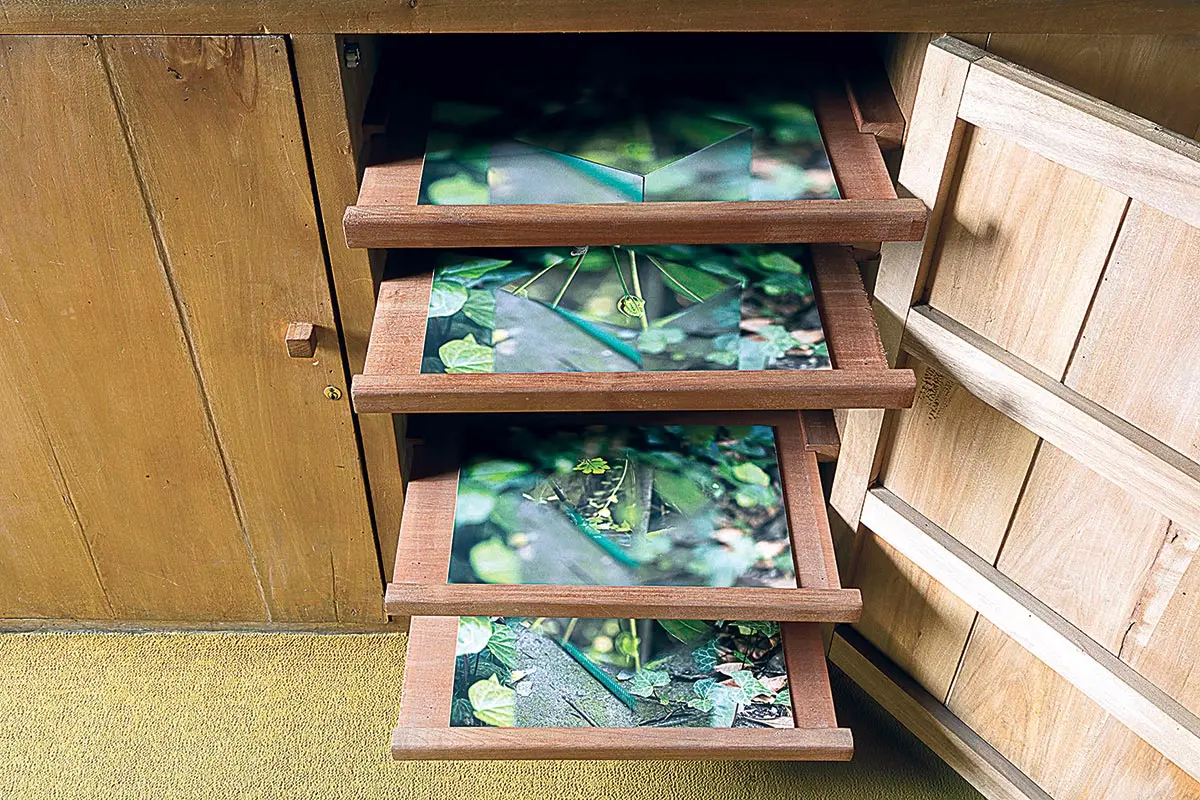
I would prefer not to reveal what the audience found in those suggestive hideaways, thus joining the gestation of another secret, but the practical and informational nature of this review nips that desire in the bud. After an exhaustive investigation into the Guadalajara-born architect’s personal holdings and other archives related to aspects of his career, his tastes, and his interests, and after a process of reconnaissance and understanding of the house’s living spaces, Bonillas opted for producing and exhibiting, in broad strokes, under four categories: found objects; document reproduction, textual explorations, and transcriptions; recreations and appropriations of the works of other artists—following Barragán’s custom—and works of his own created specifically for the occasion. The amalgam results propositional, generous, fun, and revealing, but also cacophonous: the objects and works of art in the house (hidden or visible, old or new, originals or copies, small or large) and the house itself whisper, laugh, half bare themselves, yell at the viewer, demand their rights, throw serpentine roses, pray in unison. Paradoxically, the secret and the hidden, once revealed, emit a soft but sharp noise. Can you hear it?
Marcel Duchamp, father, and icon of Twentieth-Century conceptualism, presides over the scene with four of his works reproduced or alluded to. In close second come, Man Ray, Marcel Broodthaers, Lucio Fontana, René Magritte, Robert Smithson, Hans Haacke, Yves Klein, Piero Della Francesca, and Hieronymous. Bosch, among others. Yet, the feast is not limited to the visual arts; we also encounter figures of world literature like Lope de Vega, Saint John of the Cross, and Sor Juana Inés de la Cruz. The presence of women is emphasized by reproduced photographs of model Valerie Lundahl and actress Joan Crawford, and an audio version of La Vie en Rose interpreted by the marvelous Grace Jones. Adding to all this are various found objects, facsimiles of documents, and Bonillas’ strictly authorial works, to form a set of fifty art secrets. All the items or gestures are properly installed and are technically unimpeachable, both in their resolution and in their integration into the space that contains them. Their presence is justified, to a greater or lesser extent, in every case. The problem seems to reside in an excessive, lax, and somewhat obvious reference to the towering art-world figures mentioned above, and also in the diversity of media and materials. The fact that the objects are in most cases secreted away does not cancel their presence and resonance; although the participants discover the secrets slowly, the stimuli and information add up and pile together in one’s mind throughout the exhibition. There is no escape. The number of works seems to have been determined by the amount of information accumulated and the number of available compartments, rather than by a specific discourse or aesthetic intention. Yes, some editing would have benefited the exhibition, and so would a focus beyond the vast idea of the secret and the hidden. Such a possible focus is suggested, for example, by works that explore the concept of the uncanny, in particular as described by Sigmund Freud in his 1919 article "Das Unheimliche."
The uncanny is described as the sensation of terror and anxiety provoked by that which is at the same time extremely familiar and strange or frightening. But the etymology of the term and its several definitions seem to fit well with the different facets of Barragán and his architecture. Those works by Bonillas that explore this notion seem to breathe better, and even to free themselves in a natural way from the fact that they are hidden. They are there, in plain view, but they are difficult to perceive; the literalness of the secret is transcended and the information is voided. Finally, we must highlight the sensibility and conceptual acuity of the works Bonillas created specifically for this exhibition, such as Secretos: huellas (Secrets: Traces); Secretos: jardín (Secrets: Garden); Secretos: proyección linterna mágica (Secrets: Magic Lantern Projection); and Secretos: dientes (Secrets: Teeth). In these works and others (including some found objects), we find enough arguments and stimuli for a valuable essay. With its heavy load of references, anecdotes, and “secrets”, the multitudinous orgy of famous figures—connected or not to Barragán—results unnecessary. Between Barragán and Bonillas, mystery, the uncanny, humor, and eroticism explode with an energy all of their own. Do you hear it?
VÍCTOR PALACIOS