
The summer season begins in Madrid and with it the PhotoEspaña Festival, an obligatory appointment with contemporary photography in different spaces around the city. Casa de América presented Und Jetzt? (Now What?), an exhibition by Cuban photographer José. A Figueroa curated by his wife, Cristina Vives, focused on the months when the Berlin wall was falling and the two Germanys became unified. Given his background, the vision of the Cuban photographer and his wife connected in special ways with what was happening around them.
Jose. A Figueroa (Havana, 1946) has been a key figure in Cuban documentary photography since the 1960s. He began his essay Exilio (Exile, 1967-1994) in those years, portraying Cuban migration to the United States. Along with his collaboration with Internacional magazine—a periodical specializing in documentary photography—Figueroa has covered other subjects in his artistic practice, such as the transformation of Cuban agriculture, the war in Angola, and the repercussions of the fall of Soviet socialism for Cuba.
The Und Jetzt project was born from a collaboration with Cristina Vives, intended to remember how they experienced the fall of the Wall while in East Berlin. The exhibition weaves Figueroa’s photographs with Vives’ first-person texts, which reflect her experience of the country’s social and economic transformations.
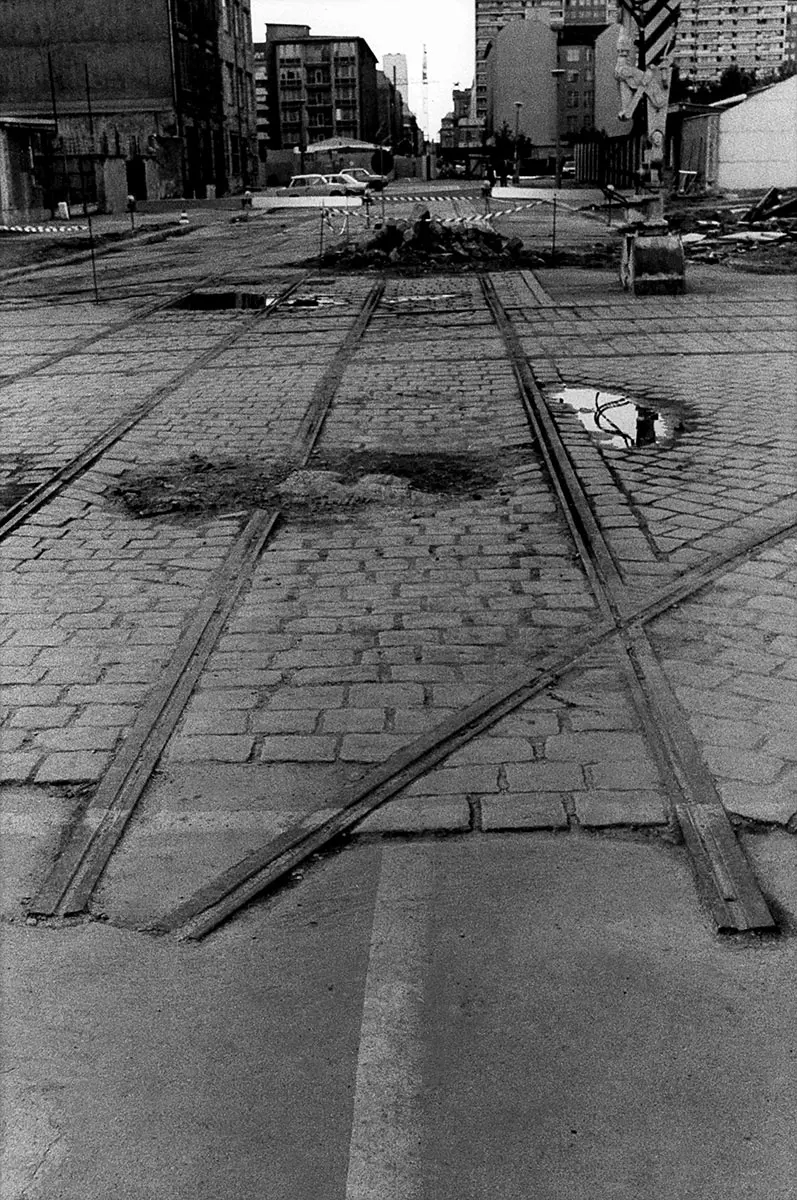
The photographs remind us, for example, that in May of 1990 Figueroa and Vives returned to East Berlin for the opening of an exhibition of his works—interestingly, the last such exhibition organized jointly by Cuba and the German Democratic Republic. The photographic approach is documentary, always in black and white and attempting a sociological rather than an individual view. Architecture—witness to and stage for the transformations—is portrayed in a geometric manner, by means of limpid, well-defined compositions indebted to 1950s photojournalism. In that sense, and taking into account the necessary contributions to the debate by critical post-colonial, feminist, and postmodern studies, it is worth considering whether Figueroa’s photography develops from supposed objectivity. And the texts inserted by the curatorship into the exhibition’s design clarify the matter: their first-person narrative transforms the proposal into a politically situated autobiographical gaze.
The contrast between that supposed “objectivity” and the narrative articulated by Cristina Vives’ written voice is one of the exhibition’s achievements. The photographer’s documentary gaze is completed by the texts, which give shape to a story of anonymous German citizens who move into and inhabit a new space. A territory marked by separation but also by connectedness—the photographs insist on the nooks, cracks, and filtrations in the wall itself—where two opposite systems coexisted. The citizens portrayed do not appear here on the basis of their particularities but from the standpoint of sociological analysis. In this way, we see a young girl, an old woman, some workers—all of them moving in the space next to a wall that is in the process of disappearing, and all of the representatives of German society.
Figueroa is also interested in shops and new commercial spaces, which represented the ultimate triumph of one of the systems over the other. The photographer’s intention is to get close, in the most respectful manner, to the subjects of his portraiture, using a “point & shoot” camera of the kind used by tourists instead of his professional equipment. There is a certain insistence in Vives’ texts on the Cuban photographer’s “heroism”, somewhat paradoxical given the journalistic focus of the project. Nevertheless, so direct a contrast between autobiography, collectivity, subjectivity, and politics is interesting precisely because it alludes directly to issues that are not ambiguous. Perhaps it surprises us because we have become used to a degree of asepsis in art exhibitions. In this case, although they can seem somewhat naïve, the texts are a voice that expresses a point of view clearly, without beating around the bush.
In a vastly symbolic gesture, one of the texts tells us that on June 30, Figueroa and Vives spent with some friends their last German Democratic Republic Deutsche Marks. Some of the themes that course through the exhibition are set in motion there: the ruins of a system in the process of vanishing, the affective ties that always survive historical events, and the opening of a new era for German society, with consequences for Cuban society. We are referring to the question launched by the curatorial proposal: Now What?
ANA FOLGUERA