
The city limits contain spaces in which urban environments gradually transform into the countryside as a result of their closeness to mountains, rivers, and hills. They are in-between places where rural and metropolitan elements converge to form areas of grey, hybrid, landscapes that are part of any city. The periphery is a fluctuating space without defined boundaries. It is an area that is neither urban nor rural (or it is both), where the inhabitants interact with nature in a very particular way. Everything is in continuous motion. Elements like the river that runs through the city—which sometimes is used for sewage disposal—or the rubble from torn-down buildings, enter and leave the city as they narrate architectural and natural transformations.
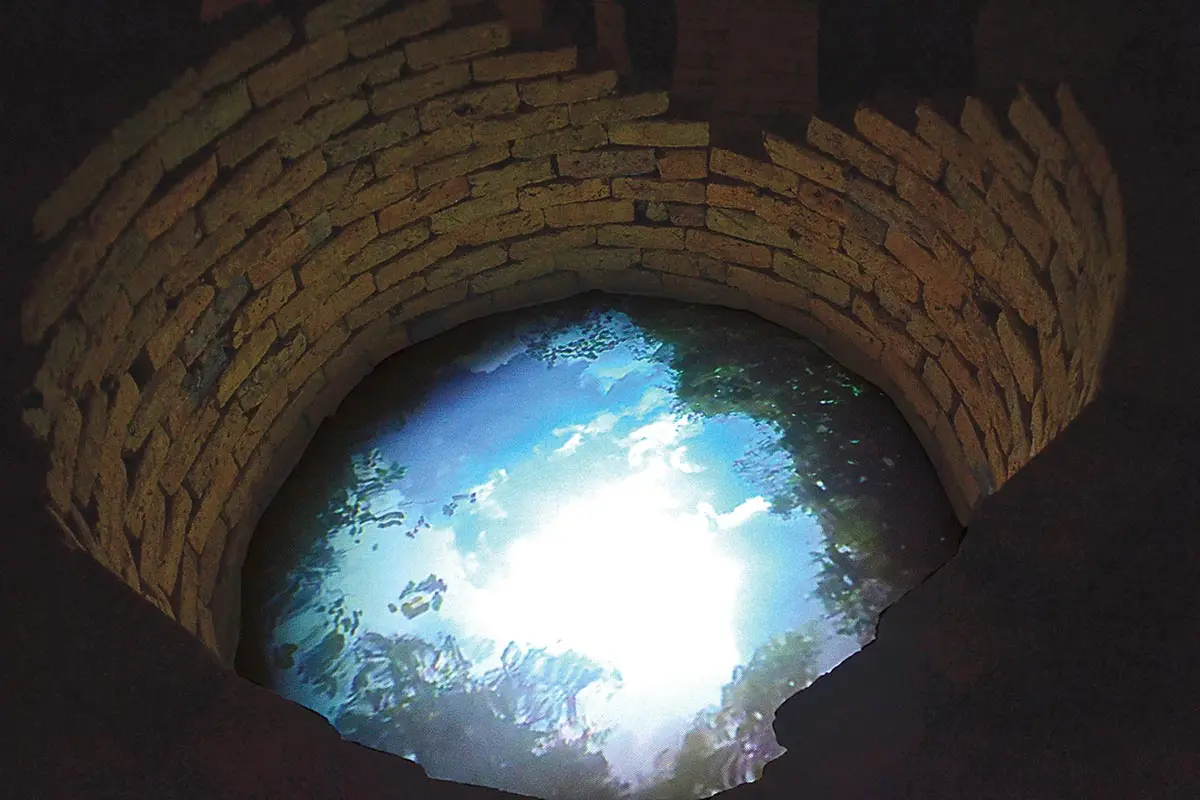
Constructions and Deconstructions by Juan Pablo Romero (Bogota, 1992) presented at Casa Proartes, consists of a series of video sculpture installations made of heterogeneous objects based on peripheral architectures and landscapes devoured by urban expansion.
During the inauguration of the exhibition, Romero performed an action titled Muro (Wall, sculpture, video and action, 2016) in which he used a baton to destroy several concrete sheets placed between the wall and a video projection that showed clouds moving across the sky. The shadow cast by the sheets evoked the silhouette of a mountain range being destroyed or reshaped by Romero, whose shadow also appeared magnified against the sky. By chiseling the concrete sheets, Romero played the role of the sculptor who shapes the raw stone in order to “find” a humanized or artificial structure. Nonetheless, the process in his work is somehow backward, since he begins with a framework built to sense or evidence a natural origin.
Likewise, in the video Buscando Paisajes (Looking for Landscapes, 2013) and in the photographs from the series Horizontes (Horizons, 2016), rubble, garbage, and ruins act as an unstable mountain range that the artist finds hard to climb. In Buscando Paisajes, Juan Pablo Romero goes through the screen from side to side, and in Horizontes the outline formed by the rubble underscores its condition as a line and confers the piece its two-dimensional feel.
Romero is an artist from Bogota who has centered his inquiries on the neighborhoods in Ladera de Cali and the capital. They are bordering areas that led him to marvel at the beautiful views from their urbanized mountains and their role as observation points from which to contemplate the sky and the city in all its splendor. In this sense, Romero is interested in the image and formal structure of objects that are brought together to interact amid their own paradoxes: the stillness of a house against the fluidity of the sky, for instance. This results in a reflection on the property (a settlement) and the natural environment (the passing clouds). And this interaction between contrasting realms is evident in works like Estanque (Pond, sculpture, video and audio, 2016) and Puerta (Door, sculpture, video and audio, 2016). The former consists of a brick wall with the video projection of a flowing river in its interior (recorded from the bottom of a river and looking up, so no reflections on the lens are shown and the landscape can be clearly captured. On the other hand, the piece Puerta is composed of an upholstered frame or threshold upon which, once again, a video projection of the sky and clouds is cast. In both works, Romero creates concrete borders to frame the landscape.
Evocador de Paisajes (Reminiscent of Landscapes, sculpture and video, 2014) is a series of small boxes made with brick models that are glued with concrete and enclosed by the wall. They have an opening that allows viewers to look inside. There, a screen, which also acts as a window, shows the sky. Upon inspection, viewers realize that the window offers an attempt to a sublime view that is nonetheless encumbered by a distancing mechanism: the realization that the small boxes are in an exhibition room, that they contain a (fake) window that shows the firmament. The idea here is perhaps to frame the gaze several times in order to create a distance.
In these proposals, Romero focuses on the “in-between” moments of a process of transformation and growth. Borders are continually being overtaken by their elements and a reconfiguration becomes necessary. The natural landscape and architecture are constantly mutating. No equilibrium state lasts forever and the works by Romero abruptly break any perception of stillness or privacy. While nature is constantly moving, mankind is also busy building, destroying, and rebuilding. From early on in our lives we are taught to differentiate between rural and urban environments. In fact, that was the very first subject we were taught at elementary school. And the work by Juan Pablo Romero focuses precisely on the grey areas generated by that relationship.
BREYNER HUERTAS