
The Centro Cultural B.O.D. presents an exhibition of the most recent works by Julio Pacheco-Rivas titled The Color of Cristal. The show summarizes the inquiries surrounding the representation of the space that Pacheco-Rivas has developed during years of continuous research. The selection of works includes a total of twenty-five pieces of various dimensions, disciplines, and techniques that transcend formal limits in order to be integrated into the surrounding area. With the exception of two works created between January and March of this year, the pieces were specially conceived for this exhibition space. This is the reason that the reading flows in a natural manner, as a result of both the thematic coherence of the works and their museographic arrangement. The group of works as a whole appears to form a grand reticle, a weave of narratives that are energized by the surroundings. The walk of the exhibition begins with the installation titled Neoglifos (Neoglyphs, 2012), reminiscent of certain isometric forms that generate enigmatic associations. Visitors try to complete the image by mentally sketching the directional lines on the wall, in a sort of geometric riddle that admits multiple associations. Gótico (Gothic, 2013) is a canvas that, from a specific angle, evidences the graphic expression of the perspective on the plane—its elements are broken down and scattered throughout the exhibition as part of different visual proposals. In this case, they address the movement of the horizon, the vanishing points, the projection of shadows, symmetry, dichotomy, degradations, and color contrasts and reliefs, all elements that have been thoroughly studied by the author for the formulation of his proposal.
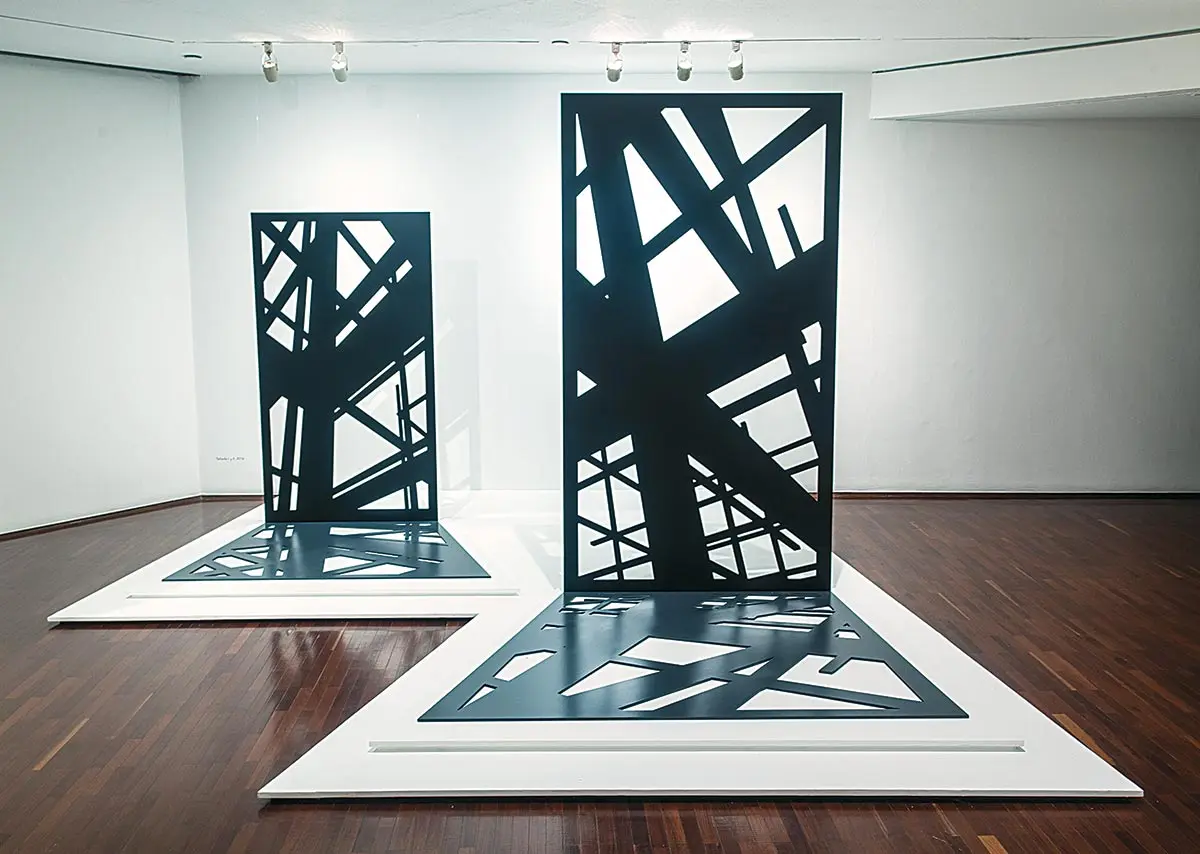
Pacheco Rivas blurs the lines between the optical and the illusory, the palpable and the suggested, the real and the deceptive, with the purpose of directing attention towards that intermediate zone that flows between the objectual world and the sensorial phenomena. Despite the constructive precision with which he develops his language, he may explore other aspects that enrich the aesthetic experience; hence, ambiguity, transparency, transiency, and virtuality give his works that fictitious aura that characterizes the visual arts. In A Través (Through), Pacheco successfully combines the planes and volumes offered not only by the quadrant protruding from the base but also by the array of light and dark tonalities that, at once, elicit the sensation of distance and proximity; a sort of optical movement that forces viewers to focus the gaze. Through visual-virtual dialectic, viewers are encouraged to establish parameters between material and perceptive elements and between filled and empty spaces, in a game of contradictions that sharpens the senses and unsettles the observers. This is the case of the diptych titled El Color del Cristal (The Color of Crystal), a monumental piece, not a result of its dimensions, but because of its compelling discourse: a compendium of illuminated and opaque frames that denote spectacular juxtapositions, realms that are reflected and spaces that are multiplied on the support, making individuals wonder whether they are before a mirror, a window, or a watery surface. “It is precise—says Susan Benko, curator of the exhibition—because of the ambivalent and reversible interpretation of the images that a certain degree of instability persists—and is accentuated—in the recent works. The reality, even that rationally created, becomes less objective the moment the same object is read and interpreted in different ways. Doubt is cast on the visual perception of forms, confirming the relative nature of many of these images […].”
Measuring 4.45 meters high by 5.80 meters wide, the work titled Lo Que Está a la Vista (That Which Is Visible) is another protagonist composition that takes most of the central wall. Seen from a distance, this mural blends in with the architectural perimeter and acquires the connotation of a revelation that simulates the building’s internal structure. Tallada I (Carved I) and Tallada II (Carved II) show the intermediation between the two-dimensional and three-dimensional realms. The framework expands on the wall like a shadow that, according to Pacheco, is like “an unfolding of form, a projection, a symmetry projected by light.” Some sort of black scaffolds is constructed through the superimposition of straight lines, underscoring the clarity of the background that supports them. This is evident in En Detalle I (In Detail I), En Detalle II (In Detail II) and In Extenso (In Extensive). Almost the opposite occurs in Positivo/Negativo (Positive/Negative) from the series Neck Deep In Water, where the silhouette of a white cube is consecutively repeated on a wall of the same tone, which generates subtle light clashes that go from the invisible to the visible. But the idea of transiency acquires greater presence in the videos titled Discursos Paralelos (Parallel Discourses) and Boing! in which animation references the elapse of time it takes an image to be altered, where change and permanence allude to a generating principle that drives both life and art.
GLADYS YUNES YUNES