
The work by Leyla Cárdenas explores the memory of places and their (re)construction. The title of the exhibition Chronotopic Inquiries, shown at the Galería Max Estrella, reveals Cárdenas’s interest in the mark, time, and space.
The exhibition begins with the work titled Indagación Ilustrada (Illustrated Inquiry), an embroidered cloth with the legend “The Spanish and American Illustrations” over several buildings that refer to the 18th century, to neoclassicism and the construction of modernity both in the West and the colonies. The language in the embroidery imitates the structure of a newspaper’s front page or the cover of an official publication. The buildings unravel, unweave, and fall in the lower section, revealing the material and technique used in the piece. This is one of the key ideas in the exhibition: the intimate relationship between material, technique, and image; strategies to subvert the established order between the supremacy of the image and a (hidden) technique that makes it possible. In these pieces, the constructive process, the icon, and the material are in the same plane. There are no political or artistic hierarchies.
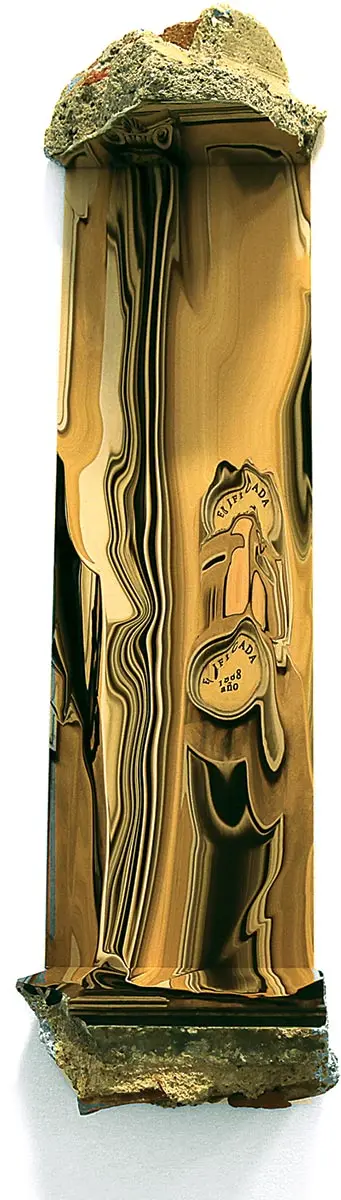
Although the aesthetic proposal goes further, it is impossible to resist a postcolonial reading of the exhibition. The referents to maps, a certain official architecture, and the research on the archeological spaces encourage a reflection on History (with capital “H”) and its mechanisms of dissemination. One such mechanism is the seemingly universal language of classical architecture. Another one, with a specific point of view, is the cartography and the desire to “control” a territory not yet explored.
The beautiful Inquiries series reproduces cartographic forms encapsulated in resin. The material, apparently recycled, draws entrances and exits reminiscent of a map’s demarcations and, why not, to its capricious forms, as if they actually corresponded to an objective and tangible reality. The borders are hard to discern because the maps are frozen in resin display cases that decontextualize them. We know that any cartographic representation is defined by relationships and contexts. By isolating them from “others”, they lose their references and their lines become purely aesthetic drawings.
The work Desenvolvimiento (Unfolding) consists of a series of fragments from a found object. Through its almost minimalist spatial arrangement, the installation eludes more to the remnants that it generates than to serial production. It is a sort of formal archeology explored through the very layers of matter. The material becomes resistant through its fragility thanks to the net-like design.
A similar operation unfolds in the piece titled Extractos de Permutación (Permutation Extracts). It consists of photographs on paper in which several fragments of buildings are randomly juxtaposed in a way that nonetheless results in a sort of chaotic harmony. The piece offers a very interesting analysis of the nature of ruins and the manner in which they define space, memory, and architecture. It also approaches images as surfaces and as volumes that they create in groups. Layers, arches, photographs of classical capitals are presented as part of an excavation that the surface gradually reveals.
A similar proposal can be observed in the magnificent work titled Permutaciones (Permutations). It consists of a partial photograph attached to several ruin fragments to form a panoramic composition that unfolds horizontally. It is as if we were before the frieze of a classical building—in which we can observe volutes, corbels, rinceaux, fences, bricks, columns, and vegetable and geometric motifs—but through its various layers and from the perspective of its own constructive memory.
Relying on a different approach, the installation titled Indagación (Inquiry) consists of three layers of mesh with the image of a building printed on them. Several superimpositions are used to render the entire image of the structure, which here is also made from visions unfolded across space, in search of physical materiality. The drawing also contains the invisible ruins of the building; those remnants preserved underground that contain the entire memory of what has occurred. It is a palimpsest to explain that the ruins are also a form of resistance.
Everything is synthesized in Contained Entropy, two pieces that combine photographs on rubble and steel. The images melt but the structure, the ruin, and the discarded material remain.
The work titled Dibujo Removido (Removed Drawing) located at the end of the gallery—in a space often assigned to site-specific projects when the mounting of the exhibition requires it—is a composition, rendered on a wall, out of which pieces of plaster intentionally fall on the floor. Here not only it is possible to observe the architecture but also that which once was but will never be again.
ANA FOLGUERA