
The artistic trajectory and life of Lydia Okumura (São Paulo, Brazil, 1948) fundamentally changed after her participation in the 1973 biennial organized in her hometown. One year later, she travels to New York, the city where she has lived and worked since then. Behind are the years of intellectual and artistic learning that describe a trajectory marked by influences from both Brazilian and Japanese cultures. Two very different cultural heritages that Okumura nonetheless has always managed to combine in a harmonious way throughout her career, within a difficult but daring conceptual and discursive balance.
In the New York of the mid-1970s, she enters into contact with two tendencies that at the time marked the pulse of contemporary art. On one hand, the experience of conceptual art, art as idea, as the concept of art extended to all the dominions of knowledge; and, on the other, the minimalistic art practices that expanded beyond the boundaries of the space-perception-work relationship established by the artistic vanguards of the beginning of the twentieth century. But Okumura’s poetic radar does not stop there. It also reaches the realm of Arte Povera—its predilection for unconventional materials—and incorporates the obsession with the organization and construction of space that has characterized Latin American geometric abstraction.
All this is reflected in the exhibition titled 1.000.000 mm, presented at the Ideobox Artspace in Miami under the curatorship of Roc Laseca. It recovers a total of seven historic installations conceived during the 1970s and 1980s for the National São Paulo Biennial or commissioned by institutions like PS1 in New York, among others. In fact, the exhibition’s titled, 1.000.000 mm, makes reference to the 1973 work of the same name with which Okumura integrally occupied the pavilion of the São Paulo Biennial. As a group, these works offer in this current exhibition an imperceptible survey, building an accessible path through work now recreated in the new spatial context of Ideobox. In that sense, the mounting of the show attains a very high level of artistic design. Because to articulate a body of works composed of installations, drawings, objects, and photographs from many different periods and spatial dimensions is a highly complex proposition. But the challenge is met through the correct spatial interpretation of the works and the very daring and coherent use of the Ideobox layout.
The exhibition 1.000.000 mm unfolds—very much like Lydia Okumura’s work does—through a mechanism of an increasingly ascending conceptual poetic. A mechanism that works based on the formal oppositions of the inclusive-exclusive kind, of everything vs nothing, external vs internal. They are formulation that Okumura incorporates as a sort of system of categories used to consider and neutralize the tensions between the different cultural heritages that are part of her artistic personality and life.
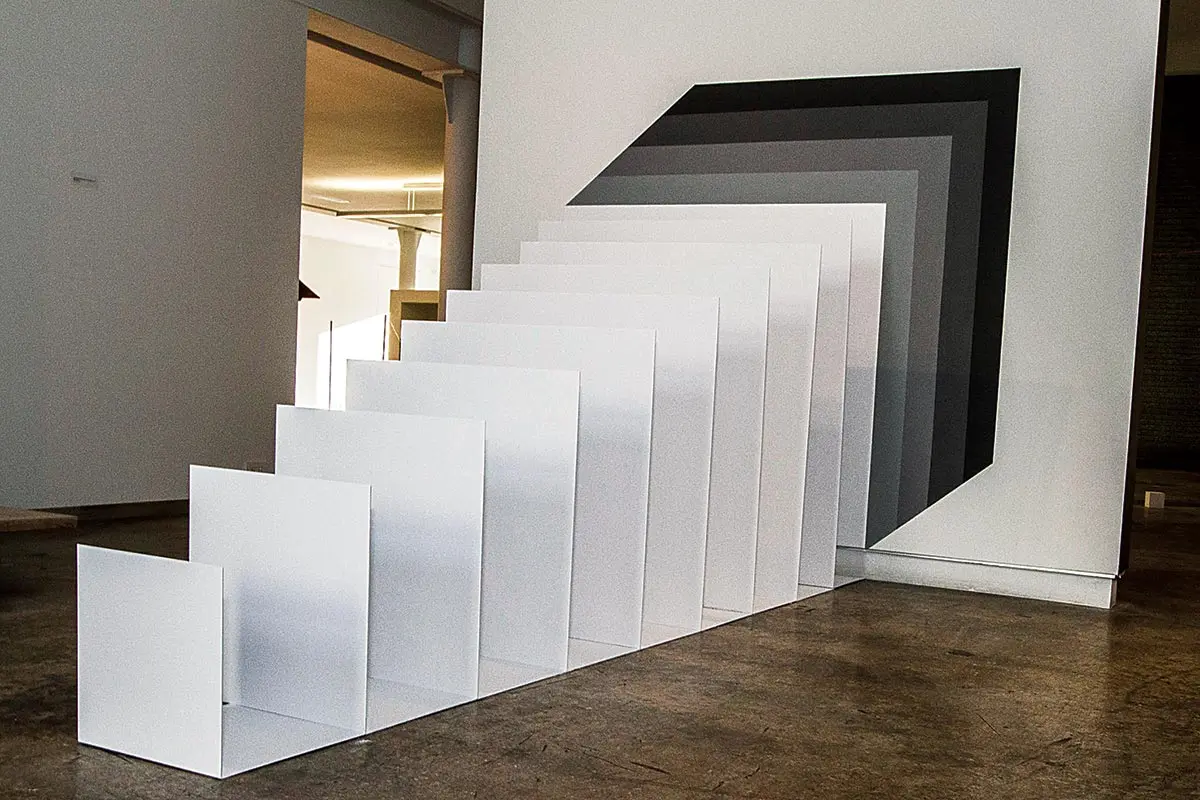
This is exemplified in works like Prismatic Appearance (1975), PS1 Nueva York (PS1 New York), and in Different Dimensions of Reality, both from 1971. These three installations begin on the wall, namely in the two-dimensional realm. From this two-dimensional beginning, the three pieces are projected to the three-dimensional space. Therefore the works communicate and are anchored both in the internal and the external. In this manner, their spatial-temporal dimensions eventually include one part—that which was previously excluded from the work—construct a whole from the occupation of something that was nothing before.
They are explicitly sober and minimally colored works whose background-figure interactions are disarticulated, fragmented, or can only be perceived by viewers in different spatial-temporal scales. And this deactivates or avoids a reading based on sensuality, on an approach that turns the retina into a fundamental organ for knowledge and perception. This attitude “attempts to leave the autonomy of the artistic sphere. They begin to construct a sort of heteronomy as opposed to autonomy, because they are trying to critique and overcome the concept of aesthesis, understood as a perceptive sensorial element. To leave aesthesis means to adopt ideo-aesthetic postures in which art is no longer conceived as the education of perceptions, tastes, or habits. This movement or transition strengthens the conceptual analytical dimension of the artistic. This inflection proposes then that art is more concept than perception, or, at the very least, is as much concept as it is perception.”1 Thus, work like the one by Lydia Okumura makes us think of the hybridity vindicated by García-Canclini; makes us think in the heteronomous as categories that help us reflect on the complexity of the development of the project of modernity in Latin America. A project whose deficits and disconnects are far from being resolved.
NOTA
1. Dennys Matos in Hablando de Abstración. Transiciones de Lenguaje en el Arte Latinoamericano [Speaking about Abstraction. Language Transitions in Latin American Art]. Catalog of the exhibition of the same title. Published by Durban Segnini Gallery, Caracas, 2016, pp. 10-11
DENNYS MATOS