
At the beginning of the millennium, María Elena Álvarez (Caracas, 1964) emerged into the Venezuelan visual arts scene with proposals of very high formal and conceptual quality. With a degree in visual arts from the University of Hartford, in Connecticut, and a master’s degree in Visual Arts from New York University, Álvarez has been amazing us since her arrival in Venezuela with work that unreservedly explores two-dimensionality through painting, collage, graphics, and photography; mediums that she uses to delve into abstraction and the internal dimensions of her being and artistic thinking.
In Soliloquies, Álvarez presented fifteen works that at first glance reveal her constructivist roots. Nonetheless, her language is far from mere formalism as she relies on elements from abstraction to account for introspective inquiries in search of answers about herself.
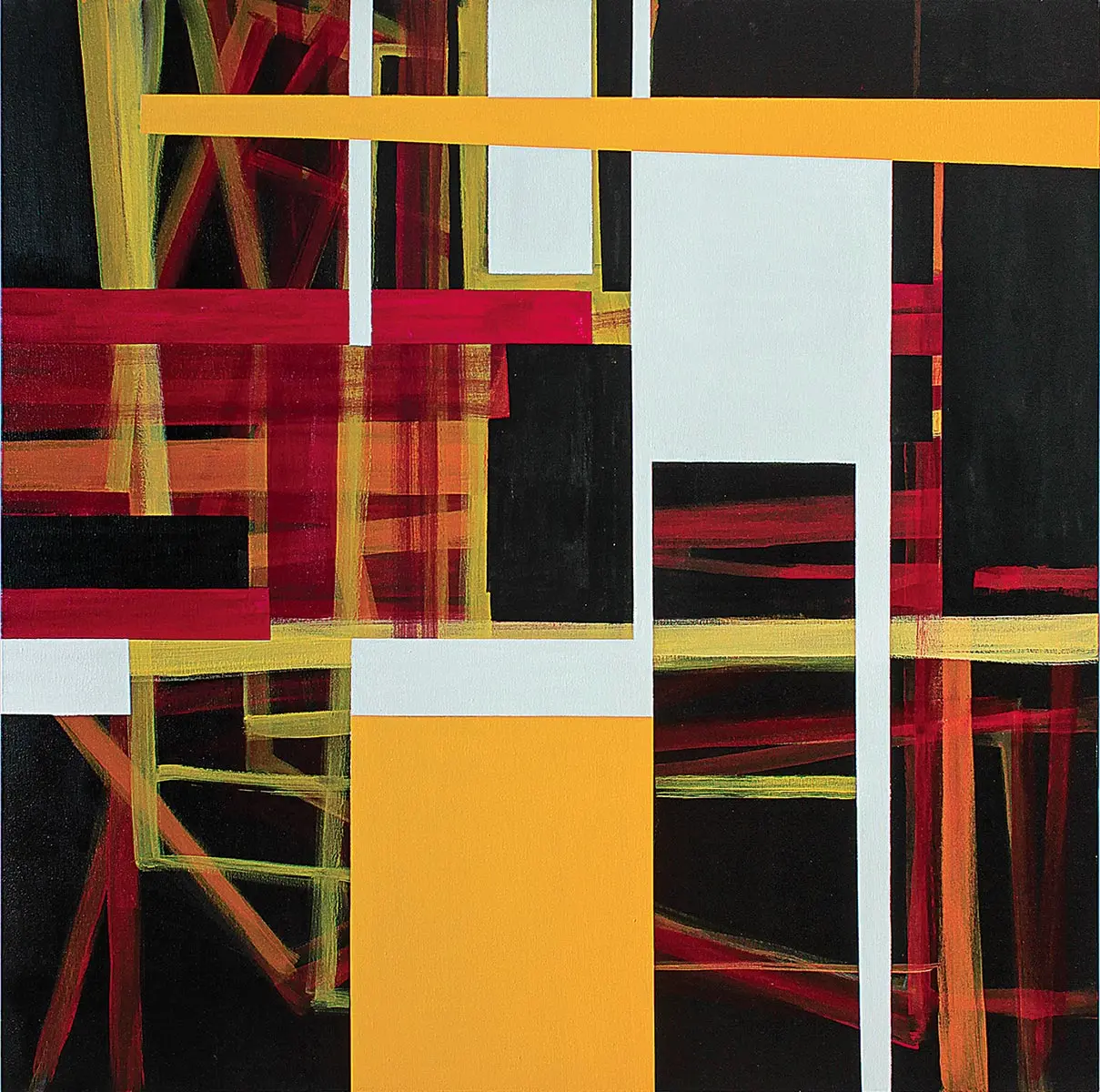
María Elena Álvarez’s interest in architecture and structures led her to approach the “window” as an expressive vehicle in which the conjunction of squares lets her inquire about positive and negative spaces, conceptualizing the frame as a device that separates, orders, and articulates them. The window also enables a metaphoric oscillation in which painting is considered a reversible realm that can act both as continent and container: “I appear to be in the image and be painting from there,” Álvarez remarked about that aspect of her thinking.
For Soliloquies. Álvarez relied on an approach to creation based on the deconstruction of a visual scene through the abstraction of the most minimal details. In the city of Valencia, where the exhibition was presented, she observed the remodeling of a building. The color palette drew from that observation: the greys were based on the concrete, the clothing of workers became the reds and oranges, a look at a can of paint inspired the yellow. Color is an element that remains and sheds light on the sensations that Álvarez attempts to abstract, as she creates her pictorial structures, which, according to her, are the result of “abstract-poetic” conceptualism.
The works presented to showcase the way in which Álvarez’s process made the structure of her images more complex and enriched her chromatic range. Created from orthogonally superimposed color planes and lines, the pieces construct a deep space. She plays with the saturation of the planes and even with the way colors are applied, counterpoising spaces where strokes are evident, and others in which they form nuanced segments. Multiple and simultaneous planes successfully energize the visual interactions that lead viewers to several levels and directions.
Álvarez has incorporated unusual color ranges—like terracottas, maroons, oranges, sepias, yellows, and greens—in earlier works. Color is perhaps one of the most compelling elements in the pieces included in this exhibition and one in which the artist took enormous risks by experimenting with difficult tertiary tones. The result has been very consistent and demonstrates Álvarez’s creative discipline. In pieces like Bugaswing (2016), Tanz Industrial (2016), and Cableado (Wiring, 2016), the use of yellow contrasts with the plays with neutral tones—whites, blacks, and greys—that the artist tensions with the incorporations of a few reds. The beautiful polyptych titled Jardín Vertical (Vertical Garden, 2016) offers a range of delicate greens, pastels, tertiaries, and greys that contrast with some planes rendered in violet and mauve. These works are composed of several pieces of varying dimensions that do not form a continuous plane but that energize spatial interaction. These contrasts in the format are repeated in the polyptych Estructure Blue (2016) and the triptych Pregonero (Crier, 2016) in ranges of blue and grey-green, respectively.
Soliloquies is undoubtedly an important exhibition in the trajectory of María Elena Álvarez. In it, she demonstrated her solid artistic education, intense creative disposition, and conceptual solvency. Just as the title of the exhibition suggests, these pieces demonstrate that they are from a permanent, conscious, and creative monologue; a soliloquy pertaining to art and painting, but one that addresses the very fact of being an artist and the very existence as space in which the creative being unfolds.
KATHERINE CHACÓN