
Whoever has started a collection knows that there are many ways to collect; although, in art, some professional curators try to convince private collectors to acquire works “in-depth”, with a certain “directionality.” This recommendation does not mean that they should buy works that probe deeply into the human condition. What it means is that they acquire with specific filters; i.e., with a specific curatorial concept in mind. For example, for years Bill Hunt, the renowned photography collector, has acquired photographic works in which the eyes of the subjects are not shown. The result was the voluminous book The Unseen Eye: Photographs from the Unconscious (Aperture: 2011).
But the child who starts collecting shells does not know where it will take him; he has no curatorial concept. Each new shell surprises him, marvels at him, leads him to believe in the possibility of endless surprises. Perhaps after finding his nth shell, the child will have refined his taste, maybe tried different classifications of his collection, given his own names to each specimen, or sought their scientific nomenclature, and/or gained knowledge beyond the sheer delight of seeing them. He may stop being surprised at the most abundant specimens, and has become more discriminating, seek the exceptional one. When he sees it, he will covet it. He will develop a yearning for completeness. Whoever peruses his collection, will understand a little bit about this child, of his sense of beauty, of weirdness, even of his character. Perhaps the child will come to understand that shells are connected with corals and starfish, and he will expand his collection.
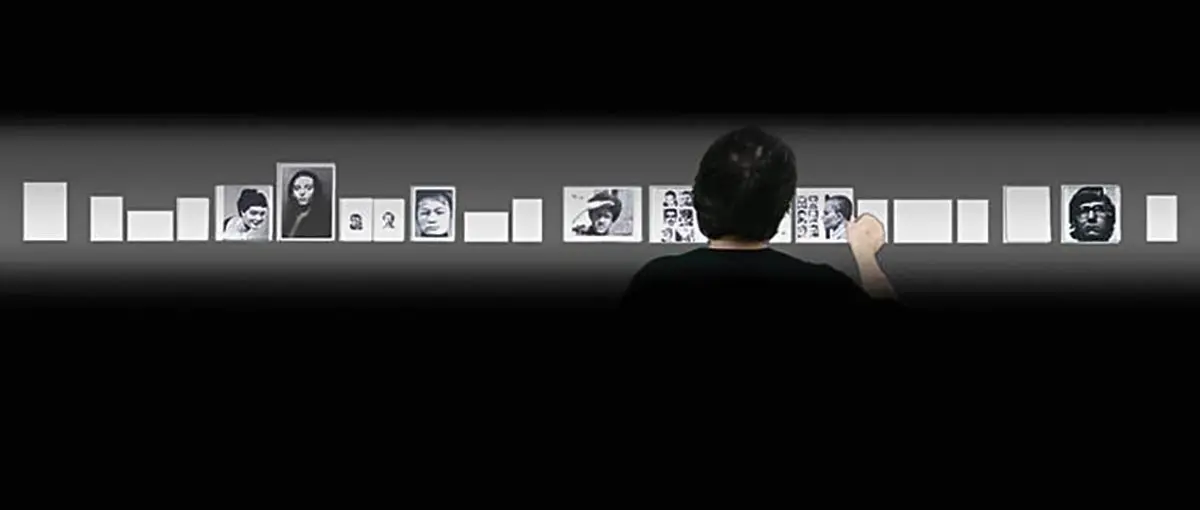
Oscar Muñoz’s El Coleccionista is a sound and video installation fifty-two minutes long. In the video we see a man (the artist himself as qua actor in his own work) placing photographs and/or postcards on a long shelf. He adds some; removes others. We do not know if his actions have directionality or are random. We do know that there is an eclectic set of images of people on the shelf. Some are iconic (Marlon Brando, Greta Garbo, James Dean); others are unknown (victims of violence or criminals); still others are historical characters (Simón Bolívar, Ingrid Betancur, Malcolm McDowell), etc. The authors of the images are also famous (Albrecht Dürer, Diane Arbus, Chuck Close) or anonymous.
Somebody could argue that the identity of the individuals who appear depicted in this collection is irrelevant; that it could be different, and the meaning would be the same. Let’s consider the following thought experiment. If this were the collection of the Japanese photographer Hiroshi Sugimoto, it would probably include portraits of known and unknown people; perhaps Toshiro Mifune, Audrey Hepburn, Yasunari Kawabata, Yukio Mishima, Marcel Duchamp, Sanae Yamazaki, Akira Kurosawa, Ikuko Toguri, etc. In other words, El Coleccionista, would be a different work. A collection is a reflection of the collector. Unless it is not really a collection, but a mere group of images obtained randomly; by an antiquarian buying a lot, for example.
Conveniently for our reflections about Muñoz’s El Coleccionista, The New Museum in New York City, opened the exhibit The Keeper. I quote William Hamilton of the New York Times ("New Museum Explores Why We Keep Things": July 14, 2016): “In a culture being redefined by the way it consumes, what to make of people who collect things, who keep things? What to make of the personal archives, the private universes, the physical stabs at permanence and immortality that collectors create?” Massimiliano Gioni and his curatorial team gathered over 4,000 objects from more than twenty collectors in order to answer those questions. Searching for photographs of her own family, Canadian artist Ydessa Hendeles, whose parents were Auschwitz survivors, collected some 3,000 photos of people with their teddy bears. In the 19th century, William Bentley, who had a childhood fascination with snowflakes, mounted a microscope to a camera in order to shoot hundreds of them in order to show their uniqueness. Susan Hiller, an anthropologist turned artist, compiled sound recordings of extinct or nearly extinct languages, and translated them into a video called The Last Silent Movie. Although Gioni prefers not to use the term “collections” to describe the thousands of objects possessed by the people who gathered them, Hamilton finds in all of them “the undeniable importance of the individual’s voice in the recording and interpreting history and its sweep.”
Going back to El Coleccionista, what is this character in Oscar Muñoz’s work like? Is he like the child who collects shells without a pre-conceived direction, or is he like a collector of say, Pop Art? It is obvious that this character does not start off from a tabula rasa as implied by the Walter Benjamin quote about “the chaos of memories” in the exhibition text. A German philosopher ought to know that chaos is not merely a disorder, but an amorphous void. And even if it was, memories require a minimum amount of order in which to endure and from which to be retrieved. That is the case of the character El Coleccionista, whose actions, like those of the child, are those of someone reflecting about the diversity and singularity of the images, attempting to classify them, considering their relevance to himself, and why not, to his vision of art.
FERNANDO CASTRO R.