
Those who believe that we left behind the assumptions that shaped platonic philosophy long ago may be wrong. Are the confused the same ones who believe that pronouncements about the rhizomes of perception in the art gallery context lead to effective results? Are we perhaps in the wrong by continuing this seditious insistence on always expecting to be wowed by what is projected from the art scene? Perhaps what we need to find our way back to the agora are nonsensical constructions that restate those considerations about the “intelligible world” and the “visible world” that existed in ancient Greek society. At the very least, they may help us to walk hand in hand and reflect; actions that almost nobody performs anymore. According to the recursive loop principle, we self-organize by questioning our mistakes and shortcomings in search of a connection that induces a new cycle that generates new possibilities.
Recently awarded the 2015 Mariano Aguilera Award (a creation grant), Paúl Rosero (Quito, Ecuador, 1982) has developed an interdisciplinary trajectory that successfully transits between biology and philosophy. Rosero is someone who aspires to create a Dasein being. Focused on sensing—as proposed by German thinker Martin Heidegger—Rosero is clear about the rules of the game: the need to disclose.
A recent visit to the Galería NoMínimo in Guayaquil allowed me to finally find the oasis that for many years I had been searching for without luck. The personal exhibition by this artist from Quito titled The Place Where Fish Are Caught with a Net alludes to the toponym Daule that, according to historian Emilio Estrada, comes from a combination of the words da (net) and li (fish) from the Cayapa language; and, therefore, the term Daule means “a place where fish are caught with a net.” Based on this term, Rosero poses several questions about the ontology of being-coastal dweller, perhaps even about being-Ecuadorian (with a dash, in honor of Heidegger); inquiries that when contextualized by that chic and acquiescent environment of Plaza Lagos Town Center—where the gallery is located—also put into question the approaches that may be directed to or generated by the art scene, in a city where the frivolity of coastal life encourages excess.
The exhibition proposes readings on our understanding of the meaning of “real” and/or “imaginary” through the scapegoating of Daule, a region of the Ecuadorian coast inhabited by montuvios (coastal peasants) and where a meteorite supposedly fell from the sky in 2008. It seems to me that Rosero’s reflections also point to the interstices formed between systems, the imaginary, and the media. In a nutshell, the aforementioned event became a subject of study for the Ecuadorian Aerial and Defensive Operations Command, which investigated the material and declared on national TV that it was indeed a meteorite.
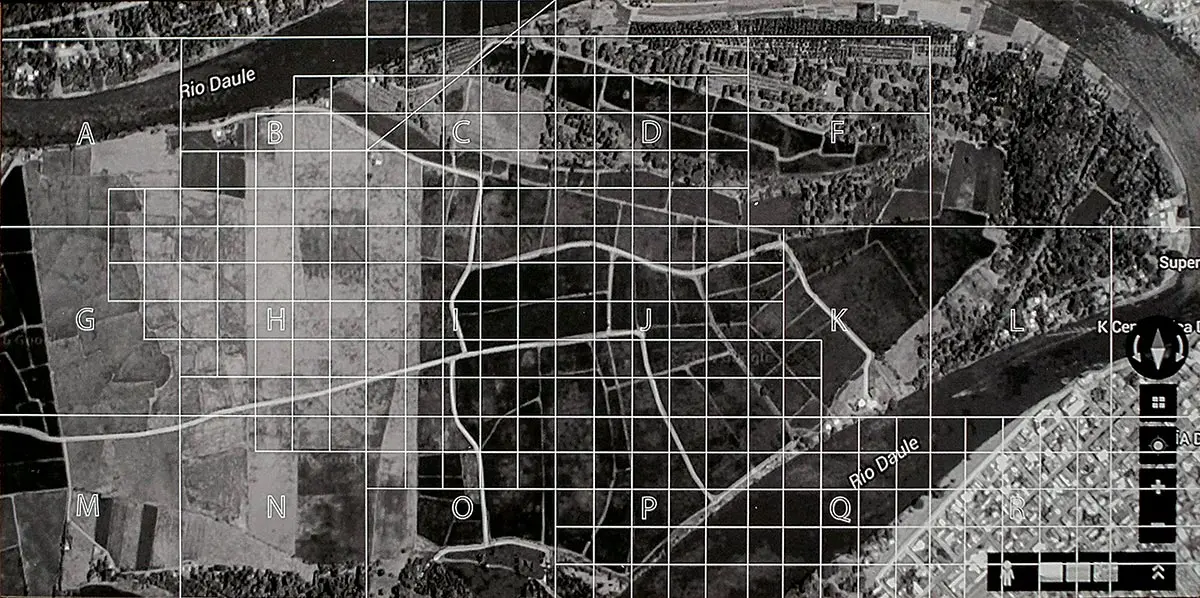
Rosero divided his proposal into three narratives: one constructed by him, in which, through the intervention of an archival photograph, he examines the place where the rock was allegedly found and addresses the supposed certainty of the “sky phenomenon.” He also shows evidence of the online sale of the meteorite on eBay. In a second narrative, he tells the story from the perspective of the locals, who relinquished the meteorite after being threatened by soldiers that claimed it could cause cancer. The last part, available also online, focuses on the allegations of Michael Farmer, a US collector of meteorites who claims that he learned about the discovery online and sent a colleague to buy the rock. In the narration of the montuvio, several meteorites had supposedly fallen from the sky, one of which was hidden by another local in his home who sold it to the gringo for one thousand dollars.
Romero presents this curatorial narrative like a garden with various pathways that branch off. Whether the stories are true or invented is not important. The important thing is that they allow us to structure a class on complex thinking that attends to the notions of nonlinearity, bifurcation, and self-organization proposed by Prigogine. This chaos takes us back to the need for self-awareness, for pulling away from logical operability, from the cognitive, in order to become exposed to the world. Heideggerian disclosure, which establishes tensions between the disfigured and that which is expressed, is part of Rosero’s discourse.
The Place Where Fish Are Caught with a Net recreates a universe in which (curatorial) order does not matter, but where a cohesive random itinerary is favored in works that are reminiscent of maps, horizons (habitable places), work instruments like a tripod (as a controllable entity), and texts (speech or language, as a powerful tool of beings). They lead us to a second level (gallery floor) where world and earth offer us a dialog. Rosero built a forest that contains crops of bearded tooth mushrooms, recyclable plastic, and salt, which may temporally change. He called it Anticipación a una Ausencia (Anticipation to an Absence) and is flanked on both sides by serigraphies on organic paper. Appearing on the right side of the forest (seen from the perspective of the staircase), are a series of already extinct plant species. In front, there is a map that shows the Ecuadorian territory and an enlarged projection of one of the areas of the Yasuní National Park that will be intervened in the near future by oil companies. By the way, this entire region is home to one of the most biodiverse ecosystems in the world.
The exhibition ends with a white pedestal that would appear to be declaring its condition as a museum piece. But as we get closer we notice the absence of certain museographic pretentions (it is not accompanied by an information label). On top of it, a supposed meteorite speaks to us with the meaningfulness of the form that it recreates: the Ecuadorian territory. Is it perhaps a reflection on the irreconcilable relationship between world and earth when it comes to their universal nature? What kinds of existentials are defining our place in relation to nature in Ecuador? How can we speak of concepts like identity, history, art, ecosystem, or good living if almost nobody dares to disclose regional, political, and ethnic antagonisms? These contradictions are the breeding ground for Paúl Rosero’s proposal. Aware of our limitations as mortals, he dares to disclose the essence of any concept, no matter how important it is to our existence.
AMALINA BOMNIN