
Faithful to its mission of promoting the work of artists who engage sensitive topics of current Latin American reality, the Art Museum of the Americas (AMA), with the support of the Nassau County Museum of Art (NCMA) and the State University of New York-New Paltz, has just presented in Washington, D.C. a retrospective exhibition of Uruguayan artist Rimer Cardillo, curated by Karl E. Willers.
A Journey to Ombú Bellaumbra refers in the first place to the Guarani-language word that names a strong, hardy tree, the provider of ample shade that protects animals and people. This initial, essentially semantic approach traces one of the paths followed by Rimer Cardillo: a call to action in the preservation of the environment and natural resources. Yet to center our analysis of Cardillo’s reflections and their goals exclusively on ecological issues would be to approach his work only in a superficial and peripheral manner. Nature becomes an excuse for the elaboration of a profound discourse about the transcendence of the small details, filled with life, that often goes unnoticed in front of our eyes. The entire exhibition is a grand metaphor for life and its capacity for coming into being in mere seconds, running its course, and ending. It is a warning about the ways in which we damage our surroundings, forcing on it our strength and our will, and lacerating a common space that we should all protect.
Cardillo, who was born in Montevideo (Uruguay) in 1944 and has lived in the United States since 1979, is widely recognized for his work as a Latin American graphic artist, a standout figure since the beginning of his career in the early 1970s. In this exhibition, the influence of printmaking can be appreciated in every one of Cardillo’s works, not only as part of the production process but also as an indispensable conceptual element to understand and define his proposal. The most important characteristic unifying most of the works on display is the “creation” of matrices that are not intervened or elaborated by the artist with traditional graphic techniques, but “found” in a seemingly random process of selection. In this way, a trip, a short stroll, the area around his studio can all become sources of raw materials for Cardillo’s art. Roadkill, animals who fell victim to their predators or were hunted by men, plants felled by inclement weather are picked up by the artist and immortalized in a kind of monotype, a metaphor for the intensity of suffering and loss. The graphic technique is used as a space for the perpetuation of a unique, unrepeatable moment that cannot be multiplied.
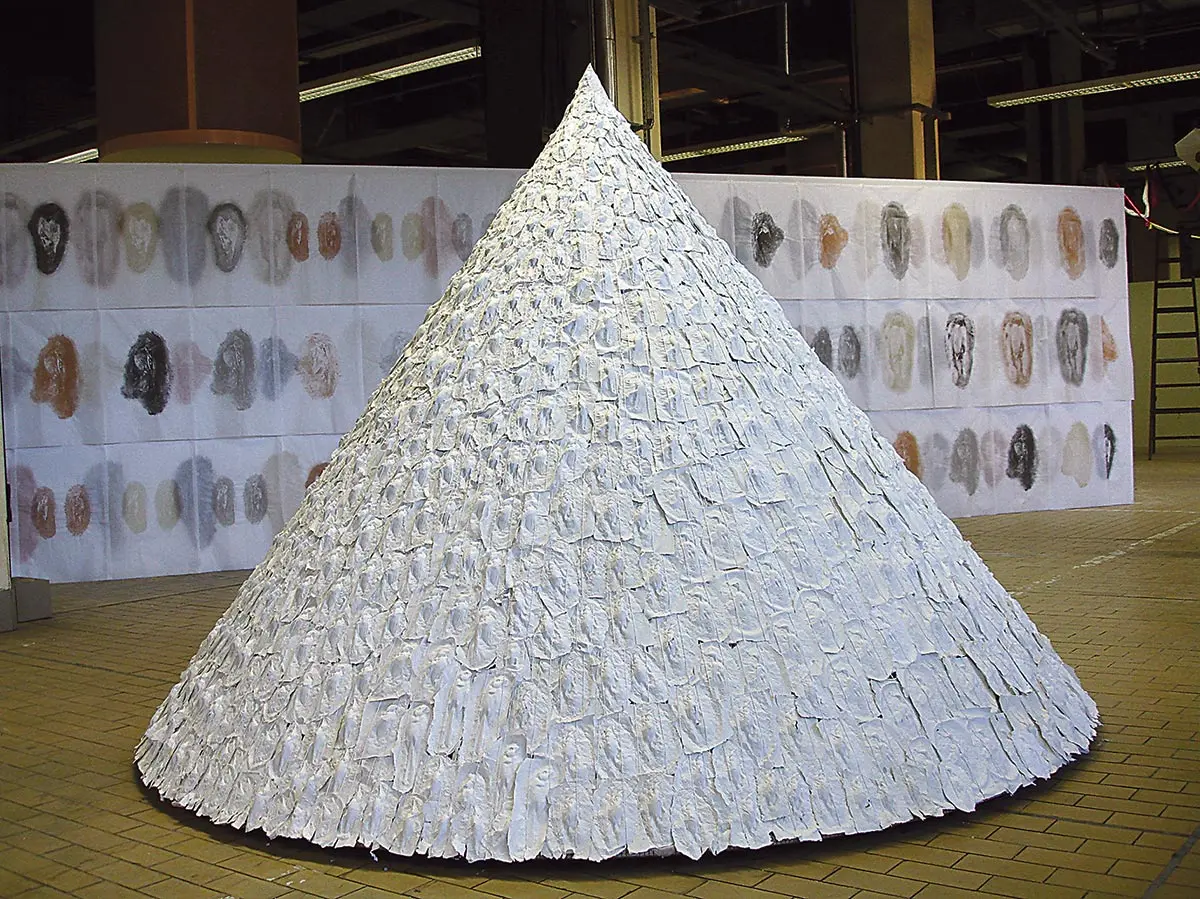
One of the exhibition’s central works is Cupí, an imposing installation in the middle of a room, surrounded by Birds of Clay, Oil, and Ashes. Cupí was exhibited in 2005 at the 26th Ljubljana Biennial of Graphic Arts and is a figure reminiscent of the cones built by ants or structures used by South American indigenous peoples for their ritual ceremonies. Built using thousands of sheets of handmade paper with the imprints of dead birds on them, the lightness, delicateness, and fragility of its appearance contrast with the essential idea of the power it transmits. In Birds of Clay, Oil, and Ashes, a gallery of birds killed by crashing against the glass walls of the artist’s studio is reproduced using different printing techniques and elements like petroleum, ashes, oil, and clay—materials with which Cardillo identifies our era. Both works are exhibited here in a dialog marked by the fragility of power in a contemporary world where the viewer is both judge and actor, in the midst of realities created by the circumstances about which Cardillo is warning us.
Barred Owls, dated between 2007 and 2008, again uses the powerful and recurrent image of birds that enter the artist's immediate surroundings and die. A detailed photographic register of the bird’s agony after several fruitless attempts to bring it back to life is placed on a lightbox that emphasizes the drama of the event of death, as well as the beauty it can bring about. Nature is once again the protagonist of a discourse about the volatility of existence.
Other highlights in this retrospective are the series Sublime Jewelry (1977-1981) and Reliquary with Ten Boxes (1974-1975 and 1978-1979). During the years of the military dictatorship in Uruguay, Cardillo sought refuge in drawing and in the development of metal engraving techniques. The result was a series of intimate works of a visceral, poetic beauty; a silent journey, a course through the space of Cardillo’s “private inventory” of butterflies, all manner of insects, personal reliquaries that helped him endure, like the perfect antidote for moments of terror and death.
VALIA GARZÓN DÍAZ