
What appear to be the remnants of a shipwreck—canvases made from tattered scraps, pockmarked paper, a cage with strange shapes adhered to it—are in reality the components of Sonia Gomes’ third exhibition at this São Paulo gallery.
Gomes (Caetanópolis, Brazil, 1948) continues with her inquiry into the second and third lives of found or donated objects, transforming detritus or found objects into narrative in an act of artistic necromancy that revalues that which has been discarded in order to make it—or perhaps unmake it—anew. Her inorganic elements, like the canvases that hang from the ceiling, acquire an organic presence thanks not only to their placement in the gallery as though to overwhelm the space and simulate the arrestment of a previous motion, but also through a hidden narrative.
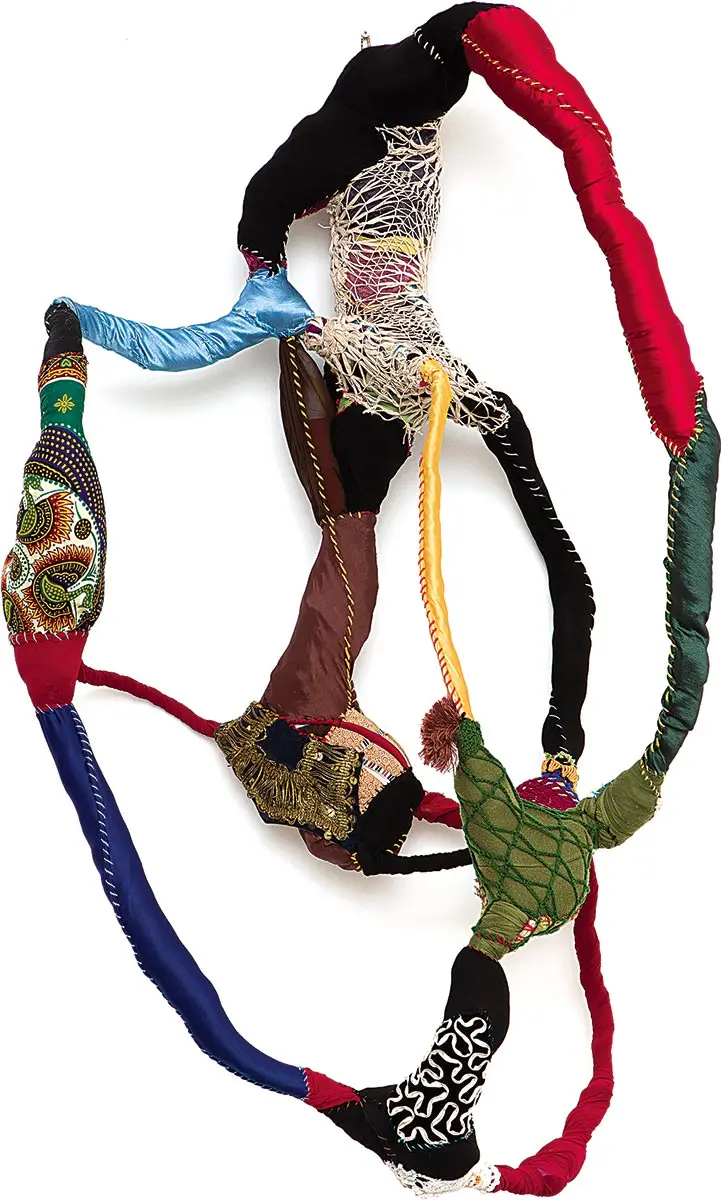
In the case of the flying, ghost-like textiles, we must refer back to their previous owner in order to see them in a different way. These are three pajamas that were part of a wedding trousseau, given by a friend who abandoned part of his old possessions after the family home was sold. The family’s background was disadvantaged, but the pajamas reveal a concern with luxury in ceremonial occasions—the information is both visible (in the embroidery details) and invisible—and Gomes is able to work with the material and also with its counter-history. Respectful of the meaning of the gift (it represents the religious rite of a couple’s bond,) she uses an artistic vocabulary to build, or rebuild, a private history.
Gomes comes from an afro-Brazilian background. This piece of biographical data is not accessory; neither is the fact that indigenous cultures are among her sources of inspiration. Artists like Ernesto Neto or the late Tunga cannot be understood without reference to their backgrounds, and Gomes’ work becomes more accessible once we are aware of her roots and acquire some knowledge of Brazilian culture. Only under those premises can we dialog with another work in this exhibition, Jaula: Gaiola (2016), and its seams, knots, embroideries, and knittings that go in and out, out and in from a wooden cage. Intervened objects are transformed into magical fetishes and rites of initiation.
In the series of works on paper that complete this small sampler of her reelaborations, Gomes—while following the same logic than in her previous works—relegates the embroidering, knitting, and tying together of elements that differ from a predetermined material to a more anecdotal exercise. In this constrained and neutral space, they lose some of their power, especially when compared with other sites where she has presented similar installations, such as the latest Venice Biennale. Gomes’ works come into relief in unusual spaces, in unique dialog with the history of the building they inhabit. Inside a white cube, they seem ripped from their habitat.
It could be argued that Sonia Gomes’ works are excessively dependent on the previous history of each object; yet, narrative or not, the suggestiveness of her proposals is appealing. Without that deep knowledge, they are exactly what they seemed to be in the beginning: the remnants of a shipwreck.
JUAN JOSÉ SANTOS