
The Galería ABRA Caracas recently presented the solo exhibition by Zeinab Bulhossen significantly titled Critical Beauty.
With vast experience in the mastery of several expressive mediums like drawing, photography, and video art, on this occasion, Bulhossen works with the evocative and suggesting power images by evidencing their ability to explicitly denunciate real-life situations without circumlocutions. For this, she deals with a central theme: the current situation of the city of Caracas.
Bulhossen initially achieves this multisensorial power of the image through the conceptual clarity that she brings to her proposal. She is worried about the state of neglect of Caracas. But at the same time, she underscores the lush and color of the city’s natural beauty, as well as its design—the urban drawing—observed on the walls of homes and, in certain compositions, captured by Bulhossen in photographs of some of the city streets. She works with these two poles—beauty/ugliness, evocation/critical discourse—in different ways, depending on the medium that she employs.
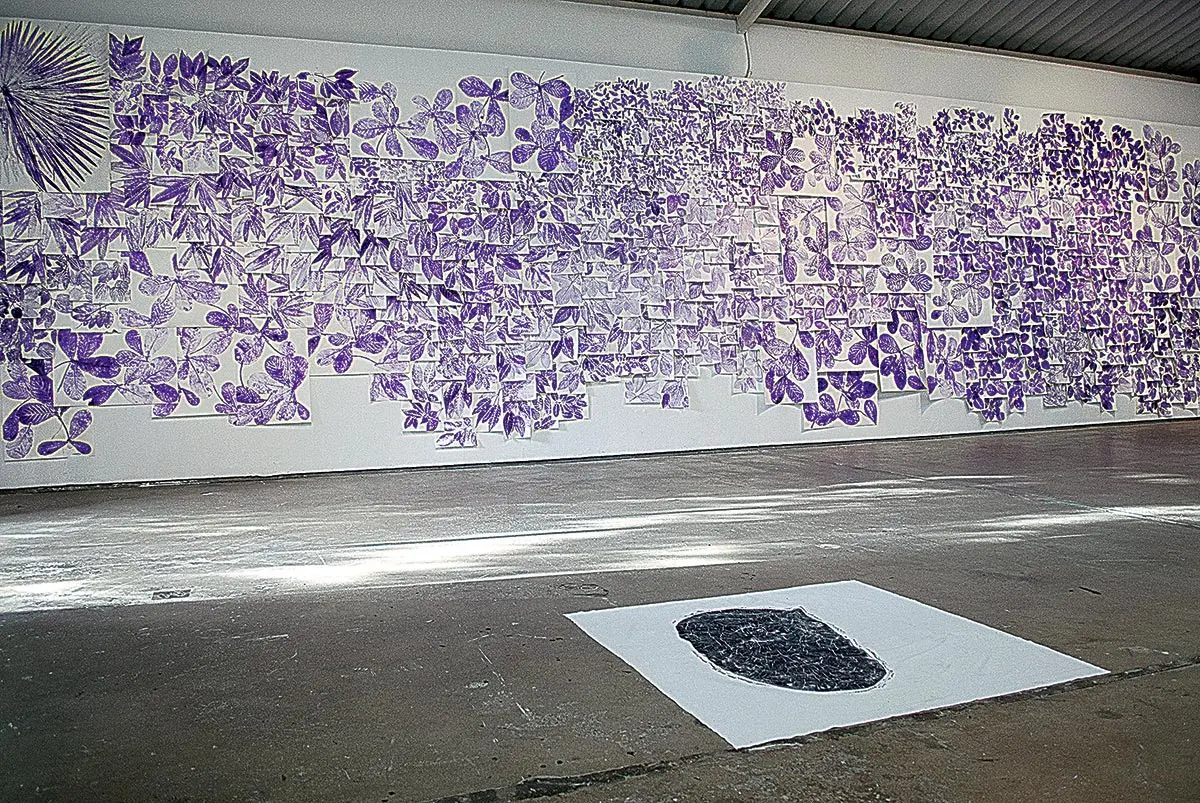
The exhibition consists of prints and photographs. The first category included a large mural installation titled Con Una Hoja Tengo al Árbol (With a Leaf I Have the Tree, 2014-2015) created with prints that Bulhossen made using the diverse tree leaves found in Caracas as “plates.” For this, she used long-lasting indelible ink to print violet leaves that were far from the natural reference of green. This color could be symbolically interpreted as a part of the critical sense of the exhibition, given that, despite the durability of the ink, the beauty we observe is ephemeral, both in the work and in nature. Both disappear the former, with the closing of the exhibition; the latter, through its natural process towards death. Thus, the ephemeral embodies the tragic underlying condition of both realities.
On the other hand, because of its magnitude, magnificence, and subtlety, the mural embodies a beauty wonderfully rendered through the use of engraving as an expressive medium. But beauty is also achieved through a reflexively generated narrative: Zeinab Bulhossen talks about the beauty of the city. For the people of Caracas, this nature is generous because of the diversity of species and always surprising seasonal vegetation and the fruits that it provides. This is why it is a critical beauty. And Bulhossen explores it by shedding light on the state of extreme neglect that Caracas has been experiencing.
Zeinab Bulhossen confronts beauty as a critical element by underscoring its terrible side. This is evident in the cut logs on the streets that have been used for the in situ creation of xylographs. There are three cuts that showcase the relentless deforestation. Bulhossen expresses dead by printing the remnants of a log belonging to a neglected tree. On the other hand, nature expresses its full force, its destructive side, when tree roots destroy the sidewalks.
The interventions by Bulhossen in the city are part of a performance process. She conceived this exhibition in the streets. Before taking her photographs, she altered the sites to underscore the critical points. In this manner, in the series Flowers in the asphalt, Bulhossen picked the flowers that had fallen from a tree and outlined a hole on the street with them. And, then, she photographed the place. In another series titled Trees and Sidewalks, she framed several sidewalks with a yellow line painted ahead of time. The compositions always include a tree and, in the background, a wall with a gate, a stone wall, or a white wall. In all of these images, she draws the city. The photographic sequence somehow coincides with the yellow line that appears in each image; a sequence interrupted by the evident destruction of sidewalks as a result of the growth of the tree roots.
Critical Beauty is an exhibition in which viewers can esthetically experience a reality (both artistic and “real”), while at the same time performing a political reading of the group of works. In the introduction text, Antonio Lazo points out: “Through actions, records, and subtle but compelling concrete re-presentations, Zeinab succeeds in doing politics with art. She does so poetically, without banners, emblems, or ideological discourses.” Because this is actually not necessary: she needs only to place the appropriate accents on specific places to deliver her points or, without really appearing to be trying, call on anyone walking in the city.
SUSANA BENKO