
Boris Viskin is an artist who swims, with solvency and certain rudeness, between pictorial minimalism and a contrasted geometry. His admiration for the history of art is at the root of his playful interventions on reproductions of Renaissance-era artworks. Drawing has been his means of expression at a young age. In inward-looking moments, it is his pencil that outlines a bristly, non-guttural voice on the paper. From there, overcoming fear of painting, he paints: minimally impastoed, deliberately ritualistic works, in layers of muted, unctuous pigment. Viskin was able to integrate small-format characters into large Italianate, operatic spaces, as in La aparición del arte moderno (The Apparition of Modern Art). At times, a word replaces a figure, or an eraser establishes three-dimensionality within work and symbolizes the artist’s intellectual facet. Viskin’s works are not strictly conceptual, but conceptualism underlies them as a matrix for the artist’s thinking; it is in this matrix that his variations are inscribed, each more interesting and different than the other. This is, as a matter of fact, a faultless aspect of the exhibition’s raison d’être.
There are series within this diverse exhibition, but difference dominates, and that is what anchors the reflection: no one is after a style or a way to recognize the author but after the results. Boris Viskin does not want to be bored or to bore the viewer. He does not want to lecture, either. He includes autobiographical elements from a variety of angles: from aspects of religion to the way in which he discovered the history of art in his family library and through his rational analysis turned geometric composition. He incorporates the symbols of three major religions: Judaism, Christianity, and Islam. His work is not a political marker, but it is altruistic and social nonetheless. Veracruz is a monumental creation for interior spaces that responds to a biographical point about the multitudinous migratory wave coming out of its port city namesake. It is an altar to the new lives initiated there and, by the opposition, to the tragic situation in that Mexican state. To intervene, to condemn, to plug and seal: Boris Viskin performs these three actions in wood, drawing, painting, and small objects. In a way, this is a musical movement, as in Cementerio de dibujos (Cemetery for Drawings), a work in oil and erasers on wood, 100 x 122 cm, and as in Katrina (American Dream), encaustic and collage on wood, 100 x 120 cm. Viskin produces small jewels—works in small format—along with others in large dimensions.
Viskin does not depict extreme violence in a direct way, but by reference to its consequences. The large paper mushroom in his installation La culminación del error (The Culmination of the Error) encapsulates this mode of expression in a geo-organic installation built inside the gallery. In it, a succession of moments on the wall—Sonata para una noche cíclica (Sonata for a Cyclical Night)—traverses the walls, and the mushroom at the center reminds us of our various Hiroshimas, the current world, and death. It is a restrained, mnemic, temporal exhibition. We note that time, as a subject matter, is present in Viskin’s work in oblique, nonlinear ways.
A long-awaited and necessary exhibition, La belleza llegará después (Beauty Will Come Later) brings together works from the last fifteen years by someone, Viskin, who has inhabited artistness since the 1980s. Here, the reading is formal, museum-like, and at the same time driven by the intimacy that emanates from the annotations accompanying almost all the works on exhibit, contributing a line of thought, connecting visitors with the fraternity of the studio, and breaking with the institutional rigor of the informational card. Humor is present in two ways: the articulation of different codes of beauty that are independent of those historically established, and today’s beauty itself, which is shifting and active.
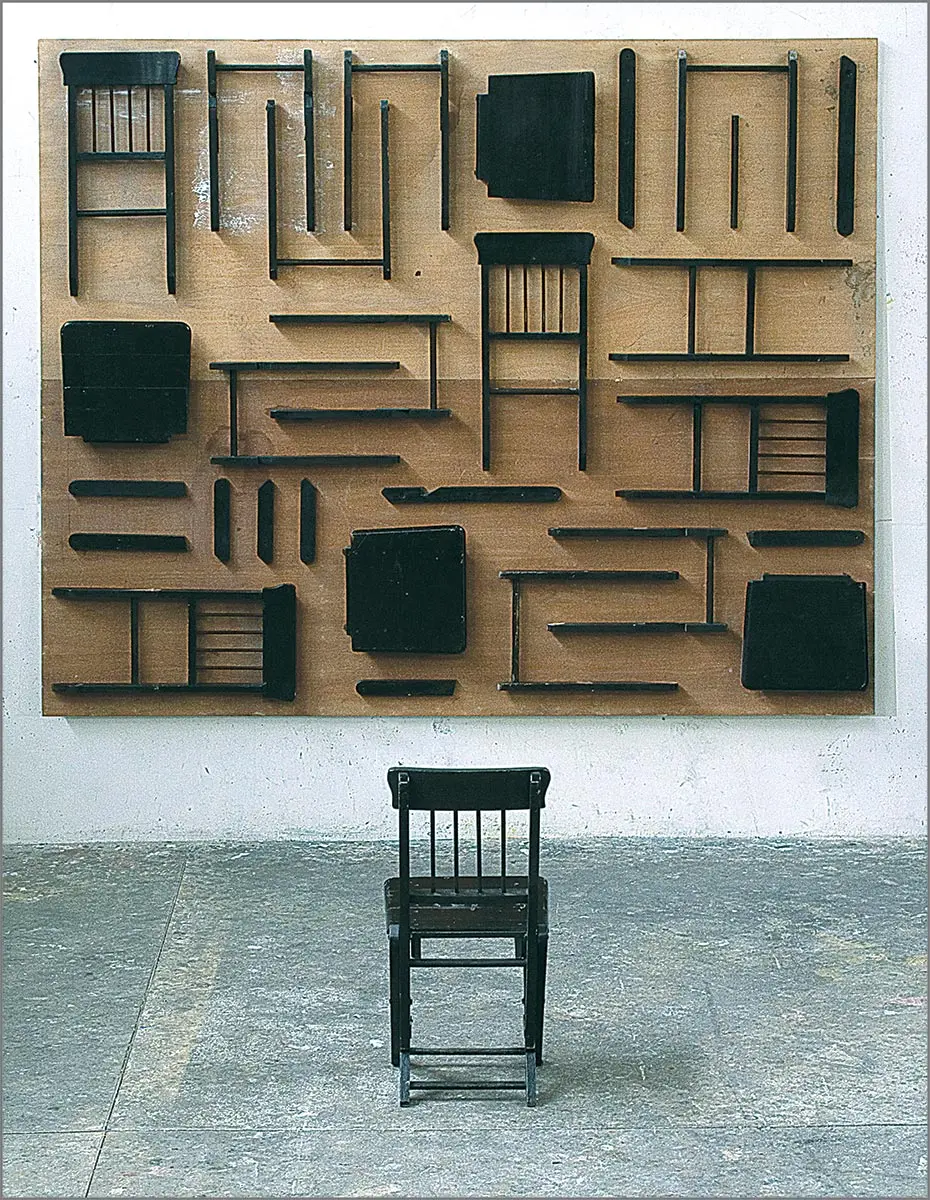
While in the 1980s and 90s many Mexican artists remained more attached to the pictorial domain, others traversed disciplines, usual methods, and materials, and incessantly proposed new paths. Viskin is as serious as he is irreverent. His work is hybrid, as are his interests. He admires the great masters. There is no doubt that he mentally analyzes, deconstructs, and reconstructs what he presents us within his works. Altered grids are a constant in his drawings, paintings, mixed techniques, and installations like Autorretrato con lengua de fuera (Self-Portrait With Tongue Out) and Autorretrato constructivista hablado (Constructivist Spoken Self-Portrait); in Petates remixed (Bedrolls Remixed), in Huacales (Crates), and in Librero (Bookshelf). In Viskin’s works, there is no concrete separation between assemblage and painting; rather, they embrace, be it in a figurative, abstract, or allegorical way. On occasion, these presences are fundamentally material; at other times, they inhabit a situation or a reflection. Silla mirando sus partes (entre Platón y Heidegger) [A chair looking at its parts (between Plato and Heidegger)] is one of such experiences. Viskin writes: "A chair looking at its parts. I look at the chair looking at its parts. I look at myself looking at the chair looking at its parts. And you? What are you looking at?"
GRACIELA KARTOFEL