
Painting and photography are in an intense honeymoon moment. It seems as though the latter had been born for the former, and the former had been waiting for the arrival of its partner to open up pathways of renewal and freshness. It wasn’t always the case. In the first half of the Twentieth century, theorist André Bazin thought that photography had arrived to free painting from the binding need to represent reality. In his humanistic approach, Bazin started from the assumption that, after centuries of attempting to master—with ever-increasing perfection—the techniques for imitating nature, technology had advanced in that direction to the verge of absolute splendor. That technological drive brought about the emergence of photography to complete the process, and a few decades later photography took another “step forward” with the arrival of cinematography. Today, painting is nourished by digital aesthetics and by the aesthetics of the mass media, implanted in everybody’s mind by video and photography, in order to reflect about the visual culture and the hegemony of the image in which we are immersed.
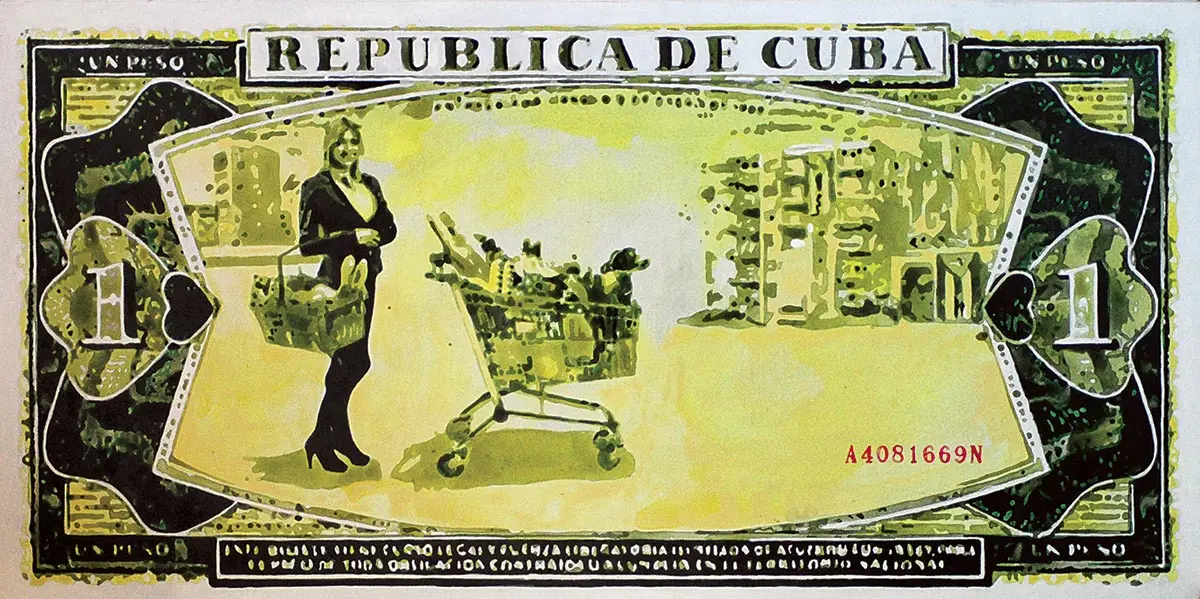
From its earliest beginnings, the work of Carlos Salazar Arenas (Bogotá, 1973) took as its starting point the translation of this culture of visual manipulation of the image into drawing and painting. In concrete, in his exhibition Filatelia and numismática (Philately and Numismatics) the artist pays homage to his childhood collections, and by extension to those of the many children of his generation who, unaware that those tangible objects would become a series of ones and zeros in a not-so-distant future, collecting stamps and coins. In our everyday life, physical materials recede to the background, but the images of politics and historical events have moved to the mass media, to the digital news we consume online. After amassing his first collections, and now as a visual artist, Salazar returns to collecting, in this case of internet images that he substitutes for the recognizable icons in stamps and banknotes. Salazar presents in this exhibition a series of bills and stamps transferred in pencil on paper or acrylic on wood. He exchanges the imagery of the original objects for images gleaned online, the Internet now being his main source. There is an element of irony and sarcasm in his work, although it is at times simply sharp and lucid. Just as we are starting to think he is following formula, we find that on occasion he prefers to experiment, presenting us with unanswerable images that respond to purely aesthetic games. As a strategy, Salazar inserts images that go against the logic of the original. On the one hand, our knowledge of the original source might be key to reading works like 2 pesos, Pola, which makes reference to the national political martyr Policarpa Salavarrieta and presents the image of a woman pointing a gun to her head, about to commit suicide. Others, although not so close to local experience, are universally understandable, such as the Asian family on a Chinese banknote in Economía oriental (Oriental Economy). The wink here is to the industry of products manufactured for the stoking and satisfaction of the American or Western dream, which fuels an entire emerging economy in the East, its growth based on cost reductions with no mind paid to those hurt by the system. Another excellent, direct, and the immediately accessible instance is the Cuban bank note in Mercado libre (Free Market), which depicts a woman posing, queen-like, with a supermarket cart and basket filled to the brim with the products that we all take for granted when shopping. Salazar’s work also speaks to the state of images today. Bombarded with images that communicate no longer truth but a push to have us gobble down an interested discourse, images have become more powerful while at the same time largely losing their credibility. The key is to know how to read and interpret them, like a child learning to read. Salazar pushes us to reflect on this: he presents us with something we recognize by association, only to shift its meaning. Whether we apprehend this meaning depends in great measure on the information we possess and our capacity for reading and interpretation. The image is like a sweet and beautiful snare that captures us, and only later do we understand what lies between its games. To return to Bazin, photography and film have a realistic avocation, intent on capturing the “trace” of reality. Salazar’s works set painting and photography to collaborate hand in hand to communicate the realities of today’s world: a world where digital images reign, surrounding our existence almost entirely and inundating our ever more fickle, ever more erasable collective memory.
CARIDAD BOTELLA