
The Parisian Galerie Bendana-Pinel continues its policy of promoting Latin American contemporary art and, for this reason, it often favors young emerging artists over well-established ones. The exhibition by Chilean artist Christiane Pooley (Temuco, 1983), her second solo exhibition in France—the first was shown at the New Galerie de France in 2008—ratifies with its great quality the success of the defining approach taken by the gallery. Based in Paris since 2010, Pooley is a painter. When asked about the reason for choosing that medium—a rare practice among young artists in the current artistic scene—Pooley justifies it with solid and ancestral convictions. And her work is there to convince us and prove her right.
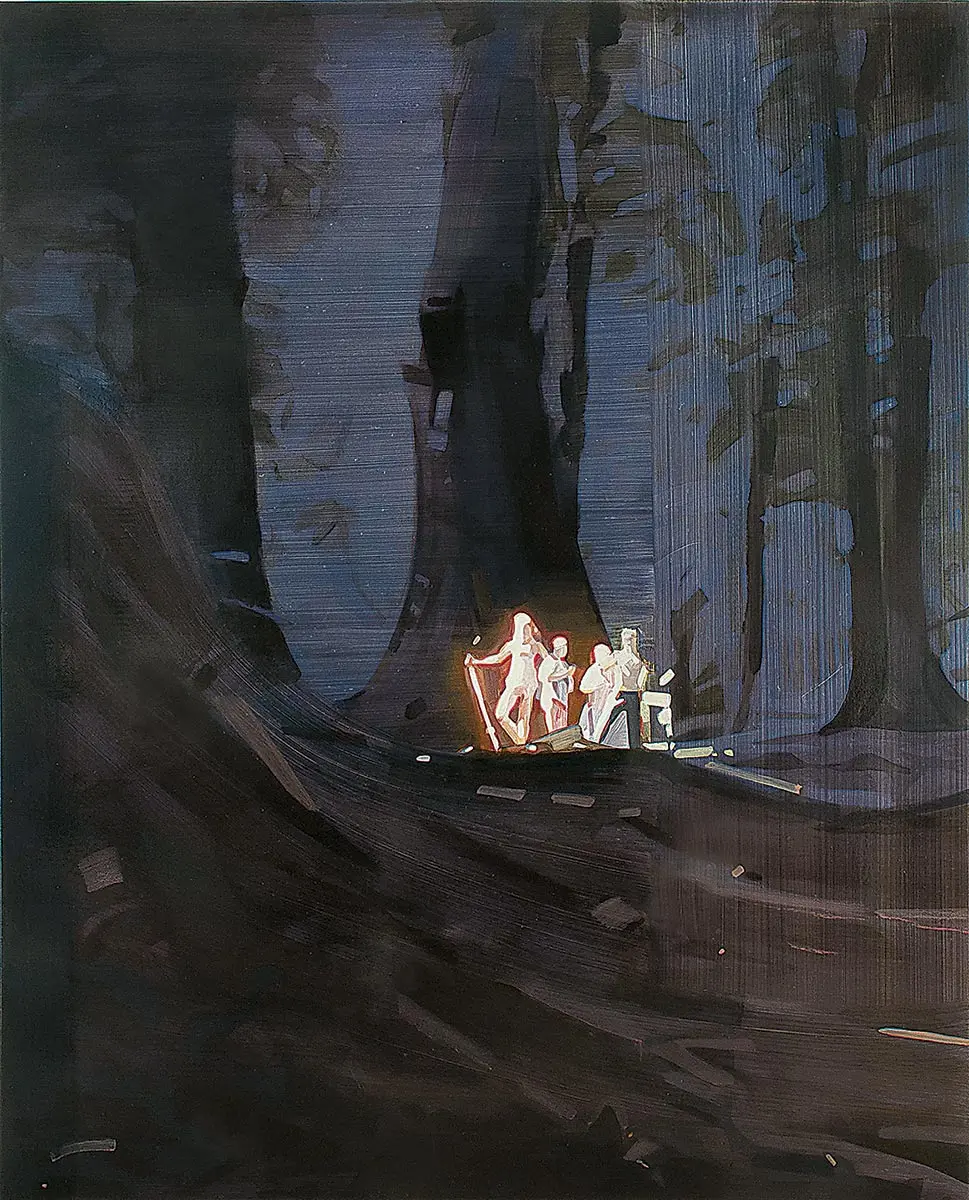
Consisting of nineteen oils on canvas (fifteen small and four large) and three oil and drypoint paintings on copper plates, the exhibition centers on the theme that obsesses Pooley: the relationship between nature and mankind, an inquiry that is more than a mere artificial pose or a simple accident. She is really deeply interested and curious about it, in part because of the telluric dimension of her homeland; a long and thin strip of land that borders on the west with the Pacific Ocean and is contained on the east by the Andean mountain range. It is an oceanic and mountainous country, desertic and wooded; an omnipresent, dominant, and dangerous natural world. And then, there is also the history of Chile, also one of Pooley’s central intellectual and affective interests.
Another Chilean painter, Vivian Scheihing, also bases her work on a quasi-visceral relationship with the mountains. But unlike her, in Christiane Pooley’s work, mankind has not disappeared. On the contrary, man is very much present and actually the one that spatially and visually justifies that which surrounds, protects or threatens him. Treated like a ghostly presence, which may be appearing or vanishing through a strange and fleeting light, the human figure perhaps attests to nature’s desolation and severity. It is a spectral and theatrical atmosphere that is responsible for the mystery surrounding universes created by Christiane Pooley. Her work brings to mind Christina’s World (1948), the famous painting by US landscape artist Andrew Wyeth. But it is not because of a shared thematic or aesthetic approach, but rather for the similar way in which Pooley sets the human figure, its solitude and impotence, against the vastness of the natural space.
But Pooley’s ethereally translucent, subtle, and delicate painting is simple only in appearance. The superimposition of spaces makes rendering the image a rather complex affair; it is much more about a pictorial exercise of layering planes than about trying to convey some sort of message. Scenographic in nature, the canvas is rendered as the fleeting instant of a frozen narrative, a sort of “still photo” like those used in films to capture our attention and instigate our curiosity, but without making us forget about the importance of the effects of lighting on the characters—which is also a reminder of the “day for night” cinematic technique used in filmmaking for nocturnal scenes filmed during daylight.
Developed across two spaces, the exhibition contains several “sets” of works. Displayed in the first exhibition room, the small and medium size works are arranged on the wall in groups following a top to bottom and right to left order. It is a sort of “sainete” in which real and supernatural elements are superimposed or combined in compositions where open and closed spaces, opacity and light, are contraposed.
Christiane Pooley plays with contrasts that set the dramatic tone of her “stories” and render them original and enigmatic. Hers is also a painting style in which the viewer is both observer and observed. The titles of the three large works included in that exhibition room reference and combined inquiries of collective and individual memory—Pooley explained that she uses photographs of her family—with her explorations of a particular place. The work titled La Forêt est Là et Me Regarde (The Forest Is There and Observes Me, oil on canvas, 130 x 200 cm, 2013-15) evokes the history of Chile based on a photograph from the end of the nineteenth century. On the other hand, the piece titled Waiting for A. Harrison (oil on canvas, 120 x 100 cm, 2012), evokes US painter Thomas Alexander Harrison. And, in El Silencio De Los Bosques Del Nuevo Mundo, Una Felicidad Imaginaria (The Silence Of The Forests Of The New World, An Imaginary Happiness, oil on canvas, 165 x 135 cm, 2016), Pooley remembers a family outing in the woods. The three works on copper plates center on the subject of the anonymous and solitary wanderer in the heart of a dense forest that appears impenetrable.
In The Last Picture 1 and 2 (oil on canvas, 41 x 33 cm, 2012), and more so in Landscape Beneath (oil on canvas, 120 x 100 cm, 2012-2016), shown in the second exhibition room, Christiane Pooley continues her pictorial and symbolic exercise centered on the things that are visible and on those that are hidden. Her love for painting is complemented by an ability to combine intimacy, history, and the landscape in a single, or in several, imbricated spaces; a fragile architecture that explores the omnipresent question of the many secrets of memory.
CHRISTINE FRÉROT