
American critic Harold Rosenberg’s observation that contemporary art is “a species of the centaur, half art materials, half-words” is considered among the most important such dictums in the Twentieth Century. Its relevance resides in the fact that it, perhaps, settled a central dispute in modern art: the confrontation between words and images, in the understanding that the latter lose some of their autonomy when in proximity to verbal elements. But this annexation ceased to be problematic. We no longer have works of art split between the verbal and the visual; now, fluctuation dominates the field.
The fact that language was important not as tribunal but as a medium was already evident in 1969, the year Rosenberg’s text was published1. At the time, modes of process art were at their peak and a sudden interest in documents and fieldwork opened up possibilities for the most diverse kinds of verbal record: diaries, declarations, and inscriptions began to populate exhibition galleries and museums, or became the entire exhibition in themselves, as was the case with Seth Siegelaub. Both phenomena—language as an “external” system and language as an “internal” medium—were complemented, already at that time, by a hypothesis confirmed by second-wave avant garde and conceptual art, the latter directly responsible for the enthronement of texts: that the artistic is best understood if one uses linguistic and communicational metaphors.
Four decades after an interest in language incited a veritable revolution, texts, words, editing, books, and the world of communication began to appear in many different ways. Their presence has reached such proportions that it is legitimate to see conceptualism and its bookish derivates as the lingua franca of contemporary art. Postmodernism, multiculturalism, and relational aesthetics are unthinkable without textuality, and it is possible to see in the latter one of the current paradigms.
A review of the last few decades reveals that solutions of the most diverse kind can coexist under the umbrella of the use of words, their articulations, meanings, and supports: aestheticism and politics, maps, relational pieces, situations, ethnographies, activism can all deploy the symbolization possibilities offered by language. Painting, sculpture, photography, performance art, video, site art: nothing seems to have escaped the omnipresence of verbal signs, writings, and readings in space, object, time, and image. The crossing of insubordinations, media, and formats that for simplicity’s sake we call “pluralism” seems to have found its main driver in the linguistic system.
It is not thus a coincidence that the presence of texts has become a subject for curators and collections, no longer under the more or less implicit premise that all art includes elements made with words and ideas, but under the materialization of some of literature’s never-fulfilled promises: that of an autonomous visual and objectual world in which words are the primary agent. This is, then, a fundamental step that can explain today’s ruptures and reshufflings of artistic modes and “languages.” In fact, the struggle with the literary, which was on the agenda for the modernist program with its desire for radical independence from all genres, remains, albeit via loans and usurpations.
An exhibition dominated precisely by this protean presence of texts, books, and words was held in Medellin: ConTexto: palabra, escritura y narración en el arte contemporáneo, curated by Francine Birbragher Rozencwaig and Óscar Roldán-Alzate. The show, presented in the exhibition galleries of the University of Antioquia’s Museo Universitario and the National University’s Architecture School’s Sala U, brought to the city recent works of art animated by verbal interests. Selected from collections guided by linguistic, editorial, and communicational premises, the exhibition, organized in three axes—Poetics, Rhetoric, and Pragmatics—brings together artistic responses to language produced over more than four decades.
Pop Art, conceptual art, the neo-avant-garde, social sculpture, and more recent developments are represented through works by artists like Andy Warhol, Joseph Beuys, and Damien Hirst. Such historical and geographic variety is accompanied by forceful thematic displays, able to bring forth the transversal position of words with respect to techniques and aesthetic resources in Colombian and Latin American art.
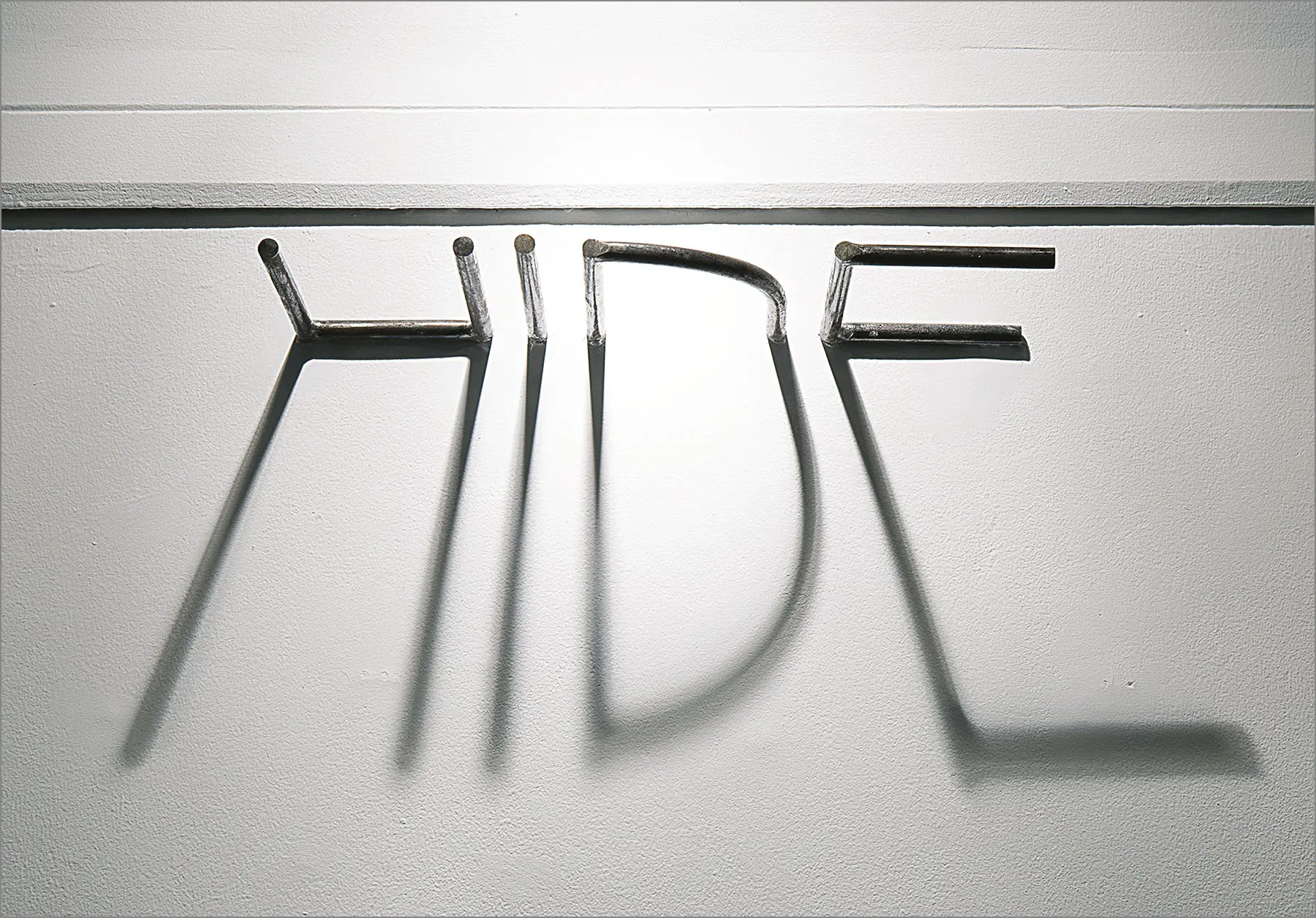
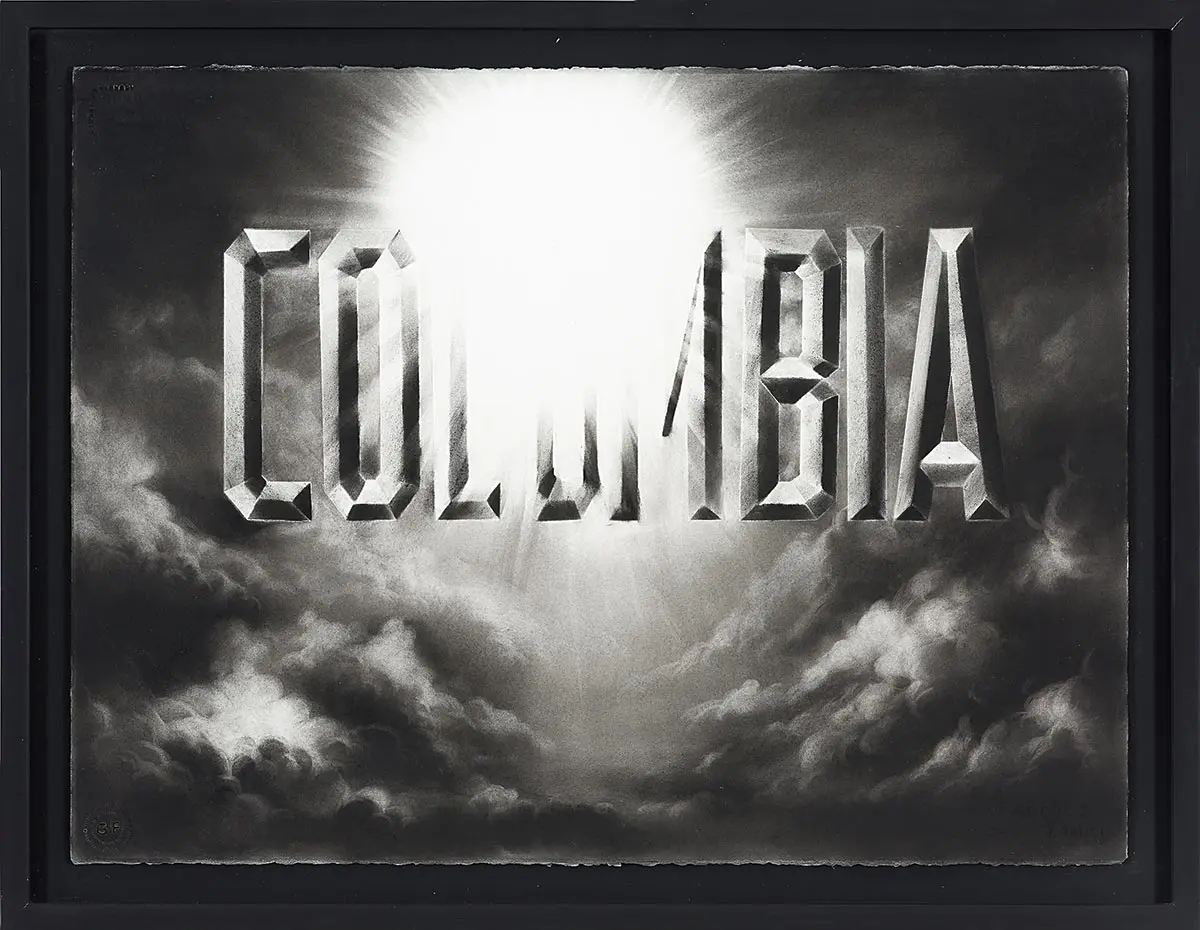
On the one hand, the exhibition features medial responses; this is to say, responses that delve deeply into a given aspect of words and interrogate them with their arrangement in space or on supports. The Columbia logo, with a shining light, can be at a given point the name of a South American country (Gonzalo Fuenmayor). In some cases, the workforces viewers to become aware of the material dimension of language, while in others what we have are appeals that emphasize an awareness of the context (perhaps it is this that the “Pragmatics” axis refers to.) While a work like Sandra Valenzuela’s TUYO (YOURS) is able to show, via the artifice of projection, the strangeness of words to which we seldom pay attention, Iván Capote’s Hide reveals the mystery of signs arranged in space in an effective way. Not even illusionism escapes the influence and the abstractions of language’s symbols.
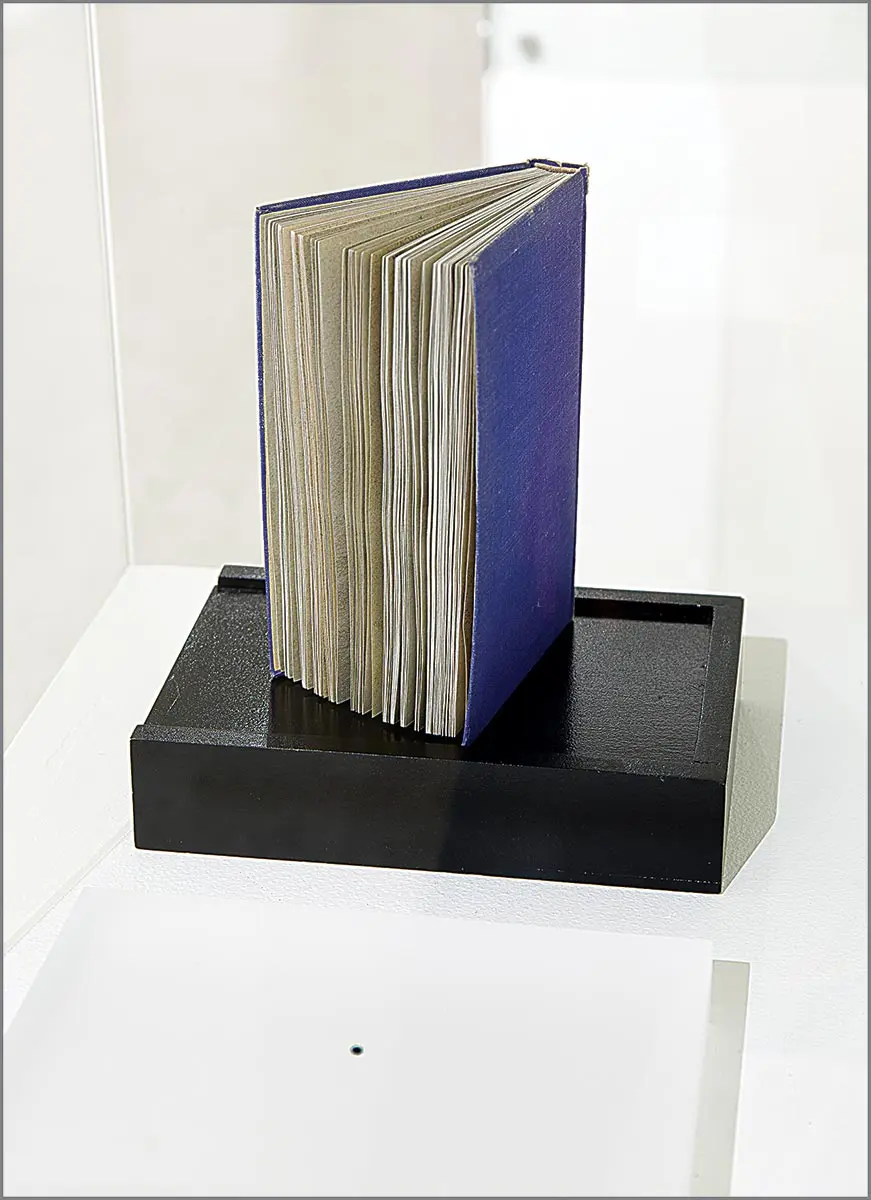
On the other hand, we have proposals connected to hermeneutic responses. In this case, we are talking about works of great semantic density and symbolic effectiveness, able to say something about such ungraspable matters as interpretation and understanding. One of the show’s deepest and most forceful works belongs in this group: Blackout where Ecuadorean artist Óscar Santillán, using a rather surprising procedure (the miraculous-seeming extraction of ink from a book by St. Augustine) in a deeply poignant operation, is able to render the problem of meaning, the synthesis of sense, literal. As though it were an allusion to the extraction to the stone of madness or a reference to philosophical quests, this work demarcates a before and after its contemplation. An ironic stance towards self-help manuals and a critique of the values of metaphysics are present here, as is poetry. The fact that we see all the ink from the book in a small solid sphere, and that the book appears “blank”, liberated from the weighty letters of a philosophical classic, is more than an illustration.
References to language as a political element also occupy an important place, thanks to works that pose a question about words as instruments of struggle and sites of activism, but also as means for social and cultural estrangement. And also an estrangement of identity, if we take into account the abundance of flags and patriotic symbols. At times recovering the aesthetics of the poster or directly alluding to iconic texts of political debate, these works are able to communicate the essentially historical place of such debates and confrontations. The presence of Latin American artists such as Cildo Meireles, León Ferrari, or Luis Camnitzer is best understood in that sense, as proof, to a degree, of what Camnitzer writes in Didácticas de la liberación: that the political action of conceptualism in Latin America always forged an alliance with poetry.
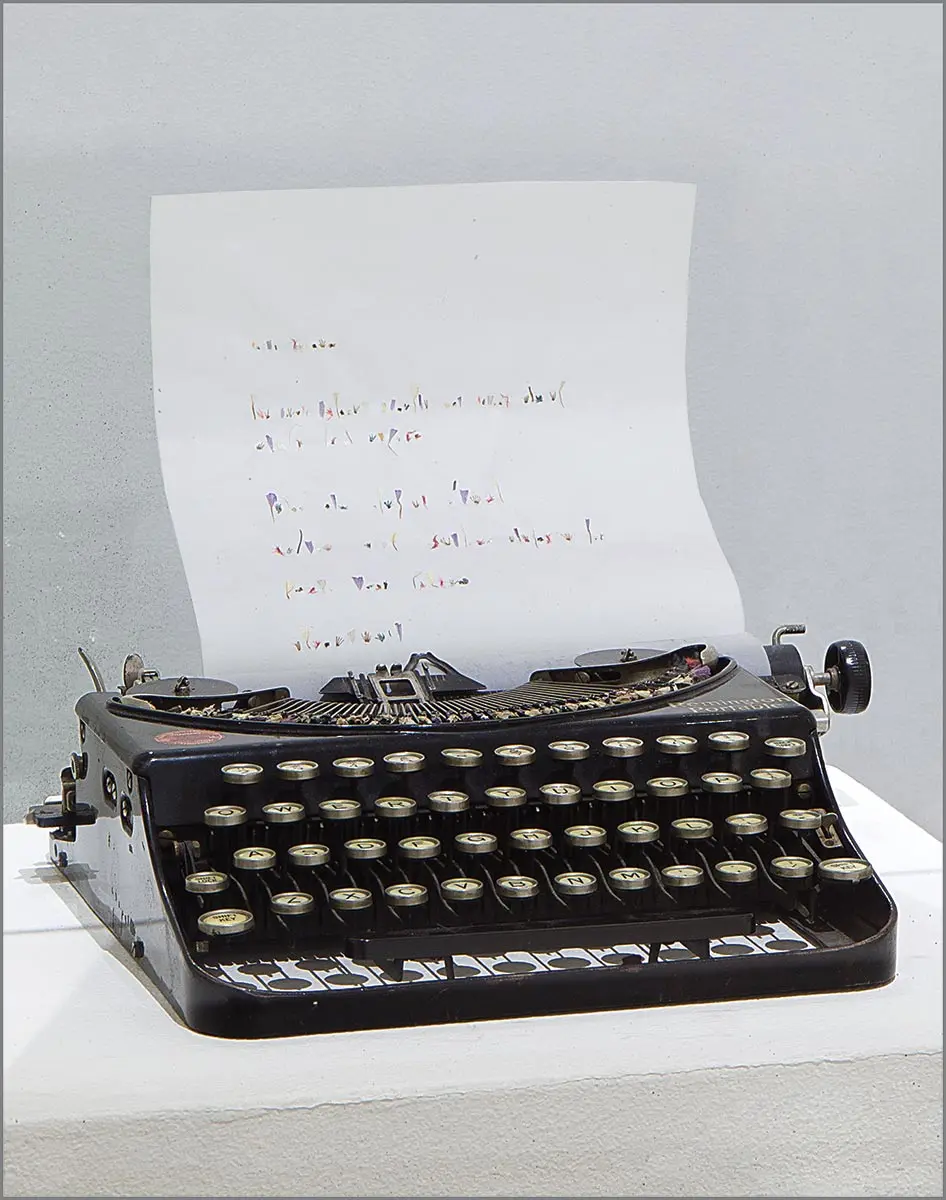
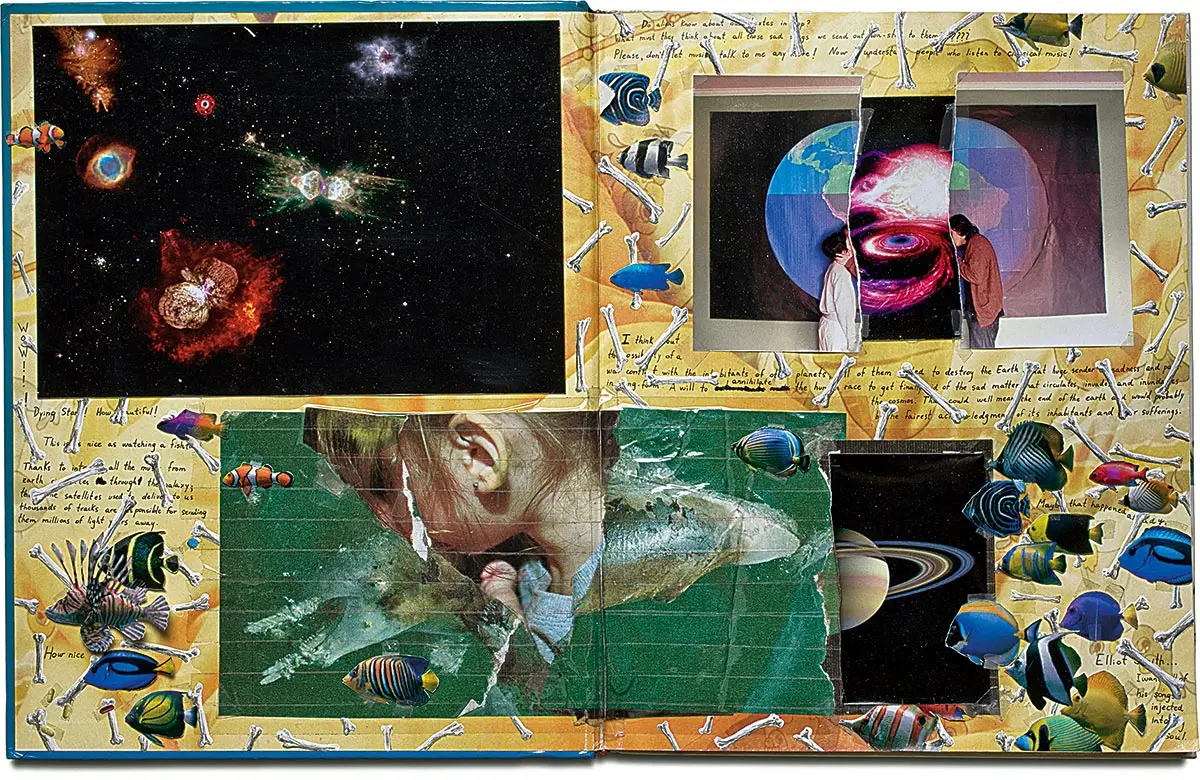
Perhaps one of the show’s most significant segments is the one comprising works that appeal to narration and the book, which is to say, an artifact with a strongly anthropological aspect and a fixative mechanism with powerful emotional resonances. Approaches that aestheticize the physical aspect of books (Miller Lagos) denote processes of editing and writing (as in Glenda León), and, ultimately, tell a story and are able to denote one of these poetics’ most important manifestations. The book and its capacity to contain what is narrated emerge powerfully in arrangements that may evoke a bibliographic collection (Adrián Villar), a printing workshop, or the simple keeping of a diary (Marta Ramírez). Or, in fact, they can be works that are books. Sometimes an artist’s book, true, but also a book of literature, as is the case of the imaginary lives of the storybook La línea sin reposo (The Restless Line), illustrated by Jorge Marín.
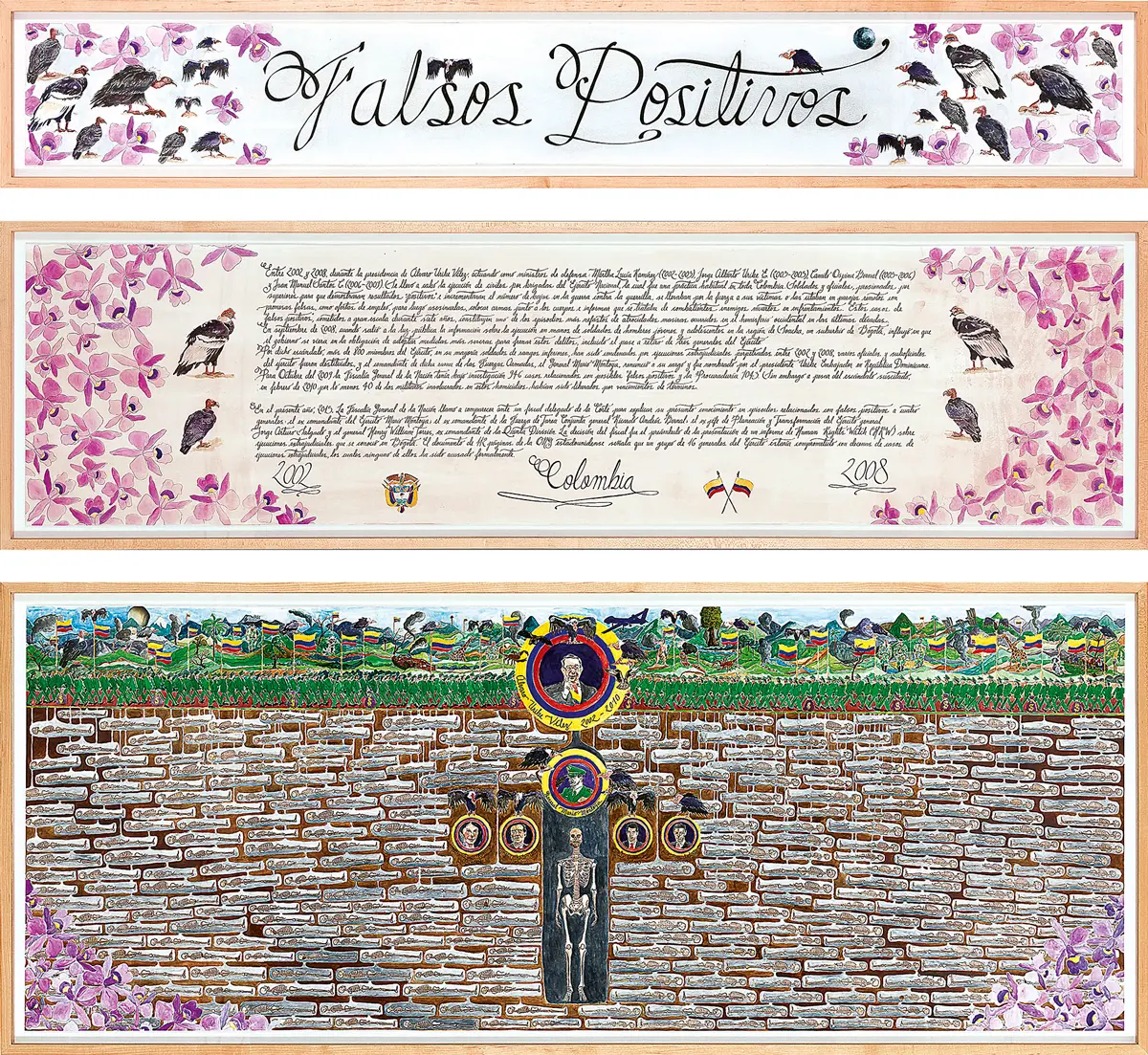
Memory, conflict, and history, which as we know play a dominant role in the collection holding the main works in this show, also offer an even broader framework for the curators. Thus, we have the appearance of traumatic subjects (or subjects strongly connected to Colombian and Latin American identity), referencing emblems with their clearest referent in the lettered tradition. For example, in Julián Aristizábal we see that the dark episode of extrajudicial executions in Colombia some years ago resorts to sinister heraldry, not unknown to artists of the past like Débora Arango and Carlos Correa, the latter also present in the exhibition with one of his engravings.
An exhibition like ConTexto holds a special interest not only because it attests to the centrality of verbal language in contemporary art, present in Rosenberg’s observation cited at the start of this essay. Its value and its persistence in the viewer’s memory (the memory of a viewer who here is also a reader) resides in the way it shows the paths, from centaur to Proteus, followed by the arts of the word and the arts of space. It has been said of our era that the figure of the editor is an inescapable reference to understand cultural-field professions. This perhaps explains why working in terrains where the problematic aspects of discourse are the major demand is mandatory for both artists and curators.
NOTE
1. Rosenberg, Harold. “Art and words”. The New Yorker, May 29, 1969.
EFRÉN GIRALDO
Ph.D. in Literature, Mg. in Art History. Chair, Humanities Department, Eafit University, Medellin, Colombia.