
Over the last twenty years, new museum buildings across the world like the Guggenheim Bilbao—commissioned to Canadian architect Frank O. Gehry and inaugurated in 1997—or Whitney’s move from the iconic building built by Marcel Breuer on Madison Avenue to the renewed Meatpacking District—to a monumental new location designed by Renzo Piano and Richard Rogers in Manhattan’s Lower West Side—have been some of the most celebrated examples of the exuberant proliferation of a trend marking the global art scene. Among the earlier pioneering gestures—speaking of the Genoese architect—was the 1977 opening of the then-controversial Centre Georges Pompidou at the Plateau Beaubourg, parking space for trucks delivering to the Les Halles market. More recently, two sites of the same institutions opened in Metz (France) and Malaga (Spain). The list of examples continues with the grandiloquent Maxxi, a Twenty-First Century museum, in Rome, which opened in 2009 and caused surprise as well as controversy. Finally, the Louis Vuitton Foundation, also by Frank Gehry, opened its doors in 2014.
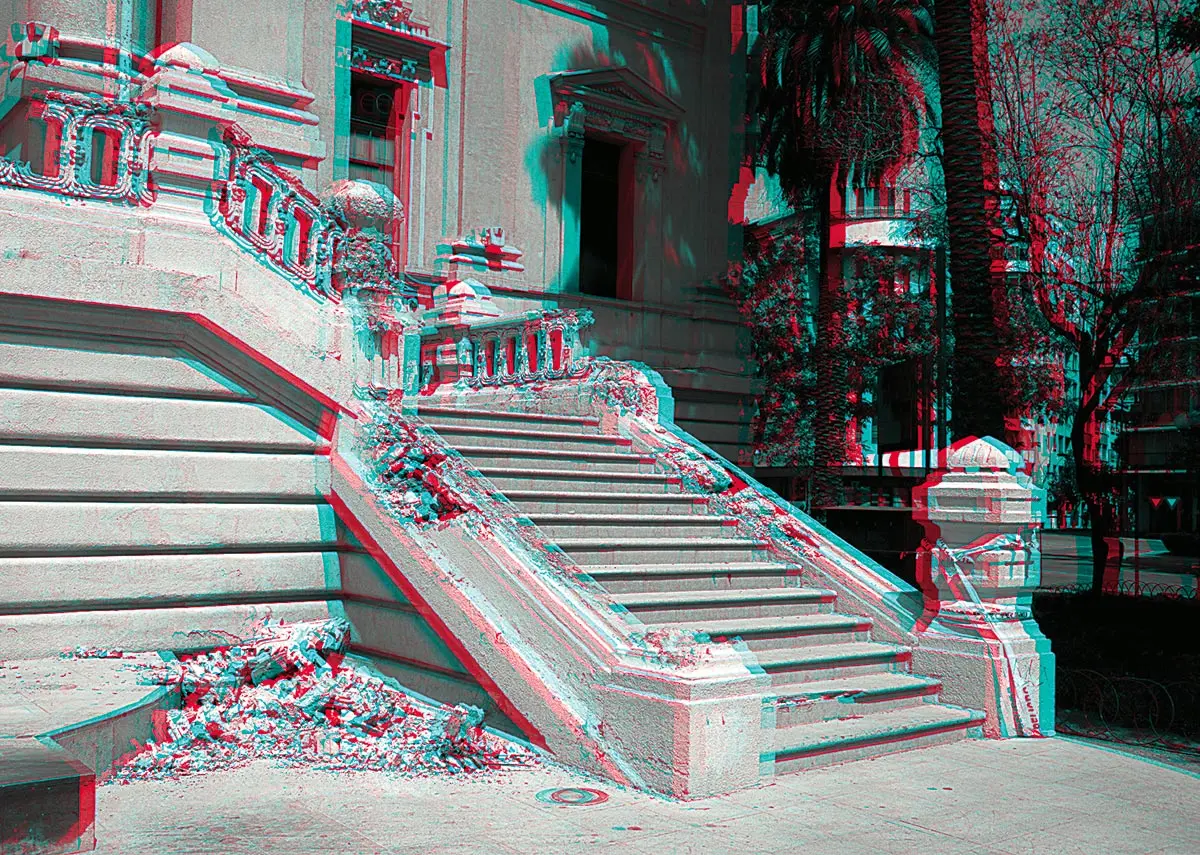
This brief list of examples of architectural magnificence for the safeguarding of modern or contemporary cultural treasures seems to contrast with the images proposed by Cristian Segura in his Sismo en Chile-El museo en ruinas (Seism in Chile--The Museum in Ruins), at the San Martín Cultural Center’s Gigantogalería, an exhibition space located atop an exterior wall overlooking the plaza where one of the entrances to the grand cultural complex is located, at the intersection of Sarmiento and Paraná streets, right in Buenos Aires’ downtown. This site will host, through February 2017, the exhibition of five anaglyph 3D photographs, 300 x 421 cm each, depicting the damages caused by the 2010 earthquake in central and southern Chile, which reached an intensity of 8.8 on the Richter scale, to the Museo de Arte Contemporáneo in Santiago. The photographs offer viewers two moments of the reception. At first glance, they are black and white images composed of two slightly out of phase color layers (cyan and magenta), and this effect evokes the seismic movement recorded in part of Chile’s territory. Viewing them through anaglyph 3D glasses, however, produces a three-dimensional effect that places the observer at the very scene of the tragedy.
The extreme synthesis and dematerialization expressed in this work by Segura, hewing so closely to conceptual tenets, are counterbalanced by its great signifying potency, which prompts thoughtful consideration of museums and cultural institutions in the global present. More specifically, it points towards the situation of countries—as seems to be the case of several in Latin America—where the resources available for the conservation, preservation, and protection of patrimony are subject to the variability of the budgets appropriated for such ends.
Segura established a metaphor between the effects of a natural disaster on the buildings and spaces holding contemporary and historical memory, and the manifold challenges faced by cultural policies both in the Southern Cone and the region around it, and in the so-called First World.
Segura has the precocious experience of having been Director of the Municipal Fine Arts museum of the city of Tandil, in Buenos Aires province, at the age of 23. He explains that his work there motivated him to create works of art dealing with these issues, exploring notions like the conservation of the artistic histories housed in the institution, its dependence on political and public support, and the idea of the permanence and preservation of art when a museum falls victim to mismanagement and lack of resources, or when it is literally consumed by flames or razed by an earthquake.
Also, new drives and initiatives emerged in today’s world, such as the development of the iconic architecture for the city where the museum site is located or of an architecture whose goals connect with reasons of urban renewal and tourist attraction, add to the primordial objectives of preserving collections or organizing exhibitions.
So, thinking about the wide spectrum of cultural policies becomes more and more indispensable. The weightless materiality of Segura’s work appeals to the intangibility at the core of culture: that immaterial nucleus embodied in works of art by means of matter, image, sound, and the subtlest gesture. This was a clear postulate of conceptual art from its beginnings.
MERCEDES CASANEGRA