
The creation of the Instituto Valenciano de Arte Moderno (IVAM) in 1985 transformed Valencia into one of the most dynamic regional capitals in Spain, following the path paved by the pioneering Galería Punto, founded in 1972. Carried out in close collaboration with public and private museums and institutions, the national and international promotion of the artists that it represents—including Joan Miró, Jean Dubuffet, Pierre Alechinsky, Hans Hartung, and Antonio Seguí, among others—earned the gallery the prestigious distinction of a medal granted by the city of Paris in 2006.
This selection of recent works by Argentinean artist Cristina Ghetti (born in Buenos Aires in 1969 and based in Valencia for many years now) confirms the quality that the Galería Punto demands from the artists it represents. It also expresses this gallery’s desire to nurture new artistic proposals by young and/or emerging creators. This is the case of Ghetti, an artist whose work is always transforming within a geometric realm, embracing the reflective and assumed impact of some similarities with US artists like Frank Stella and Bridget Riley. While Sol LeWitt is the US artist that she most admires—for his inquiries on planned seriality—Ghetti also draws from the conceptual and formal legacy of another generation of artists, this time from South America. The abstract, constructivist, and concrete artists from Río de la Plata and Brazil, as well as the artists from the MADI movement and later from kinetic art, opened a path towards visual reflection—was essential to counter the figuration of “magical realism” and the various forms of political art—and established an international abstract tradition that defined the Latin American art of the 20th century.
Through time, the evolution of Cristina Ghetti’s work has been defined by the permanence of theoretical and formal inquiries that have led her to appropriate and reformulate the contributions of abstract and geometric art. She approaches the new forms of mass media and the new technologies both “physical” and, most importantly, intellectually. The learning she attains with her inquiries allows Ghetti to explore seriality through color and form and humanize virtuality without neglecting the gesture that shapes the elegance of her patient and wisely constructed forms. Hand (the preliminary work) and machine (the computer) are combined to create evolving work that changes according to technological advances and that is continually exploring new chromatic experiences and moving forms.
For the most recent exhibition of her work, Cristina Ghetti designed an innovative and dynamic museography in two exhibition areas of the gallery. The curatorship wanted a departure from earlier, more conventional, presentations. With this in mind, the exhibition was to be approached as an installation in which 15 works, created with different materials (canvas, wood, aluminum, acrylic paint, and three-dimensional objects), were arranged to establish a “dialectic” in the space, where each piece would chromatically or formally echo the work nearest to it. It is a walk conceived by Ghetti as a continuum that allowed a panoramic view in which to experience the sensitive and evident transition from one piece to another, from one series to the next, between two different zones (black and white, and color). There, the sensorial and spatial experience (virtual movement) was combined with the experience generated by the visitor´s actual movement through space, conceived just like kinetic artists Jesús Soto and Carlos Cruz-Diez would.
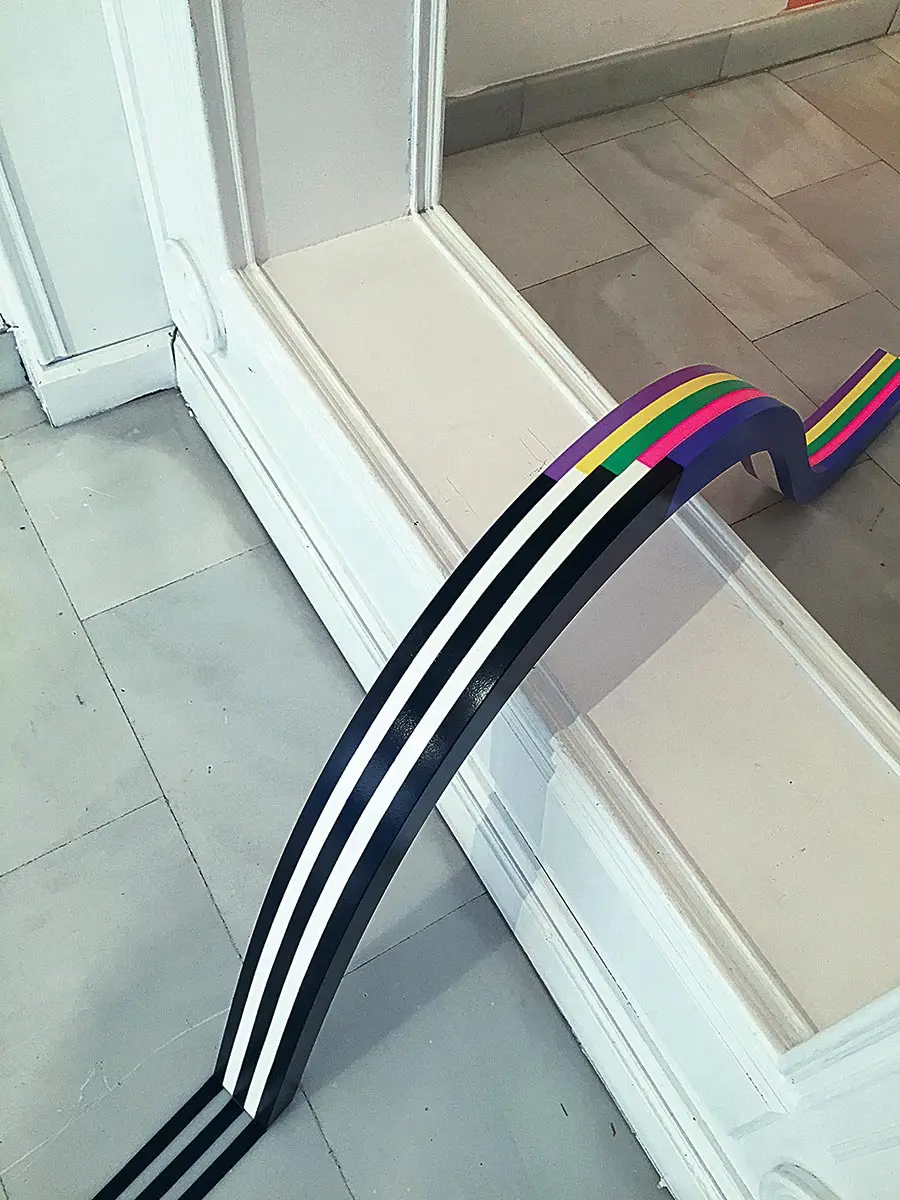
It was also a way of encouraging viewers to generate their own associations, interactions, and surprises. In the first exhibition area, the black and white undulations in Boucle (a mural object, mixed media on aluminum, 120 x 45 x 4.5 cm, 2016), Folding Pattern (acrylic on canvas, 160 cm x 160 cm, 2016), and Swingers (a mural object, mixed media on aluminum, 100 x 10 cm, 2016), share parallels with the polychromy found in the second exhibition area. The stripe painted on the floor that begins in Mareas (Tides, mixed media on wood and vinyl intervention, 100 x 90 x 35 cm, 2016) continues to Passage (wood and mixed media, 140 x 70 cm, 2016) where it takes shape as it negotiates an architectural obstacle—the arch that separates the two exhibition rooms—to arrive at the next piece. The black and white on the canvases and objects in the first exhibition is answered by the happy and symmetric palette in another Mareas (Tides, mixed media on pressed wood, 100 x 110 cm, 2016) and Swingers (mural object, mixed media, 110 x 10 cm, 2016)
The subtlety of this presentation resides in the intelligent and fluid spatial and relational concept. The complex techniques and forms, the oppositions of vertical and horizontals, high and low, black and white and color, legitimate this artistic approach. According to Ghetti, “abstraction is the correct language to express the complexities of our time.” And adds, I am interested—an obsession in my research—in the geometry of perception, a geometry susceptible to emotions that favors multiple perceptions of calm and lyricism and of confusion and agitation.
This exhibition clearly demonstrates that her approach is successful.
CHRISTINE FRÉROT