
The third solo exhibition by Mexican artist Emilio Chapela (Mexico City, 1978) at the Henrique Faria Fine Art gallery was presented at a second venue, the Hôtel Americano, during the month of Frieze. The exhibition draws from the research performed at the famous Bell Labs in Holmdel, New Jersey, by 6,000 engineers and researchers (8 of these, Nobel Prize winners) in the 185,000 square meter space. After its heyday, the building remained abandoned for sixteen years. The exhibition by Chapela consists of sculptures, sound installations, and objects found at the site. For its part, the Hôtel Americano screened The Space Around (2016), an entire year of documentation on the emblematic building in the Holmdel Township.
Notable at the Bell Labs was the series of collaborations with prominent artists working in a variety of disciplines—music, film, animation, and infographics, among others—like John Cage, Robert Rauschenberg, and Laurie Spiegel who, during the mid-1970s, created the piece The Expanding Universe. Along with the original music by Esteban Chapela, those sounds are part of the video The Space Around, centered on the Holmdel Horn Antenna, 50 feet (15.24 meters) long and created with 80 tons of pure aluminum. This antenna led to the discovery of fossilized light—instrumental in the development of the Big Bang theory—and proving the expansion of the universe. The video shows the evolution of the Horn Antenna, from a revolutionary scientific instrument to a forgotten ruin.
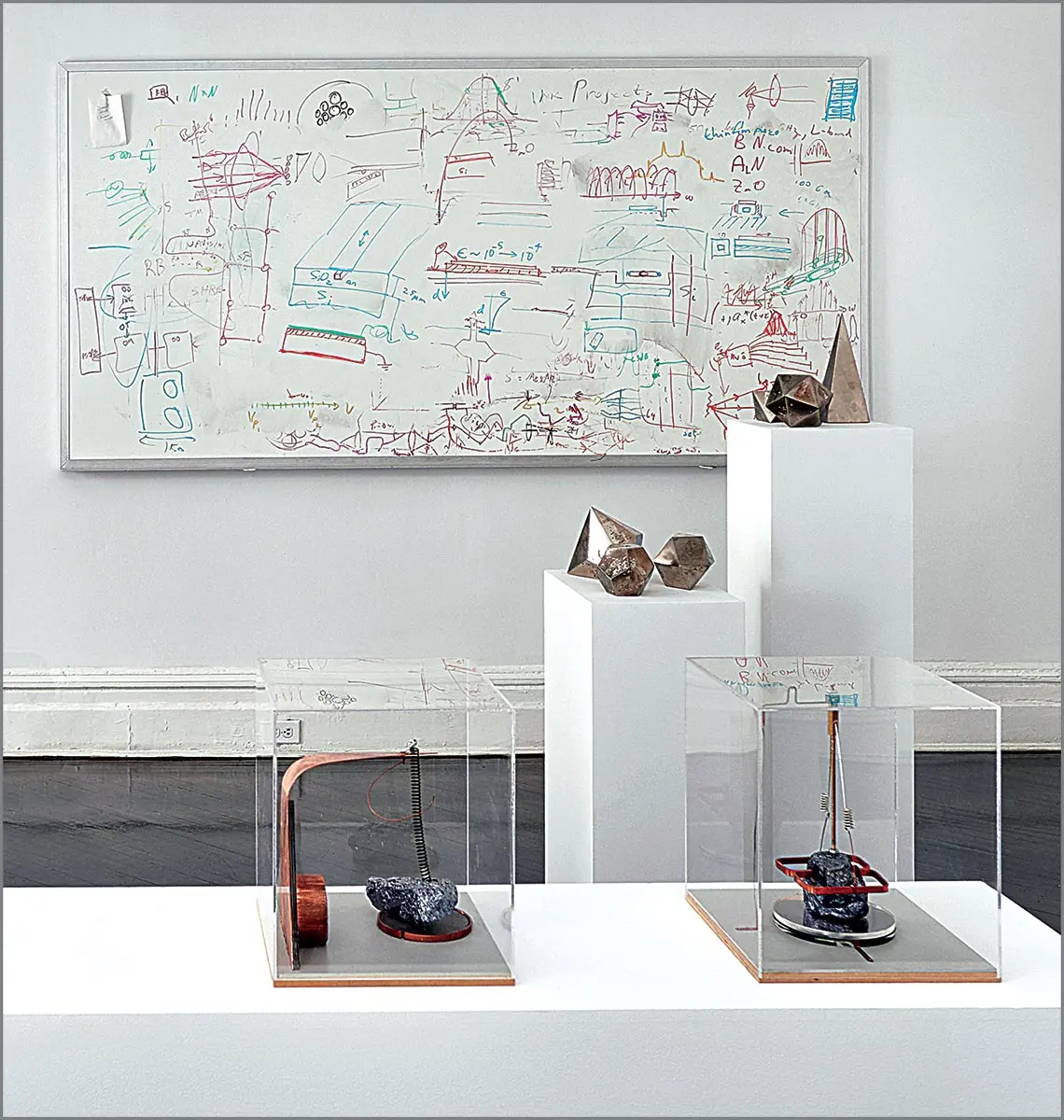
The work by Chapela records the neglect of a laboratory that today exists as a time capsule for a vanished dream of technological progress: produced sculptures, appropriated objects. Among these, Do Not Erase (2016), a series of blackboards that remain intact despite the passing of time. The title of the exhibition, No Pain, No Brain, is written on one of them. It alludes to the pain and effort inherent to intellectual work. According to Chapela “The only thing that we can be sure about computers today is that they cannot feel pain.”
A likely reflection on artificial intelligence, the work Bell Nobel Prizes (2016) consists of eight resin and silicon brains representing the eight Nobel Prizes won by the scientists working in the company. Perhaps the single most important result yielded by any research at Bell Labs was the transistor. Made of silicon (an atomic relative of coal that is part of our brain), it is used today in computers and cellular phones. Bell Nobel Prizes suggests the idea of a future when computers will be able to think like humans and, who knows, maybe even win a Nobel Prize. In this same speculative vein, the work Silicon-Based Proteins, a group of sculptures that represents chemical schemes of a potential silicon, oxygen, hydrogen, and nitrogen alloy to create life.
Chapela’s interest in the elements and the passing of time becomes once again evident in Bismuth-Cast Polyhedron (2016), sculptures that refer to the time at large scales. The bismuth is a highly stable metal that does not break into any other and that would likely survive the universe.
Chapela projects his work into the future, even as it does not lose sight of the past. The piece Semitransistor (2016) randomly brings together conductors, insulators, and semiconductors; failed attempts at creating a functional transistor. These sculptures pay tribute to the attempts that did not work but that paved the way for the creation of the first transistor developed by Bell Labs in 1947—which catalyzed the digital revolution.
Oscillating between invention and its abandonment, between monument and ruin, the exhibition by Chapela is an extended meditation on technology in our society and its role in the development of the world. Epistemologically, No Pain No Gain explores new readings into the ways in which technological research influences our everyday life, with a focus on the relationship between art and time.
VERÓNICA FLOM