
The images by Esteban Pastorino-Díaz (Buenos Aires, 1972) broaden our vision and expand the boundaries of the plausible. Through optical effects derived through the techniques that he uses in his work, most of his formidable landscapes look like illusions. Pastorino-Díaz, who exhibits his work often, nationally and internationally, was able to establish a mastery and style of his own that is already recognized and respected. He received a certificate from the Guinness Book of World Records for the “largest photographic negative in the world.” Measuring 39.54 meters, it is the longest photo ever and was captured one day in June of 2010, for a 15-minute period, during a 3-kilometer walk through downtown Buenos Aires. The shot involved several camera rotations and repositionings. To achieve the image, and following what has become a family tradition, he created a unique photographic device capable of housing a 305-meter long roll of 35 mm film. The film moves during the take to generate a blurred background and static figures, without the use of any digital retouching or Photoshop.
Then, during the 2011 New York City Marathon, Pastorino-Díaz took an even longer panoramic. The 305-meter image was achieved, once again, by advancing the film inside the camera while the shutter remained open. In 2013, he exhibited the striking Guinness photo at the Kir Royal Gallery in Valencia, Spain. It was during his stay of several years in Spain when he decided to add the last name Díaz to his name; an important clarification since either one of the two versions of his name is used in the publications in which he is mentioned.
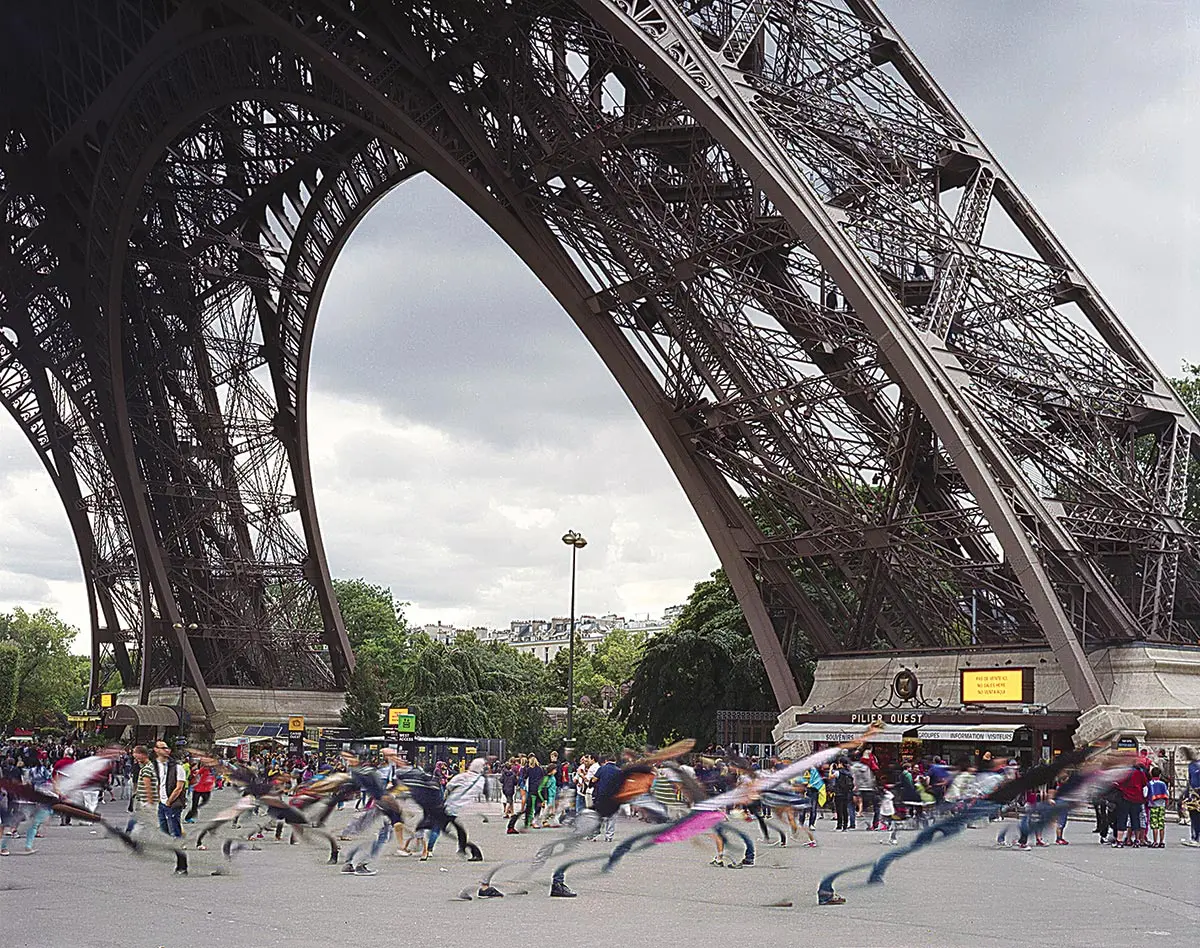
Ten masterfully manipulated images of Paris were shown in the photographic exhibition at the Praxis Gallery. In diametrical opposition to the other variants of Pastorino-Díaz’s continuous technical experimentation, the views exhibited here show blurred figures set against static backgrounds, in particular, those closest to the camera that captured the images.
Pastorino-Díaz—who has been working for many years with architecture, urban and rural spaces, and also with a chance—presented views of the Latin quarter, the Eiffel Tower, the Place de la Concorde, La Défense, the Arch of Triumph, a Metro’s Art Deco style entrance, among others. It is well-known that, after the 2015 terrorist attacks perpetrated by the Islamic State, the vibration in the French capital—where its citizens resist by trying to continue living their everyday lives—changed forever and will never again be perceived the same way. In this manner, the amazing views by Pastorino-Díaz may even be associated with a sense of perceptive dislocation that results from the turmoil of the real context.
Pastorino-Díaz is not interested in using photography “to still and hold on to the present before it disappears into the past” (Annie Leibovitz), nor does he wish to capture the “decisive moment” (Henri Cartier-Bresson). He is attracted by constructive methods and processes as well as by the possibility of offering another perspective of reality. To that end, and without transforming the found scenes, he develops singular techniques and devices that help him create his strange images.
In the Parisian cityscapes shown at the Praxis Gallery, he continues working with perception, approaching photography with the intention of capturing time and space. This innovative artist produced these images through the manipulation of photographic tools. Distorted by movement, the pictures transmit a surrealist atmosphere. Even though he did not graduate as an engineer, his studies in the field of mechanical engineering allow him to perform optical adjustments and create his own artifacts. According to Cecilia Molina, curator of the exhibition: “In this manner, Pastorino-Díaz defines aesthetic results through a technically precise production process that nonetheless incorporates uncontrollable variables presented by the urban environment being photographed.”
The catalog of his essays includes aerial photographs that look like mockups. Pastorino-Díaz resorts to techniques from another era to explore all of photography’s potential. He uses stereoscopy to gather three-dimensional visual information, and with a camera mounted on a barrel—like centuries ago—and from an airplane, he captures countryside and urban images in which he achieves the illusion of depth, some with sharp images and others out of focus.
Local critics paid attention to his work in 2002 when he showed it in Buenos Aires Musica Ficta. It consisted of a series of magnificent photographs centered on the architecture of Francisco Salamone, a rarity of the Argentinean pampas. Between 1936 and 1940, this Italian-born architect built in the Buenos Aires province municipal buildings, slaughterhouses, and cemeteries in a monumental style difficult to define. Hints of Art Deco, Mussolinean accents, perhaps?
According to Pastorino-Díaz, “I made those first trips to the towns and cities in which his work is located with my friend and colleague Nacho Iasparra. I began to photograph them at night: I used the street lighting or a flash to generate shadows that projected upwards, which increased the sense of scale. At the same time, the dark sky helped isolate the buildings from the background and to increase the contrast of the images.” The use of the gum dichromate process—employed in traditional printing—increased the ghostly appearance of the tall buildings in the middle of nowhere and underscored their amazing singularity.
VICTORIA VERLICHAK