
Restrained but energetic at the beginning of their construction are the adjectives that best describe the main characteristics of the work by artist Fabio Miguez. And this was true in the exhibition titled Short Cuts, which consisted of small works, large paintings, and suitcases.
The group of works presented in Short Cuts is an important example of Miguez’s most recent inquiries. The cohesion between the canvases—which measure 40 x 30 cm or 30 x 24 cm—results from a pictorial structure based on paintings by other artists like Agnes Martin and Henri Matisse, whose influence Miguez openly references in his proposals. His early works were characterized by powerful brushstrokes, the use of mixed media, and reliance on gestural abstraction influenced by German Neo-Expressionism and US painter Philip Guston. But in the last two decades, Miguez has become more economical with the use of materials, opting instead for the containment and flattening of the planes through thin layers of opaque surfaces, schematic visual components, and a palette that consists of whites, blues, corals, and sea-greens.
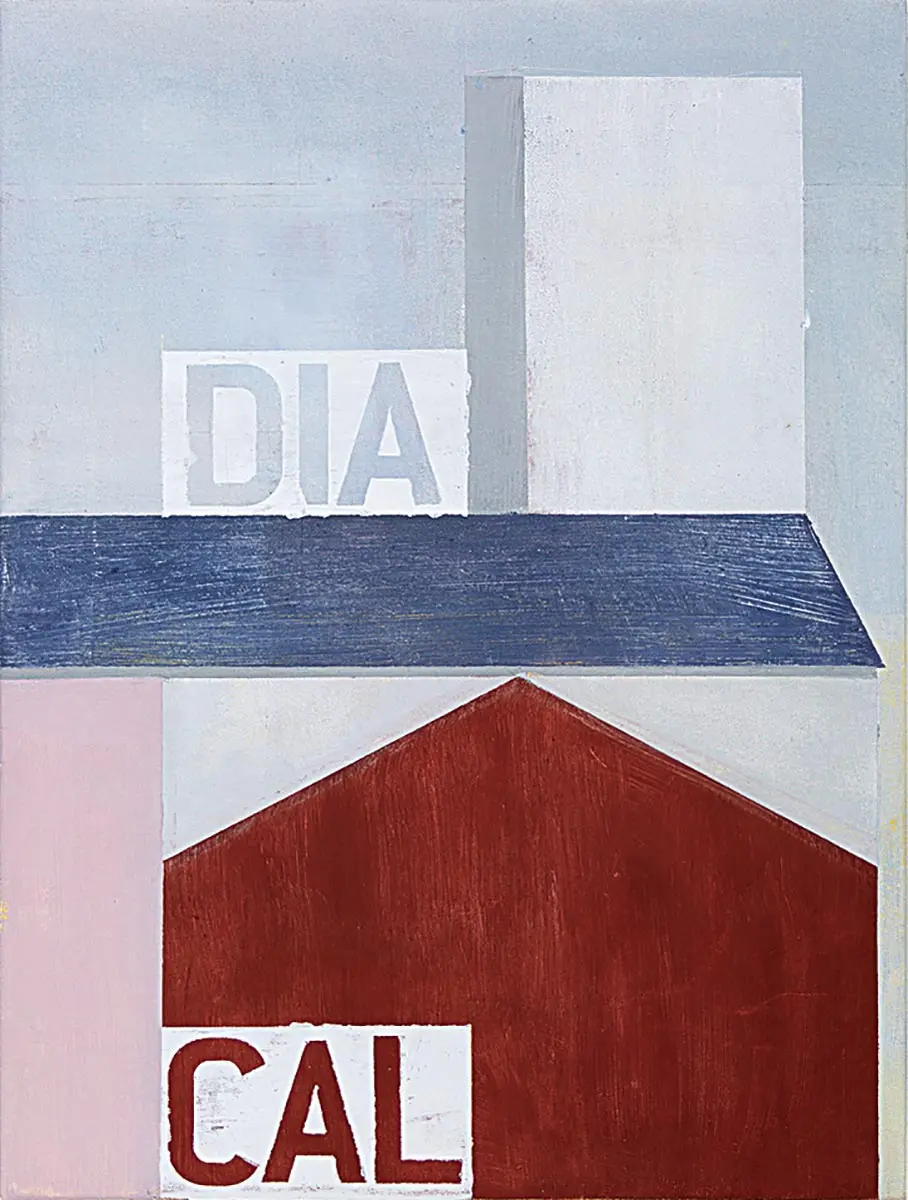
The exhibition is titled after the movie by Robert Altman of the same name based on Raymond Carver’s complex and cohesive group of short independent stories. Transferred to Miguez’s artistic universe, the idea reveals passage openings between works with inherent notions like cut, size, and incision that convey the idea of a certain unity.
Miguez has always produced small and large works rendered as quick sketches that allow him to expand his visual vocabulary faster than with his major works. These Short Cuts narrate small pictorial events, unexpected flashes of color, as well as elusive and fleeting themes rendered with various degrees of attention. The intimacy of the scale and the apparent simplicity of the works demand complex recognition and not a determinist definition.
The exhibition also includes new work from the series Suitcases. It represents a three-dimensional continuation of his painting inquiries. These suitcases are modular planes that open to form various compositions according to their arrangement. Miguez’s sculptural production reveals his training as an architect. Reminiscent of architectonic floor plans, elevations, and courts, the works expand and contract with the movement of the painted surfaces and, when completely open, resemble the plans of a city.
These works approach matters pertaining to space and placement in a manner that is different from what can be observed in his paintings. It is a combinatorial arrangement where colors, planes, and texts are subjected to repetition, reflections, and slight permutations, allowing for what painting can only express on its surface to unfold and exist in the form of simple exercises—which are nonetheless entertaining to the observer’s gaze and mind.
Born in São Paulo in 1962, Fabio Miguez continues to live and work in his hometown. He has participated in the São Paulo International Biennial (1985 and 1989), in the 2nd Havana Biennial (1986), in the 3rd International Biennial of Cuenca (Ecuador, 1991), and in the 5th Mercosul Biennial (Porto Alegre, 2005). His work was presented in the retrospectives of the Brazil Biennial Twentieth Century (1994) and 30 x Biennial (2013), both organized by the Fundação Bienal de São Paulo. He has also presented solo exhibitions at the Centro Universitário Maria Antonia, the Instituto Tomie Ohtake, the Pinacoteca do Estado, and the Centro Cultural São Paulo, all located in his hometown.
A decisive period of Miguez’s career occurred between 1982 and 1985, when he was part of the Atelier Casa 7, alongside Carlito Carvalhosa (1961), Nuno Ramos (1960), Paulo Monteiro (1961), and Rodrigo de Andrade (1962). It was a period that initiates the production of monumental works rendered with wide brushstrokes and strong colors. Then, during the end of the 1980s, he produced heavily pigmented abstract paintings on canvas that favored a monochromatic palette achieved through muted tones.
In the canvases produced during the mid-1990s, the planes in the background are often large grey or white areas. There, Miguez experimented with dissolved pigments and intensified colors. This process prevailed even in his photographic production, as demonstrated by the series Adrift produced between 1993 and 1994: they are seascapes of a beach retreat where geographic accidents and solid bodies are shown surrounded by a foggy environment.
Since the 1980s and to this day, Fabio Miguez has always based his work on the exploration of painting. In his work, he has established dialogs with several artists like Jasper Johns, Willem de Kooning, Mira Schendel, and Iberê Camargo, among others. Transiting between Neo-Expressionism, Minimalism, Abstraction, and Constructivism, his work appears to be driven by the constant questions and explorations, not merely about painting as an artistic medium, but about the role of art itself. The strength of his work resides precisely in the continuous questioning of art’s existence.
ALESSANDRA SIMÕES