
Symmetry, the title of Fanny Sanín’s most recent solo exhibition, has unusual characteristics in her oeuvre. Covering almost four decades of artistic production, work after work the show gives new meaning to that word. Sanín addresses the internal geometry in each of her works in a different manner. “It is said that I rely on architecture because I live in New York…, or that my work references the pre-Columbian world. It is possible that I do this unconsciously. My language bears no relationship with reality, it is just a language,” says the artist. Sanín produces studies with acrylic on paper. These can take her days, weeks, and even months, to complete. In them, she searches for the unity that she wants to convey in her paintings. Each study is numbered and dated with the order that characterizes her. She does not begin painting on canvas until she is satisfied that the studies capture what she was looking for. Her work never begins directly on the canvas. She does not rely on assistants and does not want anybody in her studio when she is working. Once the painting is completed she would rather show it than sell it.
Born in Colombia (Bogota, 1938), Fanny Sanín is one of the key figures in Latin American and international geometric abstraction. In Colombia, she studied art and earned a master’s degree from the Universidad de Los Andes. She studied engraving, graphic design, and art history at the University of Illinois in the US, and also attended the Chelsea School of Art in London. She lived in Monterrey (Mexico) on two different occasions and has been living in New York since 1971.
Several influences define different periods of her artistic career: Abstract Expressionism, Gestural Painting, Hard-edge Painting, the bands, symmetry, and Geometric Abstraction. Some of these periods overlap a little, while others have been clearly independent of others. In the exhibition Symmetry, emotional and rational elements are a recurrent part of the works. Each piece is organized according to a relationship of planes, forms, and colors. Great leaps, syncretic to some extent, in the evolution of her work are not limited to her transition from Abstract Expressionism to Geometric Abstraction. In London, Sanín discovers something that will mark her work definitively: the monumentality and solid colors in the works of Ellsworth Kelly and other artists who approach their work in the same manner. It was then when she began using less material and stopped rendering textures and translucencies. The 1970s are a key period in her career: she transitions from oil to acrylic, which allows her to flatten the colors more effectively, leave matter distractions behind and increasingly concentrate on geometry.
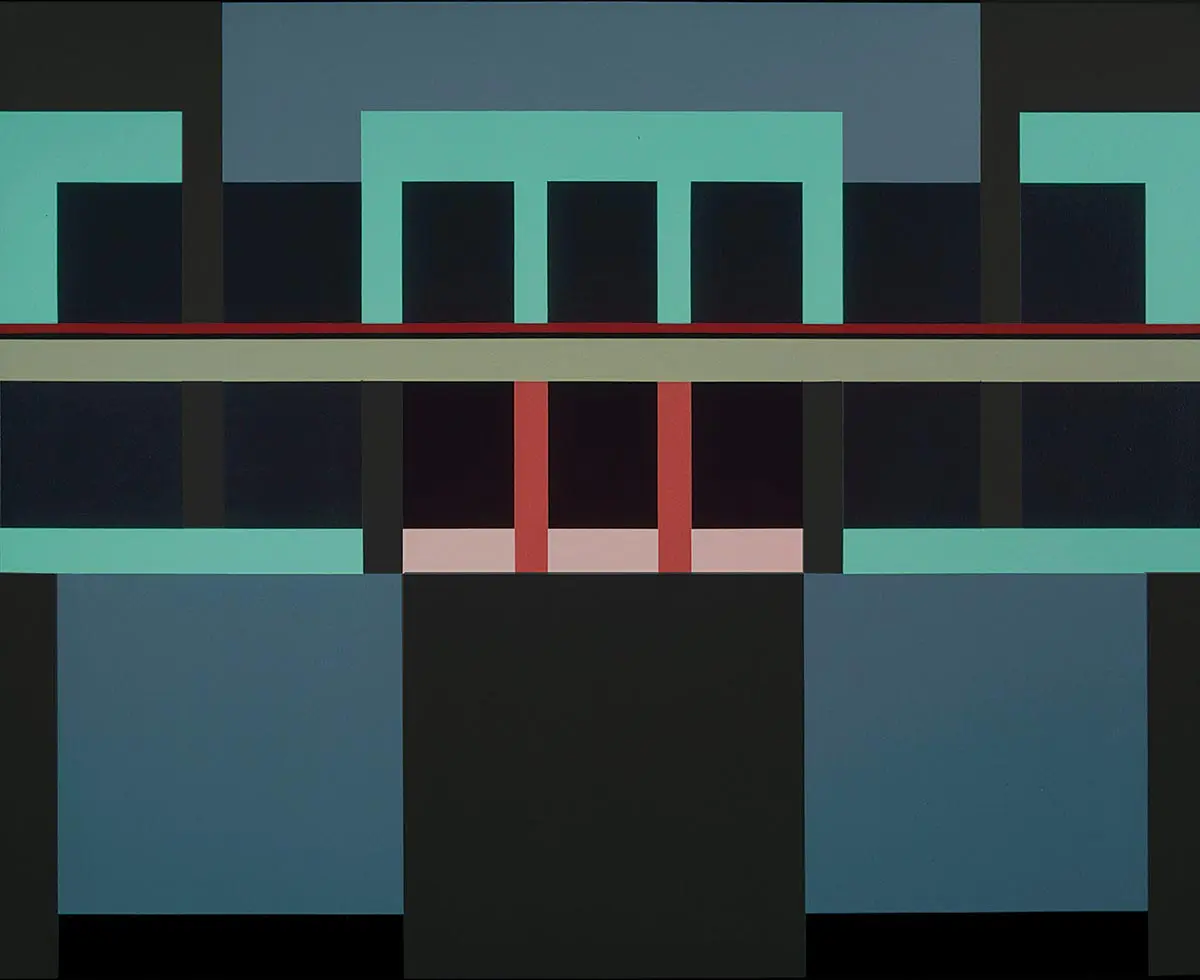
Sanín feels more comfortable with paintings of large dimensions. The exhibition in the generous space of the Leon Tovar Gallery offers viewers the appropriate experience to observe the emotional rigor and geometry expressed in her work. The show includes recent engravings that contain powerful images. Far from being mere versions of her paintings, they are independent creations that offer very original compositions. In both approaches, bands, superimpositions, rectangles, squares, triangles, and lines of various thicknesses interact through a variety of compositions. Each of these geometric manifestations acts as a connection and a divider and/or as one of many diverse spatial stages. Verticality is predominant in the compositions, but so is horizontality. Groups of forms that crisscross at the center of some works convey thrones, altars, or centers in which the works themselves become offerings. One could also suggest that, through geometry, Sanín conceives offerings to symmetry, and vice versa. Truncated pyramids, crossed rectangles, and triangles breaking into rectangles, are part of the compositions created by Sanín.
Colors and their shades are very important in Fanny Sanín’s work. Some pieces are rendered with seven colors and a single tone. There is an important presence of widely developed reds and greens. Black is also important and frequently present, unlike white; a color that Sanín covers and sees no need to use. Color encourages movement without being psychedelic. The palettes are cold and warm, whether they contain grey or pastel tones. Through the compositions that Sanín develops in her studies—which, by the way, are marvelous works in their own right—she expresses a geometry that is not cold or rigid but rather one with a structured emotion across different geometric elements. The work titled Acrylic Number 5 (1983) offers a complex composition. It is also the case that in some works by Sanín the heaviest part of the work is on the upper area, or that similar formats are broken down in several parts of the painting. A must-have for any collector, an excellent catalog accompanies the exhibition.
GRACIELA KARTOFEL