
Así es como entra la luz (This Is How Light Comes In) is the title of the exhibition with which Federico Ortegón (Bogotá, 1976) recently made his presence felt at the Sala de Arte Suramericana, in Medellin, after his return from Helsinki, where between 2010 and 2015 he studied for his B.F.A. and M.F.A at the Finnish Academy of Fine Arts. Sala de Arte Suramericana, which opened along with the building in the 1970s and has been ever since a bastion of visual arts activity in the city—thanks to the committed efforts of Jorge Molina Moreno (the company’s president at the time and the initiator of one of the most important corporate collections of Colombian art)—is now revitalized with a unique exhibition, given the sensible complexity and, at the same time, the sobriety of Ortegón’s compositions. The first impression caused by this show brings to memory the best moments of an institution that has long been the vessel for a singular tradition in the understanding of local cultural phenomena, particularly until the turn of the century.
Ortegón, an architect by training, has been outlining an investigation of the material conditions in which we erect the tangible world and the direct relationship with the symbolism carried by the constructions prevailing in our cultural and economic consumer scenes. The presence of his proposals in the gallery is powerful; it brings forth the best aspects of the space and counterbalances the architectural difficulties of a modernist building with strong public inclinations.
The show’s introductory text, written by Nicolás Betancourt, reminds us of one of the artist’s recurrent expressions: “Men are divided between those who have a shovel and those who don’t.” In view of the selection of works featured in this exhibition, we can equate that shovel with the means necessary for the transformation of things into other things, but it can also be read as the very ability of certain individuals to create paths for others to traverse. The latter meaning is a clearly mobilizing metaphor for the selection presented by the artist, to the point of becoming an interpretive key in the relationship established between the works. Which, it is worth noting again, also resonates with the significance of Sala de Arte Suramericana in the national context during leading industrialist Nicanor Restrepo Santamaría’s tenure as company President. Nicanor was also a central player in the launch of the city’s Modern Art Museum, at the time neighboring the Suramericana building, in the sector known as Otrabanda.
Each work in this exhibition is resolved in itself. The chromatic selection of the elements providing formal support for the constructions is at once sophisticated and extremely basic. Austerity is a front-row guest in the execution of every work; the result is forceful visual poetry, with an economy of means, materials, and phenomena made evident in the strangeness of the temporality they propose for a lived experience of space. The tempo/rhythm achieved by Ortegón’s proposal is, in that sense, affecting, and poignant.
After leisurely exploring the gallery and paying attention to details—because there is something that imposes on our bodies a behavior distinct from what oftentimes occurs in galleries or museums—we begin to understand the strange familiarity of each visual declaration proposed by this architect who gave in to the communicative and constructive virtues of contemporary art. Light is a connecting thread that filters into each observation, into each relationship one is able to establish with the objects; their allegorical world and the closeness they begin to offer are certainly exciting, thanks to the dialog sustained by the various materials used in each construction.
Here it is important to consider the process of Ortegón’s education and disciplinary shift. A school’s power over the artists it educates is evident, but what would happen if it weren’t so? We have noted that Ortegón studied in Finland, a country where the psychology of light dominates everyday life. Also, in Scandinavia we find human and social geography that has achieved the highest standards of elegance using the least possible amount of elements; I am talking about the design developed in this peninsula, in all of its expressions. This logic helps us begin to reflect on some of the objects that comprise the recently returned artist’s latest production.
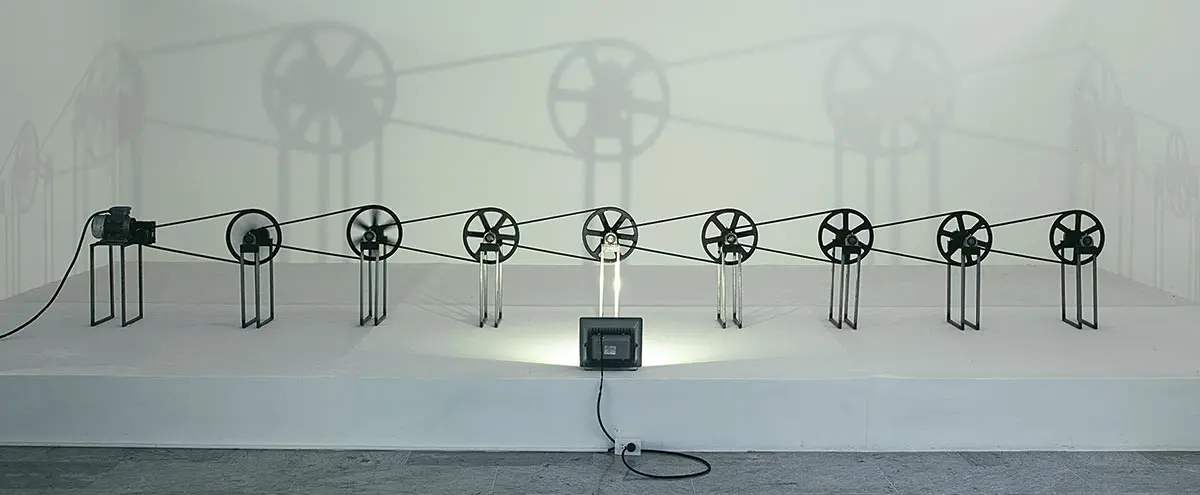
Before The Ocean Was Blue, from 2013, is a time machine, a precision device anchored to the ground, heavy like the truth of gravity on the body, using five gear assemblies and a motor. The force of the motor, which turns at 300 rpm (5 revolutions per second), is factorized by each pinion, until the last in the series reaches one turn on its own axis over the course of a day. This motion device, which can be understood as an elaboration on social evolution and the notion of work, is at the same time a metaphor for the time of life, for the insignificance of our time on Earth; it can also be seen as a kind of vanitas coming to replace our skull structures with an insensible yet evocative machine. In this work, the interplay of light is decisive. A powerful spotlight projects the gears against the wall; the sketch of shadows recreates a macabre and beautiful theater.
Right across from this reflexive device the artist installed another relationship moving in the same logic. Concierto para paso fino y corno (Concert for paso fino and horn), from 2013, is a video installation presenting one of the most controversial signs of this country’s identity. A Colombian paso fino horse takes a step on a resonance plank; the body of the binomial is enhanced by a background curtain arranged as a film loop in the manner of Eadweard Muybridge’s montages—where, in the Nineteenth Century, he attempted to deconstruct motion using photo stills that ultimately served as an antecessor to the invention of the cinematographic miracle. Helped by an algorithm, the artist recreates the motion of this unique specimen that moves laterally in four-time (i.e., always with a leg on the ground, in an execution that transforms it into the self-propelled driver in an extremely fast rhythmic march, perhaps the fastest of any equine family), in a dance that is as fascinating as it is unsettling because the horseman seems to move not a single muscle and to placidly advance atop the impressive beast, while a French horn, a traditional instrument of Imperial Europe, plays in the background. A musical box, resulting from the intertwining of a mathematical study, a play of sounds, and an exquisite product of cabinetry (a small resonance box in polished wood, closer to the Stradivarius family than to a drum) complement the video. There is also a water-filled fishbowl with a bubble machine inside, which functions as a filter for the video reproducing the action of the beautiful horse. The result is the aesthetic and mathematical exploration of an animal often judged in absentia by a culture that does not recognize itself, a culture that rejects its own past in embarrassment and seeks instead to empathize with other latitudes (in general, those of the North) in the hope of being recognized without a face of its own, all the while recreating a flawed dynamic that will, in the end, dissolve what little essence remains of what it once possessed, as happens in lands that believe themselves rich in gold but discover, with the passage into the age of machines, that they are merely inert and helpless landscapes. Emptiness reinforces the invasive, soul-depleted action of human greed.
Finally, it is worth noting among the remaining works on exhibit Reuniones (Reunions) and Serie esmeraldas (Emerald Series), from 2015. The former comprises three spheres, 1,7 meters in diameter, each built from eighteen plastic chairs of the kind that has invaded the informal street markets in commercial areas in mid-size and central cities throughout Latin America. These common chairs acquire special relevance by their involvement in an artistic form that represents a painstakingly constructed platonic solid; each chair has been worked as a unique object but is joined to the others through a minutely built weave, with craftsmanship that brings to mind traditional indigenous productions. Indeed, the material for the joining of this reunion of equals—which support one another in propping up a uniform structure, reinforcing the social metaphor of the construction of reality—is at the same time the bearer of indigenous traditions; it is a chambira, an artisanal derivate of the palm tree of the same name, which has traditionally been an ingredient and a symbol of union in communities of the Amazon basin: a team of female weavers (located in a settlement near Leticia, Colombia) sent it to Ortegón after he chose it for the construction of his work.
The assemblage is playful and exquisite at the same time. The connecting joints allow the legs of the chairs to be arranged so that the works perambulate around the exhibition gallery. The union of these elements propitiates a dynamic and forceful, yet beautiful, form devoid of a clear purpose, something that keeps the three spheres at the boundary of the relationship between industrial and artisanal elements, tradition and innovation.
In turn, Serie esmeraldas, also from 2015, emphasizes the tradition of functional elements, the material culture of peoples who develop new ways on the basis of ancient methods. A series of seven boxes built using plates of galvanized steel, one cubic meter each (four of the cube’s six sides form a kind of tunnel, in the manner of air ducts of the same material) hold inside thin layers of “closing fabric” (as the canvas used to hide urban transformation, also used to make food sacks, is known), which have been deconstructed to allow for the affirmation of diagonal writing that evokes the precious emerald (emblematic of Colombia’s underground riches) and the carefully made textiles of indigenous cultures.
In this work, light is a grammatical component of the resulting object. A halogen lamp accompanies each of the cubes, and its beamlets we see the translucence of the construction, filling the space it occupies in the gallery with an unsettling, magical color.
Federico Ortegón, undoubtedly a man “with a shovel in his hand,” has just returned to Latin America, bringing with him valuable information contained in his taste for tradition and for the painstaking forms of the contemporary techné, signaling a space always privileged for the arts in Colombia. We trust that, as will surely happen with the artist, the space that has hosted this and many other significant experiences will begin to shine brightly again.
ÓSCAR ROLDÁN-ALZATE