
Chelsea-based Andrea Rosen Gallery presented an exhibition of word portraits by Félix González-Torres, curated by artists Julie Ault and Roni Horn. The three-part exhibition also took place at Massimo de Carlo Gallery, in Milan, and Hauser & Wirth, in London. This is González-Torres’ first solo show since 2000 at the gallery that represents his legacy. In recent years, Andrea Rosen had opted for presenting exhibitions that paired him with artists like Joseph Kosuth, Agnes Martin, On Kawara, and even Roni Horn. This strategy was ultimately successful, positioning González-Torres as one of the most influential artists of the late Twentieth Century; he was even selected to represent the United States at the Venice Biennale, only the second artist (after Robert Smithson) to be granted such honor posthumously.
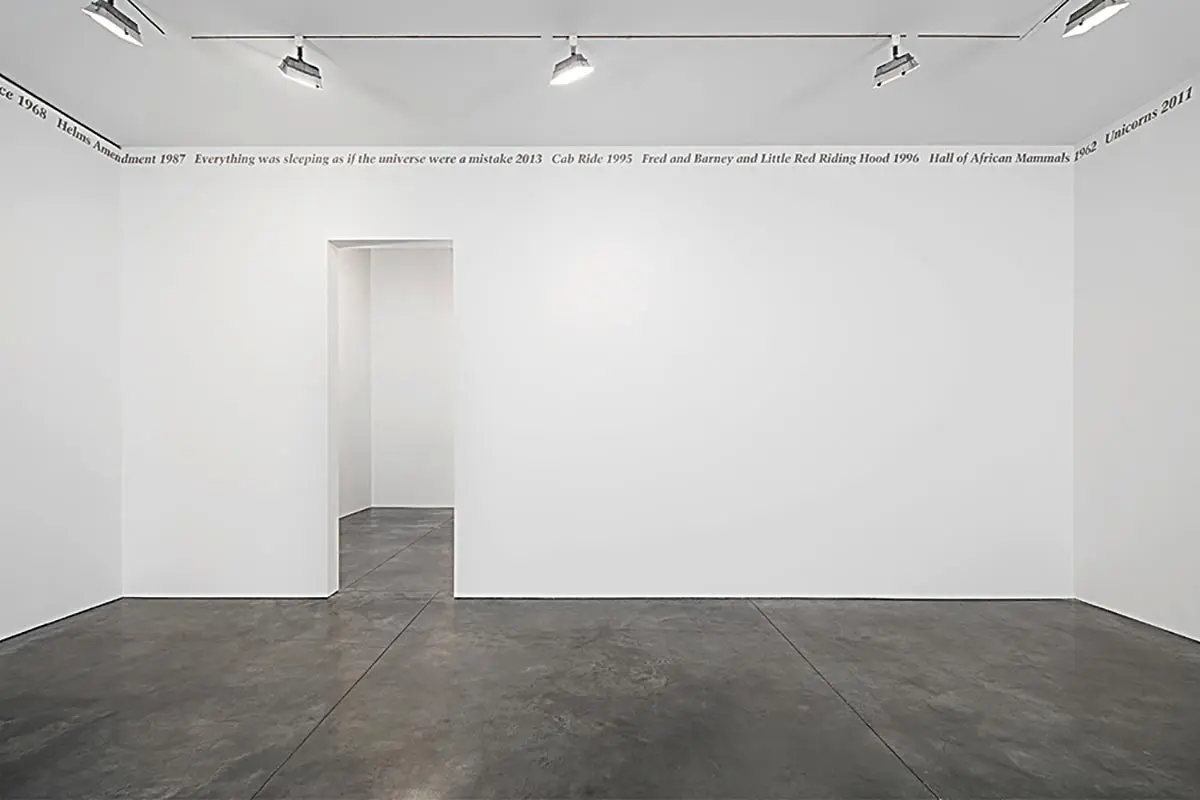
Visitors were greeted by empty space and soon realized that no objects or images blocked their view, which naturally moved upwards at the suggestion of the lighting to reach the edge where the wall touches the ceiling. There we found the artist’s silent traces, like a kind of lettered frieze. It was a selection of González-Torres well known “word portraits”, which consist of a variable-length band of words and numbers against a color ground. At a distance, they look like perfectly legible printed ribbons. The text makes reference to the year and a word or group of words connected to events that are significant for the portrait subject. González-Torres made a total of sixteen such portraits between 1989 and 1994, the first one a self-portrait originally exhibited at the Brooklyn Art Museum in 1989. There was one portrait per gallery, or in some cases, the portrait began in one gallery and continued in the next one. In this case, each gallery became a kind of monument to the memory of the portrait subject.
Like many of González-Torres’ works, the portraits consist of a series of instructions and ideal features specified by the artist in a document or contract that should govern the work of the curator, always leaving room for any necessary adjustment. González-Torres did not title his works, but added the name of the subject in parenthesis to the descriptor Untitled. The fact that Horn and Ault, who wrote an extensive monograph on González-Torres, were close friends of the artist must have been a driver of their decision to have his self-portrait placed in the most prominent gallery. Following the instructions, they used a silver color and a typographical font named Trump Medieval, in bold italics. Along with his year and place of birth—1957, Guáimaro—came a parade of historical events that had a deep impact on González-Torres’ personal life, from 1980 Mariel to 1986 Group Material, the art collective that first made the artist known in the New York art scene.
The bands of words at the frieze level bring to mind the use of such features on memorial architecture, presenting the hero’s feats. An immigrant from an early age, having left Spain and Puerto Rico prior to settling in New York in the 1980s, González-Torres reflected on the subject of memory and its essential connection with the written word in many of his works. To that end, he revised Western culture’s mostly neoclassicist and conservative memorializing tradition. Some early works, made in Puerto Rico or soon after arriving in New York, took the shape of combinations of photographic images of marble statues with textual commentary about them. Similarly, González-Torres presented in a series of photographs his texts inscribed on marble planks, with words of great institutional weight in connection with the New York Museum of Natural History.
In his word portrait series, however, González-Torres took these reflections to an extreme of abstraction by stripping the text of all visual references, save for those derived from the printed text itself. In this reduced range of possibilities (typography, color for text and ground, size, placement) the artist found a spare vocabulary that forced viewers to bring into the gallery their own images in connection to the events at hand.
In its press release, the gallery explains that the process of creating the commissioned portrait involved a dialog between the artist and his subject, since to the list of personal events provided by the subject González-Torres added public events, thus highlighting the substantive impact of the public on the private. Also, and as is the case with many of González-Torres’s works, at any point when one of the portraits is put on display new dates can be added and older ones can be deleted, introducing permanent change as something inherent to the work of art.
ELVIS FUENTES