
Jorge Eduardo Eielson and Fernando de Szyszlo are not only from the same city and country (Lima, Peru), but they are also two of the most important contemporary artists in Latin America. Both traveled to the Europe of the postwar and witnessed in person the emergence—and booming—of informal art, the still reverberating echoes of futurism, cubism, and surrealism, as well as the height of abstract art. Both of them were influenced by these artistic currents with various degrees of intensity. But it was abstraction the approach in which both artists found their more fertile expressive terrain and the one that most impacted the poetic and discourses of their respective artistic careers.
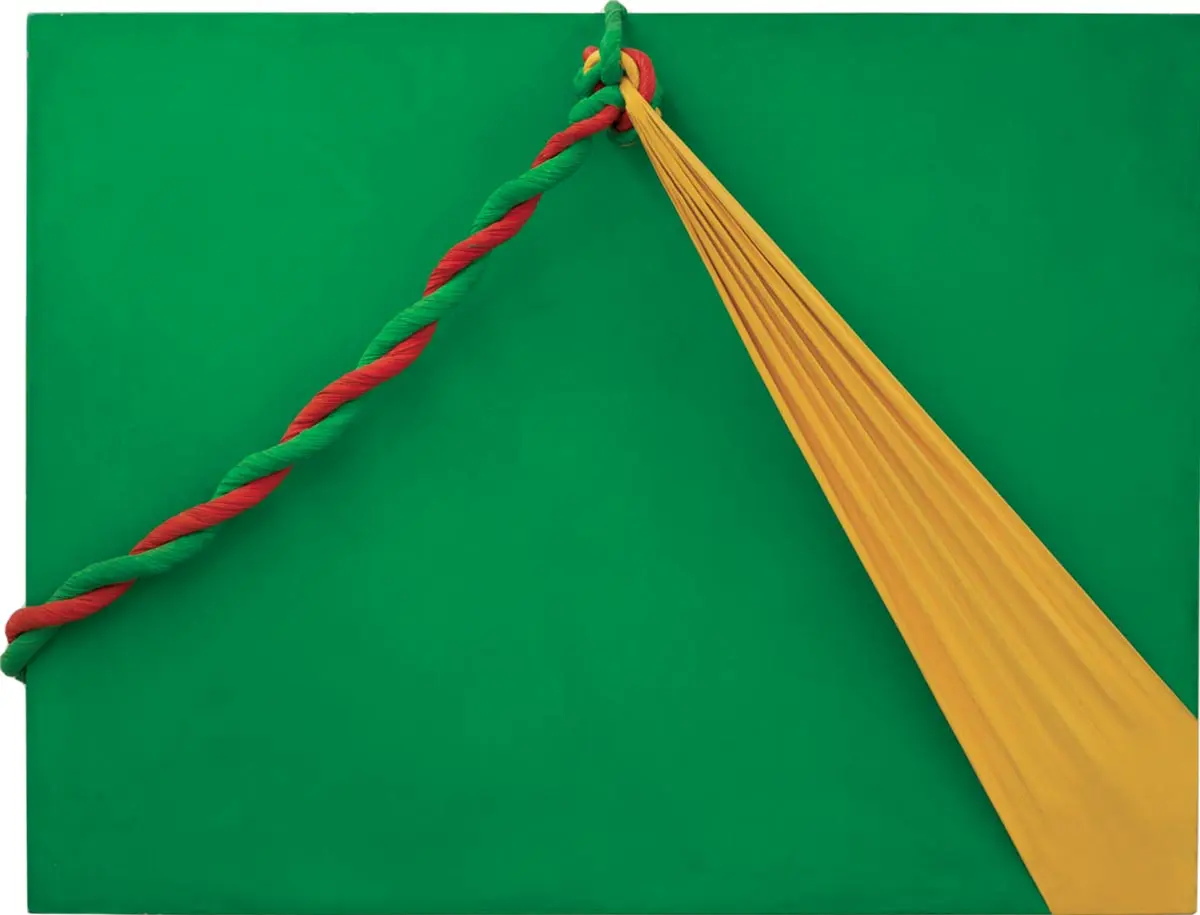
Organized by the curatorial team Aluna—integrated by Adriana Herrera and Willy Castellanos—the 2016 exhibition titled Jorge Eduardo Eielson: On the Other Side of Languages presented at the KAbe Contemporary Art gallery, represents a concise survey of the long trajectory of Eielson. It explores and evaluates the relationship between poetry and pictorial art that has defined his work. Or, in other words, the exhibition explores the singular relationship between the language of words—which the artist masterfully and compellingly used in his work—and the language of signs, as a distinguishing element that distinguishes Eielson’s work in the contemporary Latin American art scene.
The pictorial works by Eielson included in the exhibition resort to abstract syntax, underscoring the expression of painting as an object lacking any representational intentions. It is an idea that other authors like Frank Stella also explored—at the same time as Eielson—during the 1960s and the beginning of the 1970s. But in Eielson’s work, this idea is brought to fruition through the incorporation of sculptural elements like reliefs and volumes that establish a greater contrast between the background and figure. This is present in works like Quipus 33 V1 (1971) and Quipus 40 T1 (1969). Mostly with monochromatic, flat, backgrounds rendered with geometric figures like circumferences, squares, and triangles, he pushes his visuality towards a certain type of geometric art. But there is also, as part of the body of the exhibition, a (visual) poetry clearly inspired by constructivism. The structure of his poems and poetry generates semantic tensions between form and function, between speech and language—in other words, between oral and written traditions. A poet immersed in concrete aesthetics, Eielson develops the ideas for his poems through writing in which phrases and words are repeated until forming the figures in the background that are the very source for his poetic reflections. Hence, the exhibition as a whole produces a curious contrast between, on the one hand, the abstract expression in painting and, on the other, the compositional concretism that emerges from Eielson’s poetry.
The exhibition Jorge Eduardo Eielson offers an abstract expression that combines matter and spirit, traditional and high culture, earthly and supernatural elements—present in the thinking of Andean cultures, particularly in Inca culture—with Eielson’s world view influenced by western culture. Some prominent works in the exhibition, like Bandiere (Flags, 1998-2004), allude to a knot system similar to the one used in the Inca mail system to communicate within the empire. This fact underscores the relationship, always present in Eielson’s work—in his role as a concrete poet—between the language of signs and the language based on words.
Like in the oeuvre of Fernando Szyszlo, in Eielson’s work there are also constant allusions to popular culture and the traditions of the Andean peoples of Peru, approached as identitary elements of Latin American culture. While Szyszlo’s work draws inspiration from the ceramics and totems from the Nazca plateau, Eielson, on the other hand, finds it in the oral traditions, especially in the quipus, a sort of Incan writing system encoded through knots. But his work is also inspired by the brightly colored and geometrizing designs in Incan textiles. In this manner, the work by Eielson visits in the map of Latin American modernity those areas marked by contradicting, sometimes opposing, stories about colonization and the west, subordination, and hegemony, peripheral and metropolitan. With this approach, Eielson also points to the nature of a Latin American modernity project where ancestral socio-cultural traditions and the development of capitalism appear to be in constant conflict.
DENNYS MATOS