
Jorge Macchi (Buenos Aires, 1963) presented his first anthology exhibition in Argentina. The exhibition brought together nearly sixty works created between 1990 and today. “The title Perspectiva, in substitution of retrospective, refers to a point of view that moves from the present in the direction of the past—the artist’s personal and experiential past,” explains the exhibition’s introductory text. “It also refers formally to the art of reproducing the shape and the disposition with which objects manifest themselves to our gaze, and evokes a constant in Macchi’s work: the tendency of the real to dissolve and the fictional character of the signs that populate the world.”
The timeframe, starting in the 1990s, coincides with a certain detour taken by Macchi’s work. In his talk at MALBA on the occasion of the show’s opening, the artist referred to this shift. In the early years of his career, he conceived every work as an autonomous entity: “independent from one another, like moveable objects that could be located here or there, hanging indistinctly on one wall or another.” In the 1990s, everything changed: Macchi traveled to Europe for the first time and visited many exhibitions. “What was happening in those shows wasn’t happening in the individual objects,” he says. “The objects were not autonomous; rather, what was important in the exhibition took place in the space between those objects. For me, that was an incredible discovery… the idea was very clear of starting to have the need to establish connections between the objects included in a show, that the work was not the object but the space in between, the space that separates them, the space inhabited by the viewer.” At the time of presenting Perspectiva, Macchi avoids all linear, chronological action, mounting a certain narrative structure in which he minutely contemplates the interplay between the works and the interstices, a structure where the part is intimately connected to the whole, driving viewers to sustain a constant, expansive, almost limitless motion. Our course through the show is not a pilgrimage from a starting point to a point of arrival, but an immersion in the event that triggers an infinite web of relationships.
It was always necessary to establish divisions in order to classify things and apprehend them: maps to lighten the load of confronting many connections, news to sustain the directions of the control of information. Along the same lines of giving each thing a defined place, it has been said that Jorge Macchi’s art is intermedia, to judge by what is most evident: the use and combination of various media (film, music, objects, painting, texts.) But what is intermediate in Macchi’s art is the minimal moment in which the real dissolves and proliferates at the same time, as much in the imperceptible time between two musical notes as in the cut of words, the cracks and indentations on his maps, the ghostly image of the double, or in the intention of controlling chance and randomness. Art here continues to escape the dominant system of knowledge and values, fleeing healthily to delay the arrival of an invariable symbolic universe. What comes to light is an exceptional, highly revealing interval that interrupts representation. All narrative structure vanishes, there is no racconto of flashback, and connections are established only in an intuitive manner.
Macchi insists on moving away from the idea of his art as conceptual (more precisely, it has been labeled as neo-conceptual); he always situates his starting point in the image. And what happens in that other interstitial space, in between the image and the concretion of the artistic object? The aesthetic act takes place in the interval towards formalization, “taking possession of a discovered segment of the real,” wrote poet Herbert Read in his Icon and idea. Macchi unpicks the dead end of the object closed on itself, ciphered, and moves it to an impasse, a holding pattern. The object becomes a work of art that opens up in that delay. Interestingly, the process is reproduced in the viewer, who will be the doppelganger, a walking double, an ambler who will stop first at the shock of the image, the first mystery. But the initial contemplation will become an activation of the experience in the present, the gaze will remain suspended in a blind spot before the enigmatic unfolding of those recognizable objects, and the intention of codifying the event will have to be abandoned.
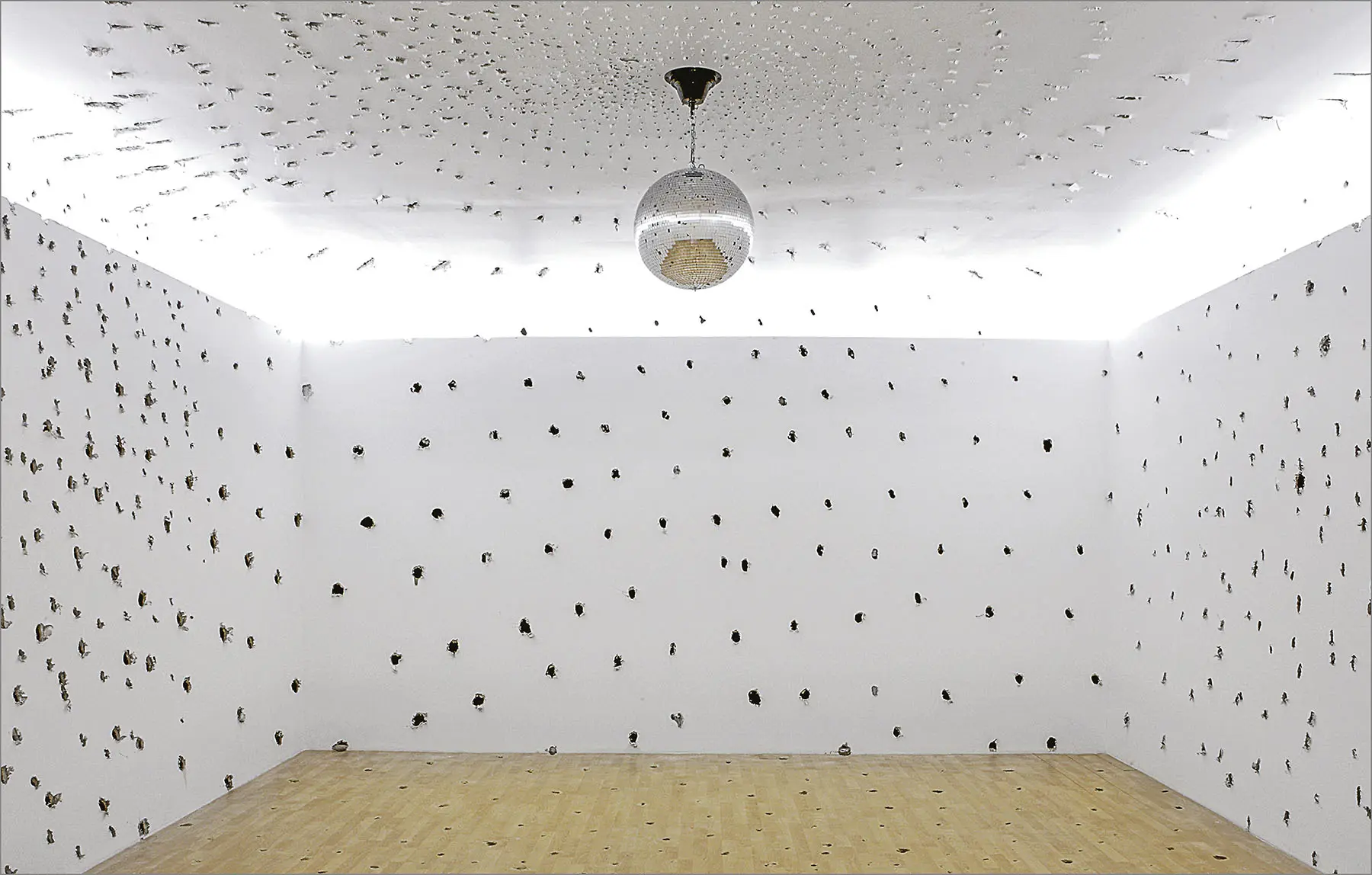
Perhaps the work that exposes itself more openly, the one where the viewer is most exposed, is Still Song. On a maximally lit dance floor, the mirror ball is frozen in place and its reflections have become perforations on the ceiling, floor, and walls, small and deep black holes from which no material particle, not even light, can escape. And perhaps this is the characteristic of the entire set on exhibit here; the impact of the works is like that of black holes exerting an inevitable attraction, their force generating a gravitational field that cannot be escaped.
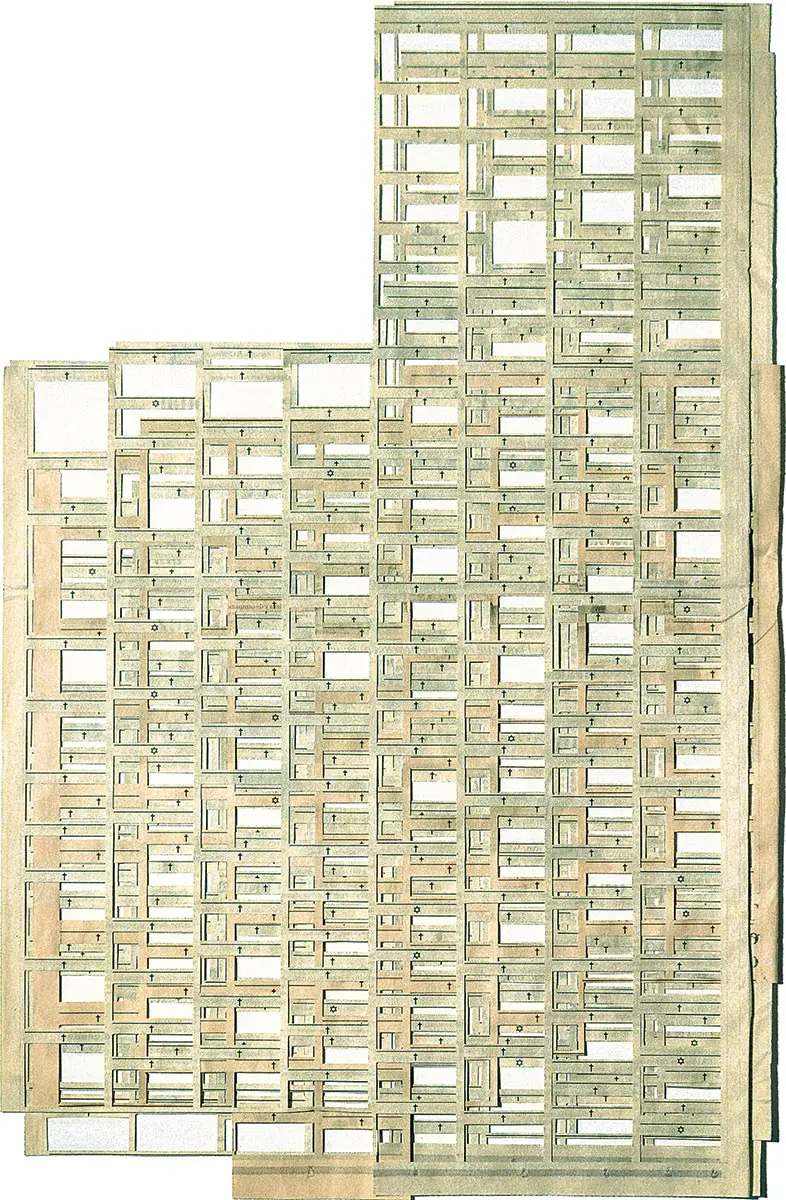
In works like Monoblock and Speakers´ Corner, the virtuous dissection of a newspaper’s death notices—in the former—and of paragraphs in quotation marks—in the latter—are delicate autopsies of bodies no longer present, like their names. What, then, keeps things together? What is the minimum of matter required for things to remain standing? In his forward advance toward the objects, Macchi dislodges their insertions into the systems of classification and renders them, classified, which is to say, gives them a kind of secret character. The potency of the vacuum progresses over the ultimate structure of things, pushing down to its limit the configuration that supports them.
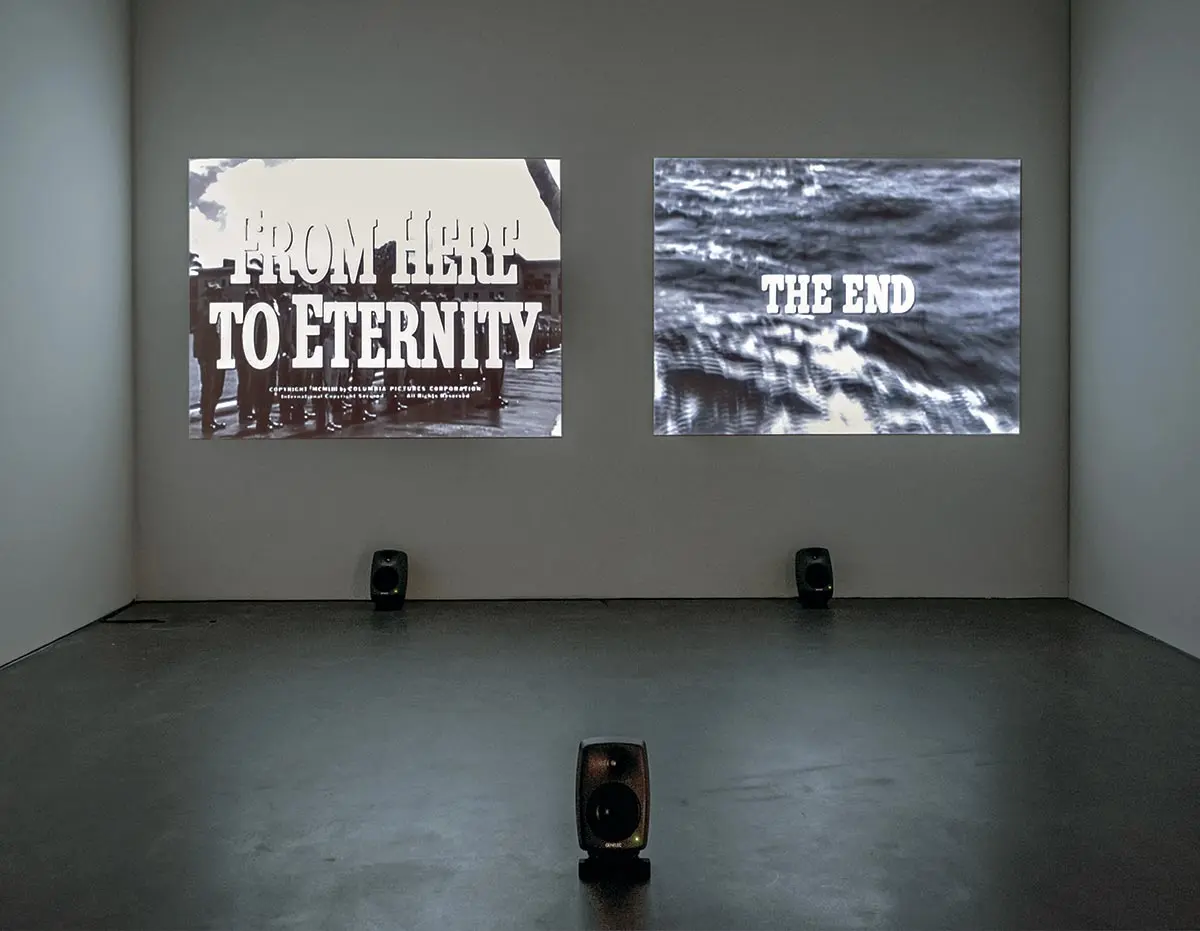
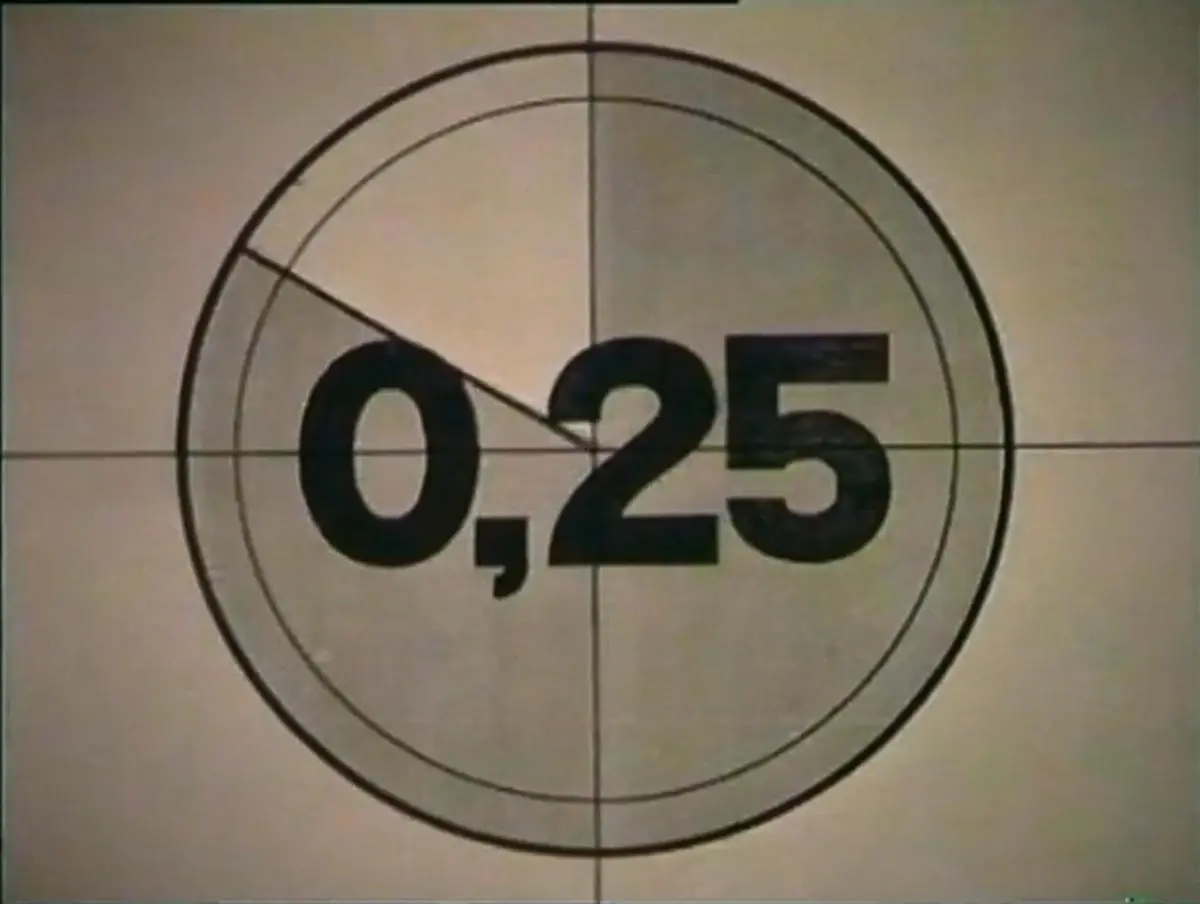
Two video works—La flecha de Zenón (Zeno’s Arrow) and De aquí a la eternidad (From here to Eternity)—are respectively situated at the beginning and the end of the exhibition. The ideas of beginning and denouement, as the foundations of a perspective to be fulfilled, are left in suspense. Time is not a pattern of progress, but the misleading coherence of their iterations in a loop amplifies the possibility of motion.
“Everything missing is important,” says the sentence that occupies the first page of the catalog. The expression seems to have the adequate dimensions to understand the entirety of Macchi’s oeuvre. It is like a banner proclaiming that matter, all that occupies space, all that is perceptible, does not suffice, even as ordinary matter is the raw material for reaching the work of art. Dark energy is invisible yet is present across space; it occupies almost 70% of the composition of the universe and seems to be the cause of is constant expansion, while visible matter represents barely 5%. The universe of known objects is tangled up in that invisible mystery, and art can on occasion irrupt into those intangible interstices that reality conceals, and it can even provoke a certain expansion of consciousness.
“Of the future I will speak later,” says a newspaper clip. This sentence closes the catalog for Perspectiva. An army of orthopedic eyes, painted in watercolor, beautifully blankets its covers.
* Courtesy Museo de Arte Latinoamericano de Buenos Aires – MALBA
VIVIANA SAAVEDRA
Writer and researcher of Contemporary Art. Teaching.