
Viewing an art exhibit from the position of a person who writes but doesn’t make art, there is always a minimum of the distance between the idea of what we see and the possibility of feeling it in the artistic practice that one, hopelessly, does not have. There are some exceptions. Ambling around the galleries that hold Planas: del 1 de enero al 31 de diciembre de 2005 (Pages: January 1 through December 31, 2005), an exhibition of works by José Antonio Suárez Londoño, produces the bittersweet desire of drawing, of becoming hand, sketchbook, paper, color, form, and pencil—of being able to extrude from the tip of one’s fingers an entire world and to transform it into the daily practice of draftsmanship. “Wanting to create space on a sheet of paper,” I write down in my notes. The frustration of having no intention of putting that into practice is the starting point of this chronicle, which begins with a review of the timeline. The exhibition features 365 drawings, one for each day, on lined, very basic pages or sheets of paper of the kind used for school. A diary made of sketches, annotations, and elements incorporated together in a collage-like manner. Time marches forward right in front of our eyes as we observe these drawings. Suárez devoted days, months, a whole year—2005—to this exercise of drawing something every day, often images that emerged from his readings or writings having to do with his everyday activities. Wednesday, June 1, 2005, using new clothes dryer for the first time. Drawings of plants and trees. Red dots and circles with the word “alameda” (boulevard) in them. The everyday character of drawing, the daily exercise of reading. The time tunnel of an inner gaze that brings a unique universe forth into the world. The floating moments of observation, of looking and looking and translating what one sees, thinks, or reads into the paper.
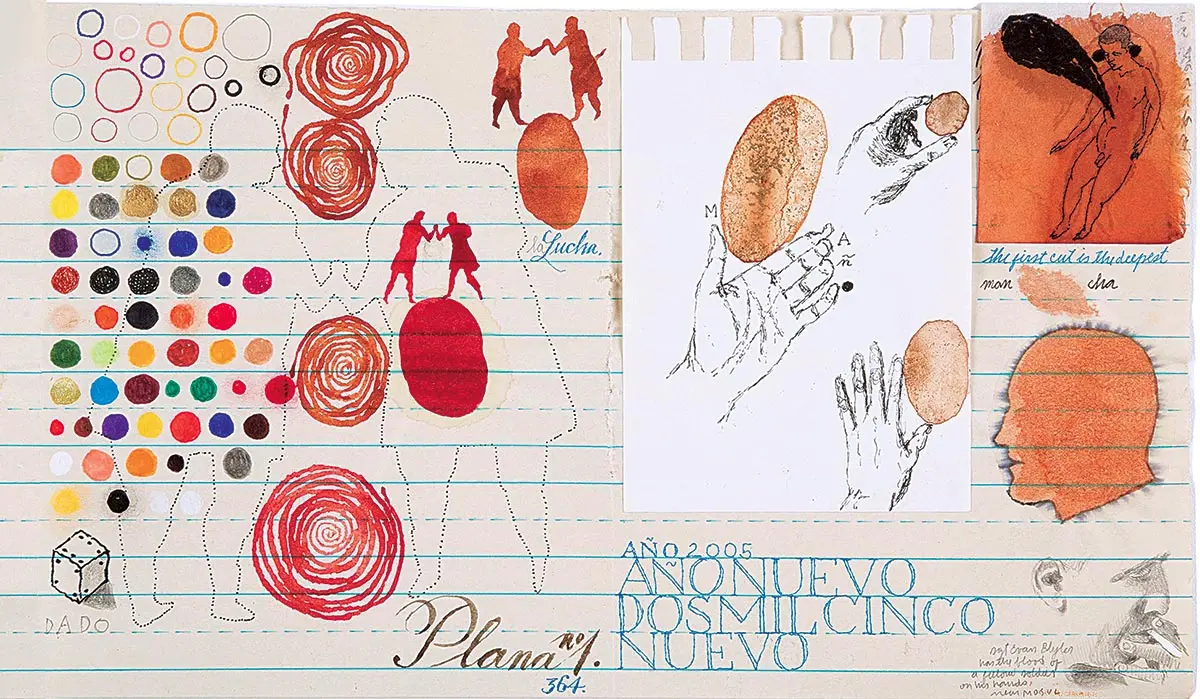
In this assessment of time, the works may seem a unit that can be “scanned” if we decide to move through quickly and getting a superficial view. Time moves forcefully, the works are consumed, and there is even a moment for us to appreciate Suárez Londoño’s monumental effort (this comes from someone who does not draw.) But if we do fall into the trap of observation, of reading, of timeless contemplation, the minutes seem to weigh down, stop, and disappear into what feels like an unending flow of images coming one after the other, ad infinitum. An unhurried, deliberate visit raises the issue of a personal poetics, the second idea traversing Suárez Londoño’s work from beginning to end. Faithful to his trajectory as a draftsman, the Colombian artist once expressed a desire to be a painter,1 but the immediacy of drawing—in those very simple notebooks—and a persistent desire to remain loyal to himself have resulted in a body of work distant from all conceptualisms and always attached to the languages that have appeared on the pages as though he were a magician of the image like some of the earliest filmmakers, such as Georges Méliès, who came from the mysterious world of illusionism. The image in motion, like a magician’s trick, like a trick for the eye, away from the realistic imprint later imposed on it, makes me think of Suárez Londoño’s practice of drawing like a magic power that opens doors, fifth dimensions, as it touches the paper. Alice would find here another Wonderland populated by mirrored silhouettes of men, giant rabbits, and animal-filled borders. The paper becomes large, then small. Pulling illustrated micro-histories out of his hat, the artist creates an enormous encyclopedia of styles, formats, sources, ideas, visual poetries. This is the third issue obsessing me as I explore this exhibition: the encyclopedic amount of drawings with almost no repetition, the recognizable style that—in spite of the routine character of the exercise—always features something new and different, a small variation as if every day implied a slight shift in our way of seeing. Everything flows. There are pages filled with black and white, with lines that connect dots into a constellation (June 1); studies for heads (January 3); two bluebirds floating on the page (January 7); silhouetted couples, color dots, and a die (January 1); and everywhere the artist’s personal calligraphy mixed with writing that adjusts to the lines on the page but, in its containment, changes styles—as we can see, again, in the drawing for January 1. Suárez Londoño’s classificatory and encyclopedic drive is often mentioned, and in this case, the order-imposing rigor is that of the passage of days, which does not force a logical taxonomy of styles but allows us to see the course of Suárez Londoño’s life and the way in which his gaze and his hand, well trained both, turn drawing into a universal practice of self-affirmation where the idea of absolute truth is entirely lost.
NOTE
1. In “El universo en una libreta”, an interview with Jun David Correa, Arcadia magazine, August 2015.
CARIDAD BOTELLA